

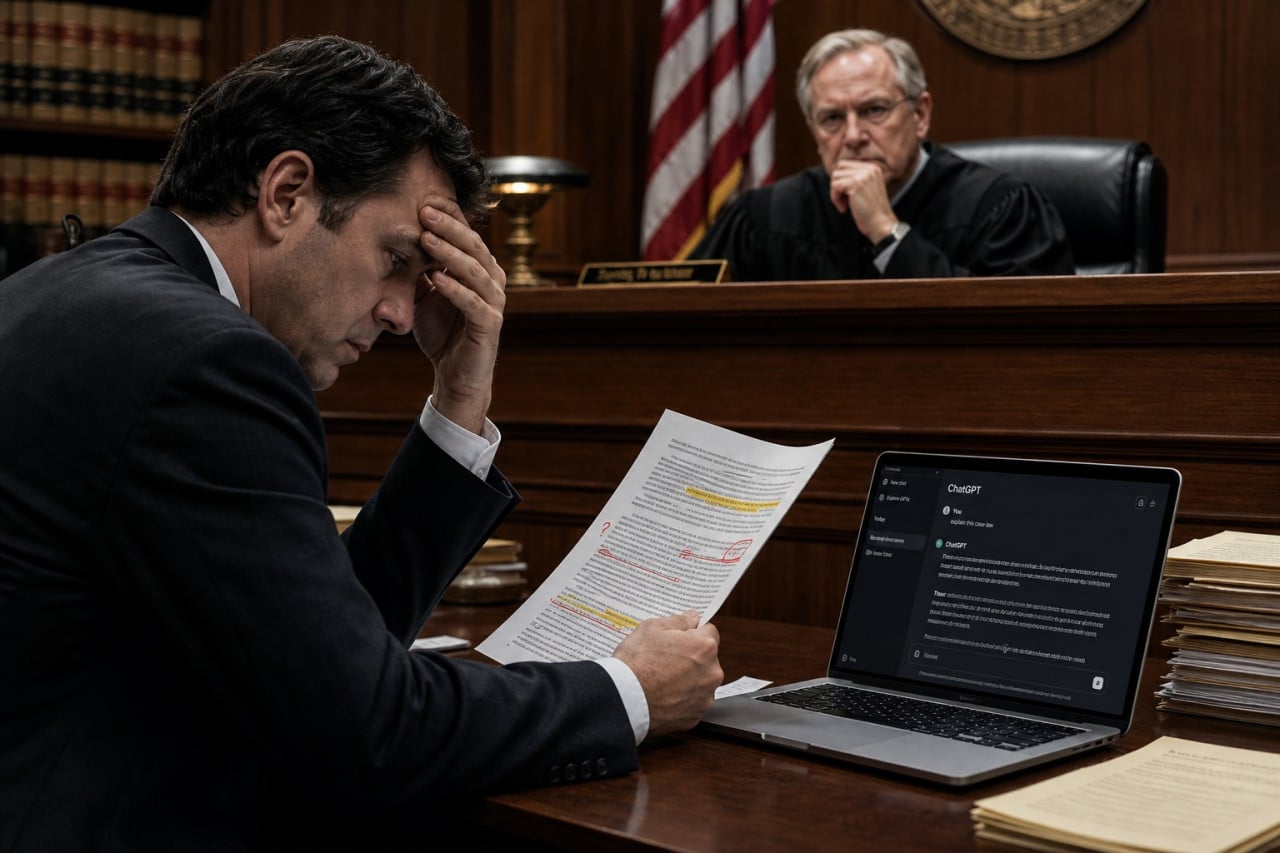
Generative artificial intelligence is becoming established in legal practice very quickly, and as a result, rules governing its use are not being created in time. However, US courts are gradually beginning to set boundaries. A recent case from Indiana is an example. Although the lawyer used AI for a sensible purpose, he took a dangerous shortcut and received a serious reprimand from the judge.
Client reported an injury, lawyer turned to AI
According to Reuters, Judge Tim Baker in Indianapolis admonished attorney Mark Waterfill for copying AI output at a certain stage of the litigation, thereby leaving his professional judgment entirely in the hands of artificial intelligence.
Specifically, the case was White v. Walmart, in which the plaintiff claimed that the Walmart chain had treated her unfairly after she reported a workplace injury. However, the company denied the allegation and was therefore asked by the plaintiff’s counsel to provide evidence.
AI found “errors,” and the lawyer sent them straight to the court
According to Reuters, at the hearing, the plaintiff’s counsel, Mark Waterfill, challenged Walmart’s responses and raised several objections. However, the judge noticed that the objections were not entirely authentic and had been generated by artificial intelligence.
Waterfill admitted that he had uploaded the responses Walmart sent him to an AI program and asked it to identify deficiencies in the evidence. He then copied the result without any further review and emailed it to both opposing counsel and the court itself. According to Reuters, he did not specify which program he had used.
The motive in this case was quite understandable: saving time. AI accomplished in a few seconds what would have taken him hours. However, the judge strongly emphasized that AI may serve as an aid but must never replace the work of an attorney. This is certainly not an isolated occurrence. Several cases have already been recorded in the US in which lawyers used AI and included nonexistent citations in court filings.
No fine, but a stern reprimand
No fine was imposed in Mark Waterfill’s case. Judge Baker merely stated that Waterfill had taken “a perilous shortcut regarding his duties as a trained legal professional,” and reiterated that AI is a useful tool, but not a substitute for an attorney. According to the judge, Waterfill therefore failed in his duty to independently assess the results obtained through AI before providing them to opposing counsel.
Nevertheless, the case did not go entirely unpunished. Waterfill was reprimanded and did not win the case. The National Law Review reports that the court instead found the plaintiff’s responses insufficient and ordered her to supplement them further.
Elsewhere, AI-related misconduct is already resulting in five-figure fines
However, similar misconduct is being addressed with increasing frequency in the US and often results in fines. According to Reuters, one US appeals court fined lawyers $30,000 in March 2026 for a filing containing AI-generated errors. And in another dispute with Walmart, three lawyers were fined a total of $5,000 last February for citing eight nonexistent cases, as reported by Justia Legal News, among others.
One thing is therefore certain. Although there are already cases in which AI has helped individuals win a court case or can assist judges, it remains more of a supporting aid than an experienced attorney and must be handled with great caution.


