
Nvidia, led by Jensen Huang, is using its enormous cash reserves to maintain its position as a key player in artificial intelligence. The company not only sells its powerful chips but also invests directly in companies that need them. This creates a network of relationships in which Nvidia finances its own customers, strengthening its market position.
Major investments in AI companies
Nvidia recently announced a $100 billion investment (approximately CZK 2.3 trillion) in OpenAI, which is focused on building data centers. This follows an earlier investment of $6.6 billion (about CZK 152 billion) in OpenAI in 2024 and another $3 billion (around CZK 69 billion) in CoreWeave. These companies are also major buyers of Nvidia graphics processing units (GPUs). OpenAI and CoreWeave, for example, buy or lease these chips in large quantities, directly increasing Nvidia's sales.
Jensen Huang, Nvidia's CEO, is thus supporting an ecosystem in which his company not only supplies hardware but also helps with financing. This allows partners such as OpenAI to obtain cheaper loans for costly infrastructure. Nvidia essentially acts as a co-signer on loans, lowering interest rates for these companies and reinforcing their dependence on its products.
Circular financing system
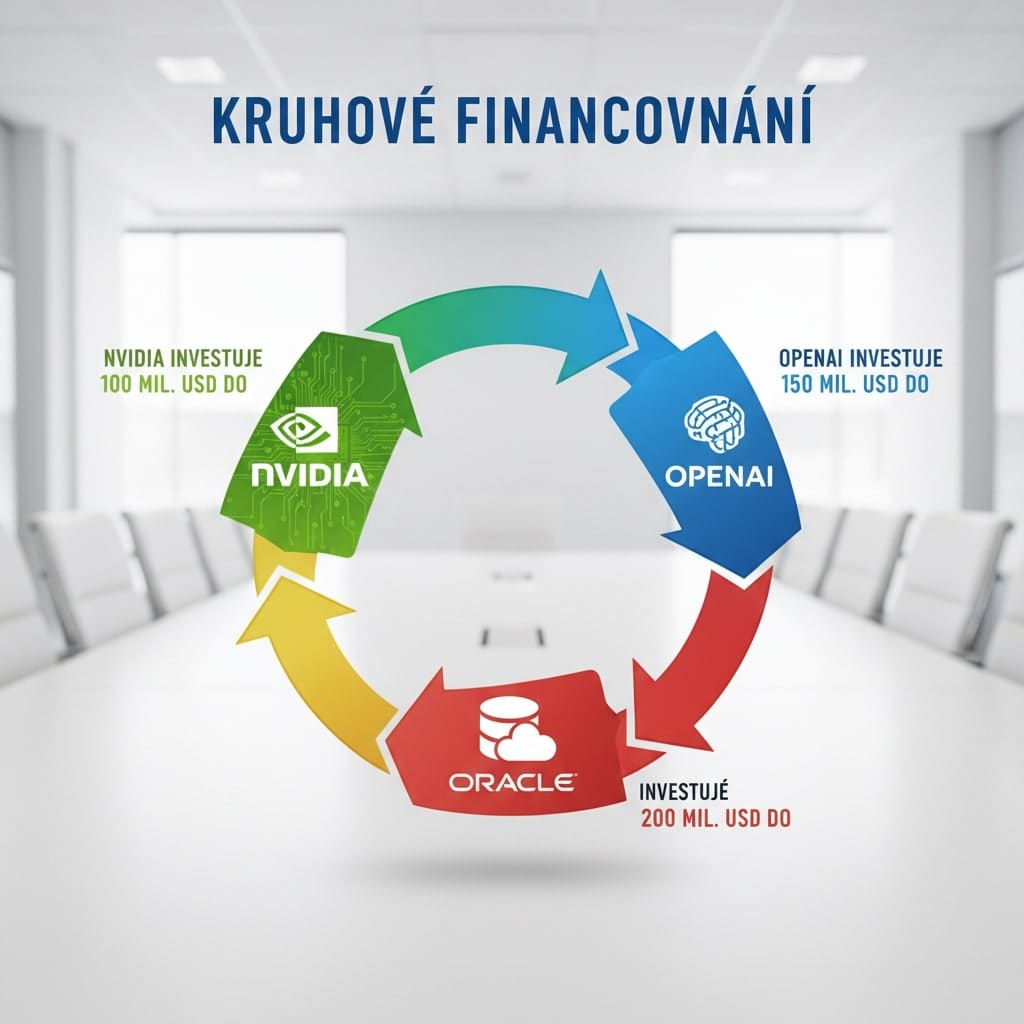
This approach creates a circular financing system. Nvidia invests in companies that then use the money to purchase chips from Nvidia. Analysts estimate that for every $10 billion (CZK 230 billion) Nvidia invests in OpenAI, it could receive up to $35 billion (CZK 805 billion) in GPU purchases or leases. Instead of selling chips outright, Nvidia sometimes chooses to lease them, meaning OpenAI does not have to account for depreciation, while Nvidia bears the risk if demand declines.
Such deals are not always publicly disclosed in detail because they often do not cross the thresholds that would require disclosure in financial statements. This makes it difficult to estimate the true impact of these transactions on the market. For example, Nvidia-backed CoreWeave has become an important provider of artificial intelligence infrastructure thanks to access to cheaper resources.
Concerns about inflated demand
Analysts warn of the risks posed by this model. Circular transactions may create the impression that demand for Nvidia's chips is greater than it actually is. This is reminiscent of past technology bubbles, when similar practices led to asset overvaluation. In this way, Nvidia is "seeding" the market with its own money, reducing financing costs for partners and ensuring a steady flow of orders.
Jensen Huang presents this strategy as a way to support developers and creators in artificial intelligence. At events such as CES 2025, he spoke about partnerships with major manufacturers and support for infrastructure across industries. Nevertheless, the question remains as to how dependent the artificial intelligence boom is on these financial injections from Nvidia.
Nvidia's influence
Nvidia is focused not only on investments but also on spreading its technology. The company works with key players to ensure that its chips form the foundation of new artificial intelligence systems. This includes supporting data centers and developer tools, strengthening Nvidia's position throughout the ecosystem. Analysts are monitoring how these moves affect competition and overall market dynamics.
As a result, Jensen Huang and Nvidia are not merely responding to trends in artificial intelligence but are actively shaping them through their financial decisions. This approach brings growth, but it also raises questions about long-term sustainability.
Source: theinformation.com