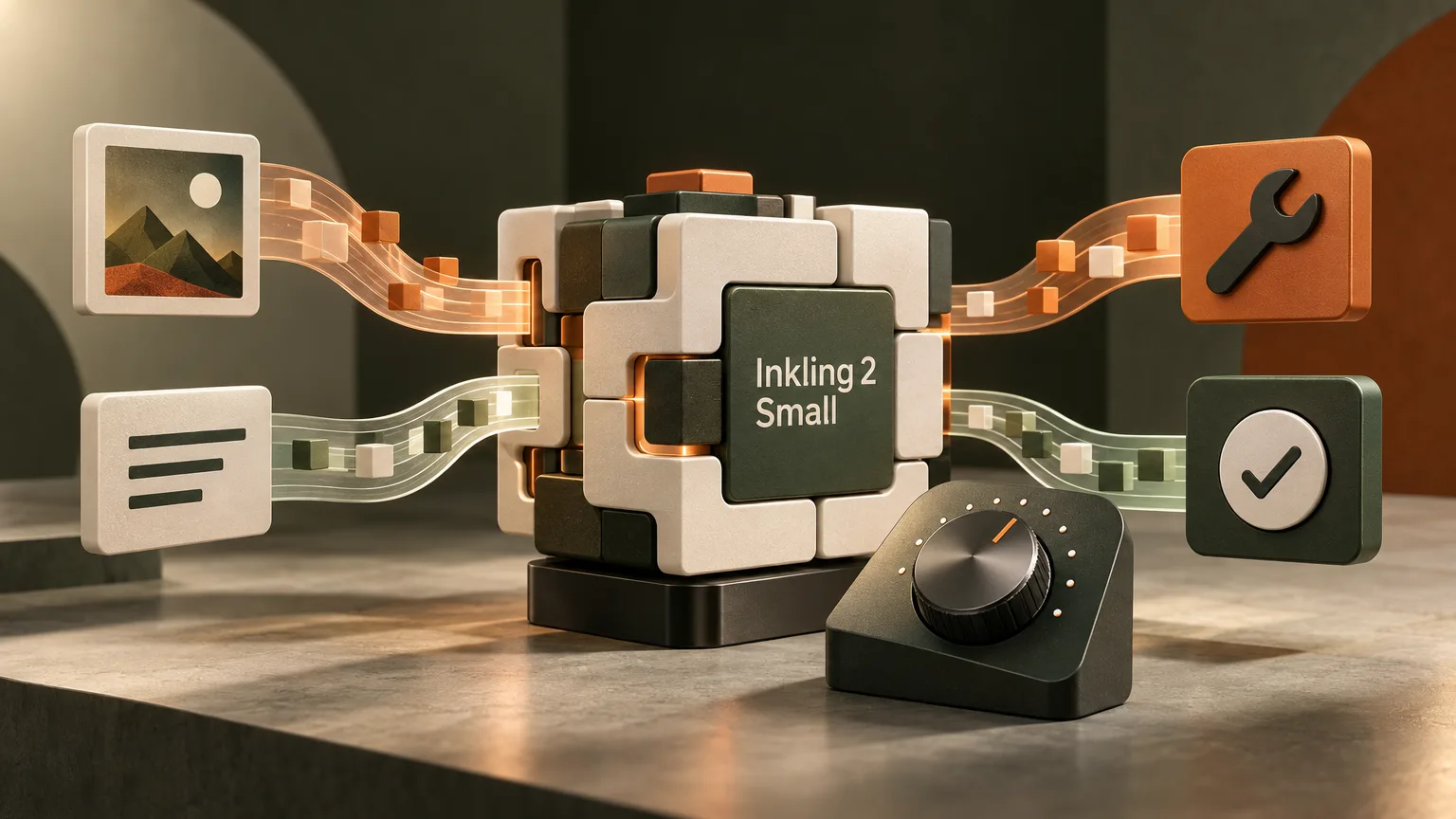
Thinking Machines Lab has released Inkling 2 Small, a model designed for fine-tuning and building AI agents that plan multistep tasks, use tools and check results. The model accepts text and images and is available to developers through Tinker. Its weights remain closed for now.
More parameters, image input and adjustable computing effort
Inkling 2 Small uses a Mixture-of-Experts architecture, selecting a subset of specialized parameter groups for each token. It has 594 billion parameters in total and activates 17 billion per token. Its predecessor, Inkling Small, had 276 billion parameters and activated 12 billion.
The new model can vary how much computation it uses to generate an answer. A vision encoder based on Perception Encoder divides images into smaller pieces and interleaves their representations with text tokens. Unlike its predecessor, however, the new model does not accept audio.
Results in vision and coding tests
Inkling 2 Small scored 31 on the Artificial Analysis Intelligence Index, a composite measure that includes coding, reasoning and knowledge work. In the reported vision tests, Thinking Machines says it led the comparison group of models with released or planned open weights on PerceptionBench, ScreenSpot Pro and MMMU Pro, among others.
Thinking Machines says the model would also lead that category on DesignArena once it qualifies for inclusion. In reported agentic coding tests, it trailed DeepSeek V4.1 Flash on several evaluations and Kimi K3 on SWE-bench Pro. It scored 25.4% on FrontierCode v2.0, 72.1% on DeepSWE v1.1 and 86.3% on SWE-bench Pro v2 Hard.
Fine-tuning and a model-training demo
The lab also designed the model for further fine-tuning. According to Thinking Machines, Inkling 2 Small matched the final performance of the previous Inkling Small after 75 training steps on a financial-document summarization task, then surpassed it. The experiment used Tinker Cookbook and a reinforcement-learning method called Stable Reinforce.
In another lab demonstration, Inkling 2 Small was given a time-series forecasting task and managed the training of Qwen3.5-4B through Tinker. It created an evaluator, selected data and training methods, and corrected an evaluation error. After 4.5 hours at a cost of $426, the resulting model had more than doubled its score on the task.
Training for reasoning and agent tasks
Initial pretraining processed 8.4 trillion tokens of natural language, code and images in 68 hours on NVIDIA GB300 NVL72 systems. Three subsequent stages extended the context and focused on higher-quality data for agents.
The lab then used a joint reinforcement-learning run for reasoning and agent behavior. Over nine days on 2,048 GPUs, the run produced more than 17 million training rollouts and 3 trillion tokens. It used a 256,000-token context window and compressed longer rollouts.
Coding accounted for 38.5% of rollouts and 65% of generated tokens in that run. Other tasks included office work, image tasks, web application development, tool use and safety.
In the lab’s internal measurements, the general misbehavior score fell from 66.8 for the original Inkling to 14.9 for the new model; lower is better. The lab says closed models such as GPT-6.1 Sol perform better on these measures.
Tinker access and planned release of weights
Developers can submit interactive prompts in Tinker Playground and use Tinker for fine-tuning and sampling. The weights are not yet available, preventing local deployment or independent examination of the trained model. Thinking Machines plans to release them under the Apache 2.0 license and add more inference platforms after external safety testing, but has not announced a firm date.
The company lists verbose responses, weak conversational organization and inconsistent tool selection in codebases with many available skills among the model’s limitations. It also notes excessive reactions to mental-health queries.