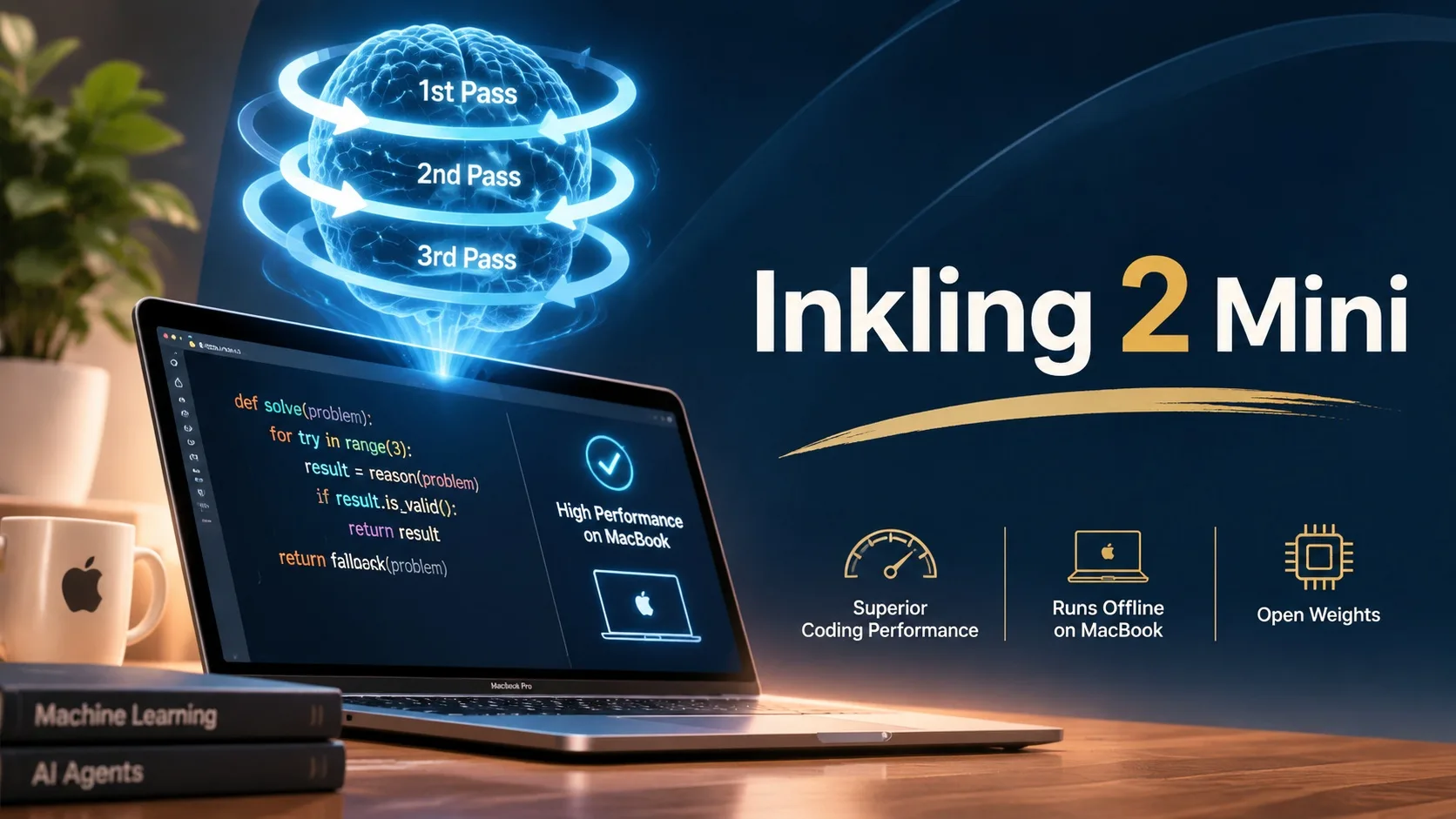
San Francisco-based startup Thinking Machines Lab, founded and led by former OpenAI CTO Mira Murati, has released a new open-weight model called Inkling 2 Mini. The model handles both text and images and runs without an internet connection on a MacBook Pro with 32 GB of memory or on a single graphics card. In coding benchmarks, it outperforms all open models with fewer than one hundred billion parameters. The company did not achieve this by making the model larger. It taught it to think through each thought three times.
A model that thinks in loops
Conventional language models send each token through the network’s layers only once, from the first to the last. When a task requires more reasoning steps than the model has layers, it has to write out the process as text. That costs time and money. Inkling 2 Mini takes a different approach. It has 24 layers divided into four blocks of six. The first and last blocks run once, but the model passes through the two middle blocks three times in succession using the same weights. The 24 stored layers thus produce 48 computational steps for each token without the model taking up more memory.
The developers worked from the assumption that the middle layers handle more abstract reasoning, while the outer layers mainly translate between text and the model’s internal language. The assumption proved correct. In their evaluations, repeating the middle layers produced better results than repeating the final layers in 27 out of 28 tests.
Inkling 2 Mini is a so-called mixture-of-experts model. Of its 26.4 billion total parameters, 3.4 billion are active in a single pass, or roughly 5.4 billion when the loops are taken into account. To make the model fit on a laptop, the company removed two-thirds of its experts halfway through training, reducing their number from 384 to 128. It then restored the lost performance by training it on one trillion tokens from the larger internal Inkling model. Most of the weights were trained directly at four-bit NVFP4 precision, with the final four layers trained in eight-bit MXFP8. The model therefore reaches users in the same format in which it was created and does not lose accuracy through additional compression. The entire model takes up roughly 20 GB. It supports a context of up to one million tokens.
However, the loops also raise a safety concern. When the model thinks more internally and writes less of it down, people and monitoring systems have less visibility into its reasoning. Thinking Machines therefore also released a research variant that can run with one to five passes. As more loops were added, the model was able to complete tasks without written-out reasoning that would take a person 37 seconds rather than the original 16. Its written reasoning became less than half as long, but remained easy to read. It simply hesitated and corrected itself less. In hidden sabotage tests, its performance did not deteriorate with additional loops.
A programmer in your backpack, but not an encyclopedia
The company primarily tuned the model for long, autonomous tasks in which an AI agent writes code, searches the web, and uses tools on its own. It solved 48 percent of tasks in the DeepSWE benchmark, 79 percent in SWE-bench Verified, and 85 percent in the DeepSearchQA search benchmark. Researchers took it aboard an airplane, where it created a playable flight simulator in just a few minutes on a MacBook Pro in airplane mode. In another demonstration, a single model running on one offline laptop controls all twenty residents of the pixel-art village Thinkyville. They plan their days, gossip about their neighbors, hold baking contests, and respond to messages that visitors leave on their doors.
However, loops do not give the model more knowledge. How much it knows depends primarily on its total number of parameters, so in the AA-Omniscience factual knowledge benchmark, it performed similarly to other models of the same size. It makes up for the gap by searching the web effectively and working with tools. It is also weaker in longer, multi-step conversations and when following instructions with many conditions, where Qwen3.8-27B outperforms it. The company itself acknowledges that the model sometimes gets stuck repeatedly refining code and may write tersely in languages other than English, such as Chinese.
Taking on Alibaba and Google
Its toughest rival is Qwen3.8-27B from China’s Alibaba. Both models scored 20.1 points in the overall Artificial Analysis Intelligence Index. According to this evaluation, however, Inkling uses about 2.8 times less compute, completes a task in nine minutes instead of thirty-eight, and costs roughly six times less. It leads the DeepSWE coding benchmark with 48 percent versus 42 percent.
Google DeepMind’s Gemma 4 31B and Meta’s Muse Glimmer remain far behind it in autonomous coding and also support significantly shorter contexts: 262,000 tokens for Gemma and 131,000 for Muse Glimmer. In DeepSWE, Gemma solved almost nothing, while Meta’s model completed only four percent of the tasks.
The model also stands out for its efficiency. Stanford researchers measure how much energy a language model requires per query to achieve a certain level of performance. Inkling 2 Mini scored 0.703 on an NVIDIA DGX Spark computer. Qwen3.6-35B-A3B scored 0.430, while Gemma 4 26B achieved only 0.159.
Pricing and availability
Thinking Machines uploaded the model’s complete weights to Hugging Face under the Apache 2.0 license. Companies and individuals can therefore download, modify, redistribute, and integrate it into their own commercial products free of charge without having to disclose their code. A research variant with an adjustable number of loops is also available for download.
For home use, a Mac with at least 32 GB of memory and the Ollama application are sufficient. The model also runs on an NVIDIA DGX Spark desktop computer. Smaller versions from Unsloth can even run on computers with 16 GB of RAM. Exo Labs measured a speed of 210 tokens per second on a Mac Studio with an M5 Ultra chip and 96 GB of memory. Those who do not want to install anything can find the model on the Tinker platform for querying and fine-tuning, and can start chatting with it directly in Tinker Playground. It is also supported by SGLang, vLLM, llama.cpp, and other tools.
Through its own interface, the company charges $0.15 per million input tokens and $0.50 per million output tokens, while prices on OpenRouter start at $0.08 and $0.35. Alibaba charges $0.50 for input and $3 for output for Qwen3.8-27B in its cloud.
Thinking Machines Lab was founded in early 2025. Murati established it together with OpenAI co-founder John Schulman and other experienced researchers. In July 2025, the startup raised a record $2 billion in its initial funding round at a valuation of $12 billion. The company introduced its first product, the Tinker model fine-tuning interface, in October 2025. In July of this year, it released the original Inkling with 975 billion parameters, followed by Inkling 2 Small with 594 billion parameters in early November. Mini is the smallest member of the family so far.
Source: venturebeat.com