

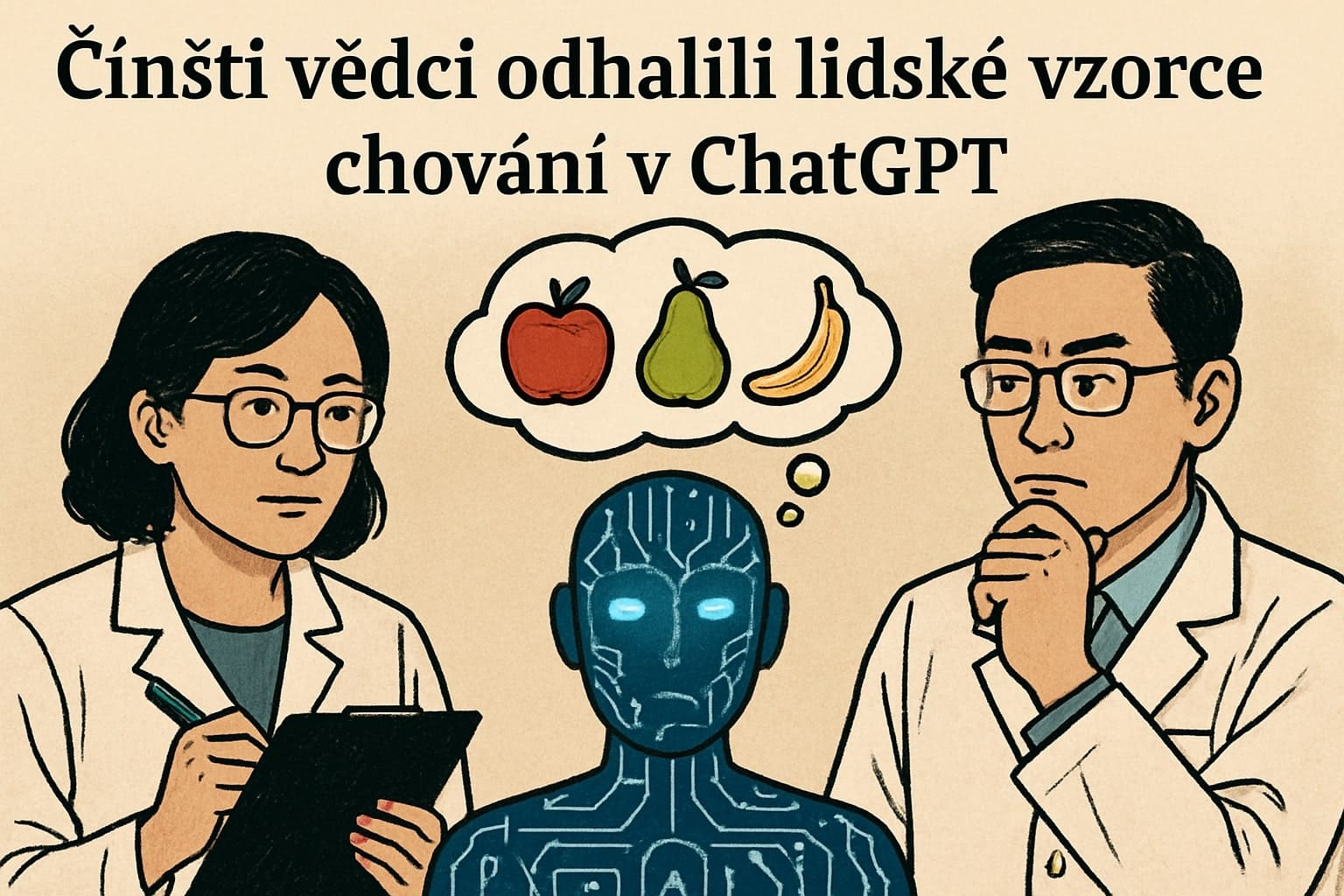
Large language models create human-like object representations—a groundbreaking study reveals surprising parallels
A team of scientists from the Chinese Academy of Sciences led by Changde Du and Huiguang He has published a groundbreaking study revealing fascinating similarities between how humans and large language models (LLMs) conceptualize and categorize objects in their environment. The research, published in a prestigious scientific journal, presents the first large-scale analysis of mental representations in contemporary AI systems using behavioral analysis methods known from cognitive psychology.
Large-scale experiment with 4.7 million similarity judgments
The research team conducted an unprecedentedly large-scale experiment in which it collected a total of 4.7 million similarity judgments from ChatGPT-3.5 and the multimodal Gemini Pro Vision 1.0 model. These judgments were obtained using an "odd-one-out task," in which the model had to select the object from a set of three that was least similar to the other two. The objects came from the THINGS database, which contains 1,854 common everyday objects, ranging from animals and vehicles to foods and tools.
Changde Du and his colleagues used a sophisticated method called Sparse Positive Similarity Embedding (SPoSE), which allowed them to extract 66 key dimensions from the vast amount of behavioral data that characterize how the models perceive similarity between objects. These dimensions proved not only stable across different runs of the experiment but also surprisingly interpretable by human experts.
Discovering interpretable dimensions of AI thinking
One of the most surprising findings of the study was that the dimensions identified in the representations of LLMs and MLLMs are readily interpretable and correspond to intuitive categories also used by humans. Key dimensions include, for example, "animals," "foods," "electronics and technology," and "transportation and movement," as well as finer distinctions such as "frozen treats versus hot beverages" or "wild animals versus livestock." In addition, the multimodal Gemini Pro Vision model exhibited sensitivity to visual properties such as "roundness," "density," and "spatial arrangement."
The researchers found that while humans rely more heavily on visual information such as color, shape, and texture, language models favor semantic categories (grouping things according to what they are used for or what they mean). For example, ChatGPT-3.5 created more specialized categories than humans—instead of a general "foods" category, it distinguished between "vegetables" and "fruits." Wei Wei, one of the study's co-authors, noted that these differences do not mean that the models are incapable of perceiving certain properties, but rather that they organize them at a different level of abstraction.
Validation through neuroimaging
A key aspect of the study was validating the findings using functional magnetic resonance imaging (fMRI) data obtained from the Natural Scenes Dataset (NSD), the largest neuroimaging dataset linking brain science with artificial intelligence. The researchers analyzed the brain activity of four subjects while they viewed a thousand different images and compared it with the representations created by the language models.
The results showed a strong correlation between the representations of the multimodal Gemini Pro Vision model and activity in key brain regions specialized in recognizing object categories. Particularly strong matches were found in the EBA (extrastriate body area), which specializes in bodies; the PPA (parahippocampal place area) and RSC (retrosplenial cortex), which process scenes; and the FFA (fusiform face area), which focuses on faces. Ying Gao and Shengpei Wang, who contributed to the analysis of the neuroimaging data, emphasized that these correlations provide compelling evidence that object representations in LLMs, although not identical to human representations, share fundamental similarities reflecting key aspects of human conceptual cognition.
A methodological breakthrough in the study of AI systems
The study represents a significant methodological shift in how scientists study the internal representations of large language models. Instead of the traditional approach focused on analyzing neuronal activation, which is becoming increasingly impractical for today's large-scale models, Changde Du and his team adopted a behavioral approach inspired by cognitive psychology. Kaicheng Fu and Bincheng Wen explained that this approach makes it possible to circumvent the limitations caused by the closed nature or enormous scale of today's LLMs and provides a more practical path for exploring their mental representations.
The researchers also demonstrated that their SPoSE method achieves up to 87.1% of optimal predictive accuracy for LLMs and 85.9% for MLLMs when predicting individual behavioral choices. Jie Peng, who contributed to the development of the methodology, emphasized that these results demonstrate the structured and principled nature of language models' judgments about natural objects.
Practical applications and future directions
The study's findings have far-reaching implications for the development of AI systems that can collaborate more effectively with humans. The interpretable dimensions identified by the research can inform the design of more human-centered artificial cognitive systems and improve their natural interaction with people. Le Chang and Jinpeng Li suggest that these low-dimensional mental representations could be used to align human and machine representations, potentially leading to improvements in human-machine interfaces and collaborative systems.
Shuang Qiu and Chuncheng Zhang also emphasized the potential of these findings to improve the alignment of LLMs and MLLMs with human reasoning. Their experiments showed that adapting prompts to emphasize specific attributes preferred by humans (such as "red" or "artificial") can produce choices that are more consistent with human judgments. This explicit guidance approach may help bridge the gap between model and human reasoning.
Huiguang He, the study's lead author, concludes that the research enriches the growing body of work characterizing the emergent properties of LLMs and demonstrates their potential to capture and reflect human conceptualizations of real-world objects. The study thus represents a significant step forward in understanding machine intelligence and informs the development of more human-centered artificial cognitive systems.


