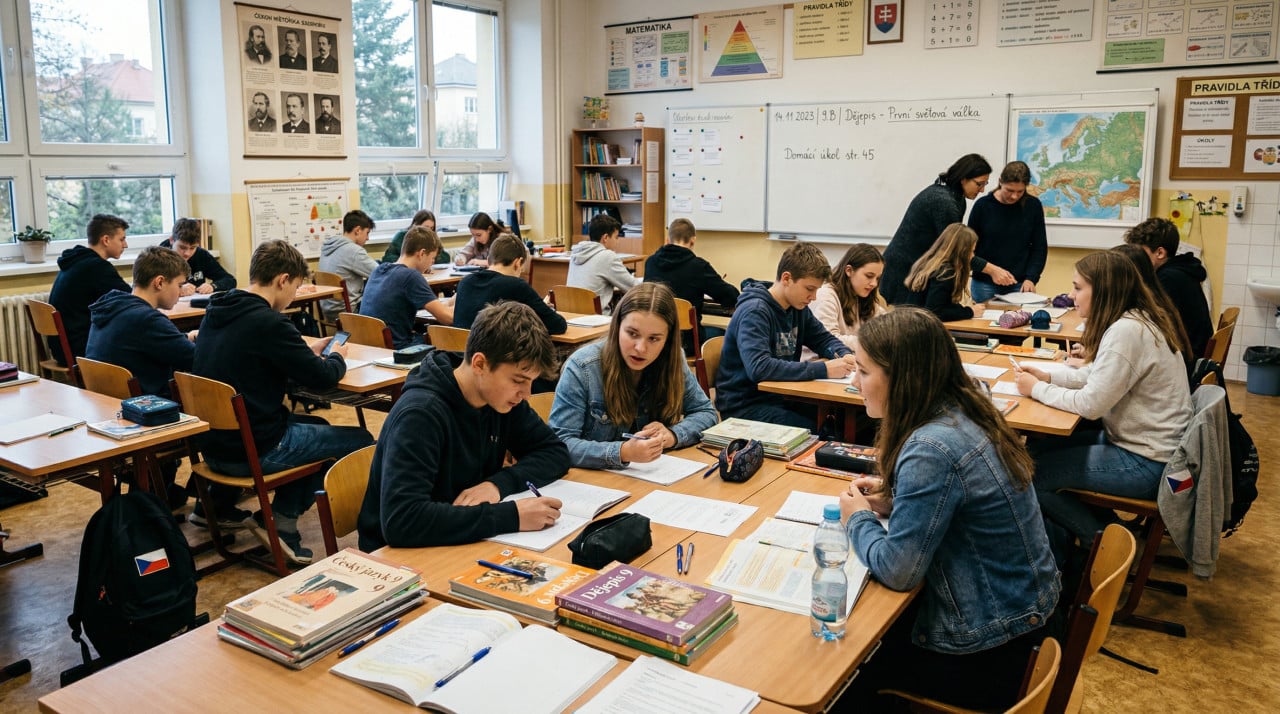
A seventeen-year-old student opens ChatGPT, enters the topic of a school report, and has a finished text within minutes. It sounds like a convenient solution. But then the exam comes, and he cannot remember a single sentence from what he "wrote." This is exactly what troubles the younger generation more than one might expect. Three independent studies from 2025 and early 2026 paint a surprisingly consistent picture: young people around the world, including in Czechia, reach for artificial intelligence almost reflexively, while also recognizing what they risk by doing so.
What do young people actually want from AI?
In February 2026, the Pew Research Center published the results of a survey of more than 1,400 American teenagers. The findings are clear: more than half of respondents (54%) use chatbots for schoolwork, and 57% use them to search for information. Entertainment and creativity? Those too, but only in third place.
A similar story is unfolding in Czechia. A research team at Masaryk University (IRTIS) surveyed more than 2,600 children and adolescents aged 9 to 17. The most common uses? Writing essays and reports (42%) and summarizing longer texts (39%). Roughly a third of Czech children ask AI for recommendations on what to watch, listen to, or buy.
And what about Generation Z as a whole? A Gallup survey from October 2025, which analyzed nearly 2,500 young Americans aged 18 to 28 for Harvard Business Review, found that three out of four young adults had used a chatbot at least once in the previous month. Most often as a replacement for Google (65%), followed by work tasks (52%) and writing (46%).
Friend or tool? Both, but mainly a tool
The media likes to write about young people confiding their deepest secrets to chatbots. But the data tells a different story. Generation Z uses AI pragmatically, not sentimentally. Only a quarter of young adults in the U.S. survey described a chatbot as a "friend," and just 10% use one as a romantic partner.
It is similar in Czechia. About one-fifth of children and adolescents (22%) talk to AI about their worries or seek advice from it. Girls do so more often than boys, while boys are more inclined to create images and videos. Only 12% of American teenagers admitted using a chatbot for emotional support.
So, for now, there is no apocalypse of social relationships.
Cheating? Yes, and everyone knows about it
Here comes the uncomfortable part. Six out of ten American teenagers believe their classmates use AI to cheat at least occasionally. One-third say it happens very or extremely often. What is more, one in six young adults in the HBR survey admitted using AI for assignments where it was explicitly prohibited.
Czech researchers from Masaryk University confirm this from another angle: children see AI as a "starting point" and continue editing the resulting content. But the line between editing and copying is thin. And teachers struggle to detect it.
The biggest fear: AI is making us less intelligent
And now for the most interesting part. Although young people use AI extensively, 79% of them fear that it makes people lazy, and 62% worry that it reduces intelligence. Those figures come from the HBR survey, and they are striking.
The three main concerns that young people repeatedly mention are:
- They are losing out on learning by doing (68% of respondents). When AI does the work for you, your brain retains nothing.
- Critical thinking is disappearing (65%). AI provides answers but does not force you to think.
- There is less learning from people (61%). A mentor or friend will teach you more than a chatbot.
MIT research confirmed this experimentally: students who wrote essays with the help of AI showed significantly lower brain activity in EEG measurements than those who wrote independently. And most of them were then unable to recall even a single sentence from their own text.
Czech children sense this intuitively. IRTIS researchers found that many children themselves emphasize that they want to use AI as support, not as a substitute for their own thinking. At the same time, however, they admit that resisting the temptation is difficult.
What can be done? Bans do not work
Ban AI in schools or workplaces? HBR experts do not recommend it. Simply because it does not work. Young people will use it anyway; they will just hide it. A more meaningful path lies in developing AI literacy, and not only among children. Czech children themselves say that parents and teachers often do not understand AI and therefore cannot guide them in a meaningful way. They want guides, not guards.
The U.S. Pew survey showed that only a quarter of teenagers feel truly confident using chatbots. Yet almost all of them have heard of them. Knowing that something exists and knowing how to use it well are two very different things.
Generation Z stands at a crossroads. AI saves them time, helps them learn, and opens up new possibilities. But it is also a tool that can quietly erode the abilities they will one day need most. The question is not whether to use AI. The question is how to use it so that it makes us better people, not more comfortable machines.