

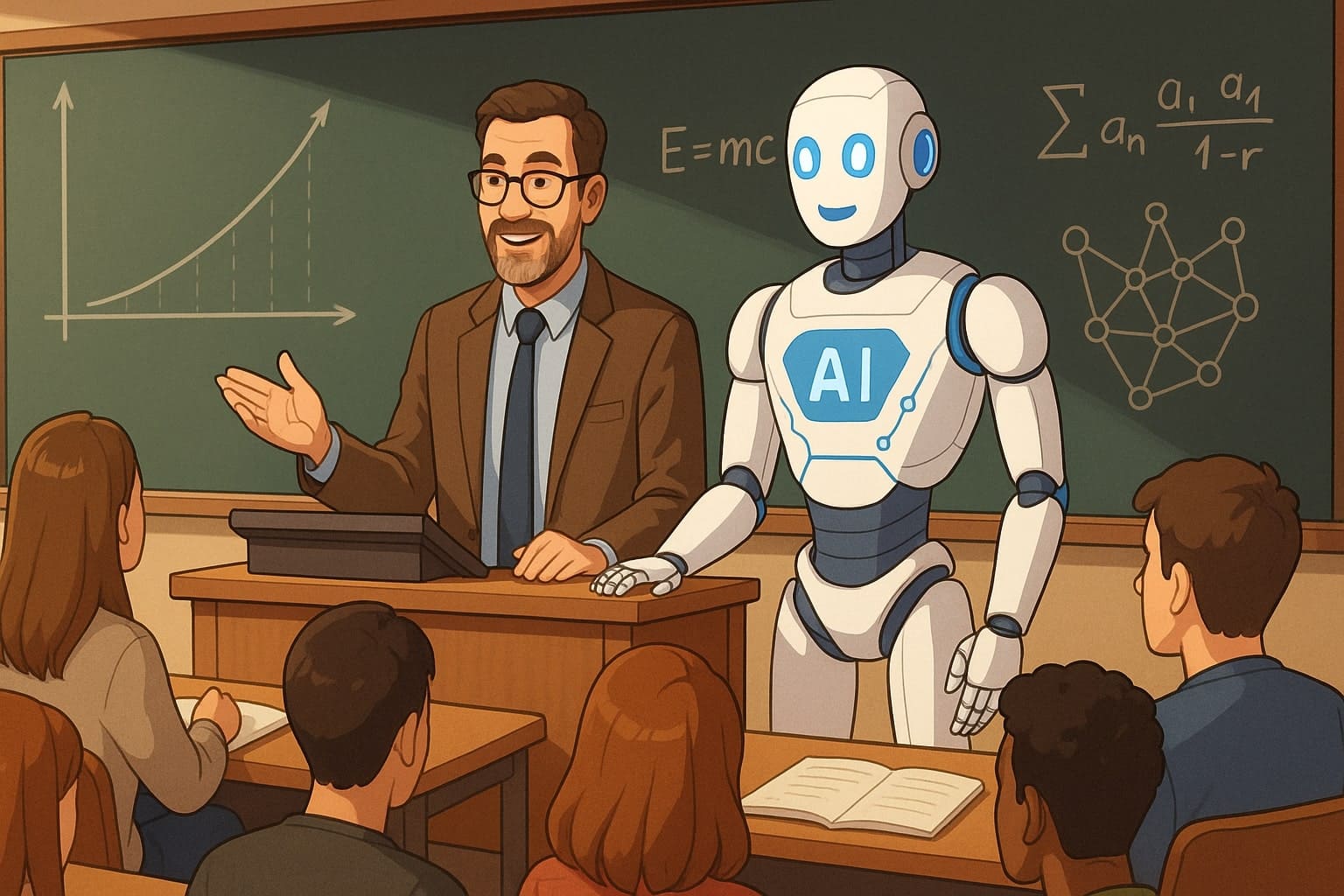
How Do Educators Use Claude AI in Their Daily Work?
In today's rapidly changing world, artificial intelligence (AI) is becoming an indispensable assistant in academia as well. According to a report by Anthropic, which analyzed approximately 74,000 anonymized conversations from higher education educators on the Claude.ai platform during May and June 2025, teachers use AI not only for simple tasks but also for complex creative processes. This report, supplemented by research from Northeastern University, reveals how educators integrate AI into their work to save time and improve the quality of teaching.
The Most Common Ways Educators Use Claude
The most prominent area in which educators use Claude is curriculum development. According to data from Claude.ai, this activity accounts for as much as 57% of the conversations analyzed. Teachers ask for help creating syllabi, teaching materials, or even fictional legal scenarios for simulations. For example, they create content for vocational education and workforce training, allowing them to quickly adapt materials to students' specific needs. The second most common area is academic research at 13%, where AI serves as a collaborator in generating ideas or analyzing data. Assessing student performance ranked third at 7%, including providing feedback on assignments.
Qualitative research from Northeastern University shows that educators value Claude for automating tedious tasks, such as securing funding, or as a thought partner that suggests new ways to explain complex concepts. One of the educators interviewed noted that AI makes it possible to create personalized learning experiences that a single instructor could not manage alone. Other reports indicate that institutions such as the London School of Economics are already integrating Claude into their teaching processes, confirming a broader trend toward AI adoption in Europe and the United States.
Creating Interactive Tools: From Conversations to Functional Applications
One of the most inspiring findings is how educators use the Artifacts feature in Claude to build their own interactive tools. Instead of mere chats, they create fully fledged resources that can be immediately deployed in the classroom. Key creations include interactive educational games, such as escape rooms or simulations for various subjects; assessment tools, including HTML quizzes with automated feedback and data processors for analyzing student performance; data visualizations for historical timelines or scientific concepts; and specialized aids, such as stoichiometry games for chemistry or computational physics models.
Educators also generate academic calendars, budget plans for institutions, or documents such as meeting minutes and letters of recommendation. As one Northeastern educator stated: "What used to be time-consuming is now becoming possible—custom simulations, illustrations, interactive experiments. That is much more engaging for students." Anthropic is also introducing a new Learning Mode that encourages Socratic questioning and a deeper understanding of concepts, adding an ethical dimension to these creative possibilities.
Augmentation Versus Automation
The analysis indicates that educators prefer augmentation—that is, collaboration with AI—over full automation. For example, augmentation is used in 77.4% of university teaching cases, including the creation of materials, in 70% of grant proposal writing cases, and in 67.5% of academic advising cases. By contrast, tasks such as managing institutional finances (65% automation) or maintaining student records (48.9%) are more often fully delegated.
This approach reflects the need for context and creativity in student-related tasks, where AI serves as support rather than a replacement. One educator noted: "It is the conversation with the model that is valuable, not just the first response. That is what I teach students as well—use it as a thought partner, not as a substitute for thinking." However, assessment remains controversial: Although 48.9% of assessment-related conversations were automated, educators in the survey identified it as the least effective area. Ethical concerns include accuracy and the moral obligation to devote personal time to students—students are not paying for AI, but for an instructor.
Anthropic is responding to these challenges by creating a Higher Education Advisory Board to advise on the responsible use of Claude and, together with educators, developing AI Fluency courses to build ethical skills among teachers and students.
The Future of Teaching with AI
AI is forcing educators to rethink what and how they teach. In programming, for example, the focus is shifting from debugging code to concepts involving business applications. Assessment is changing—some educators are abandoning traditional essays in favor of assignments that AI cannot easily handle, such as complex real-world problems. One Northeastern educator shared: "I will never assign a traditional research paper again. Instead, I will design an assignment where Claude and similar tools are not useful—and that is a compliment."
Nevertheless, there are limitations: The analysis captured only conversations associated with higher education email addresses, excluding primary and secondary schools, and focused on early adopters. Seasonal variations and the use of other platforms were not included. The future promises dialogue on policy and research to ensure that AI strengthens education rather than weakens it. Anthropic supports this through initiatives such as AI Fluency courses, which help build skills for responsible use.


