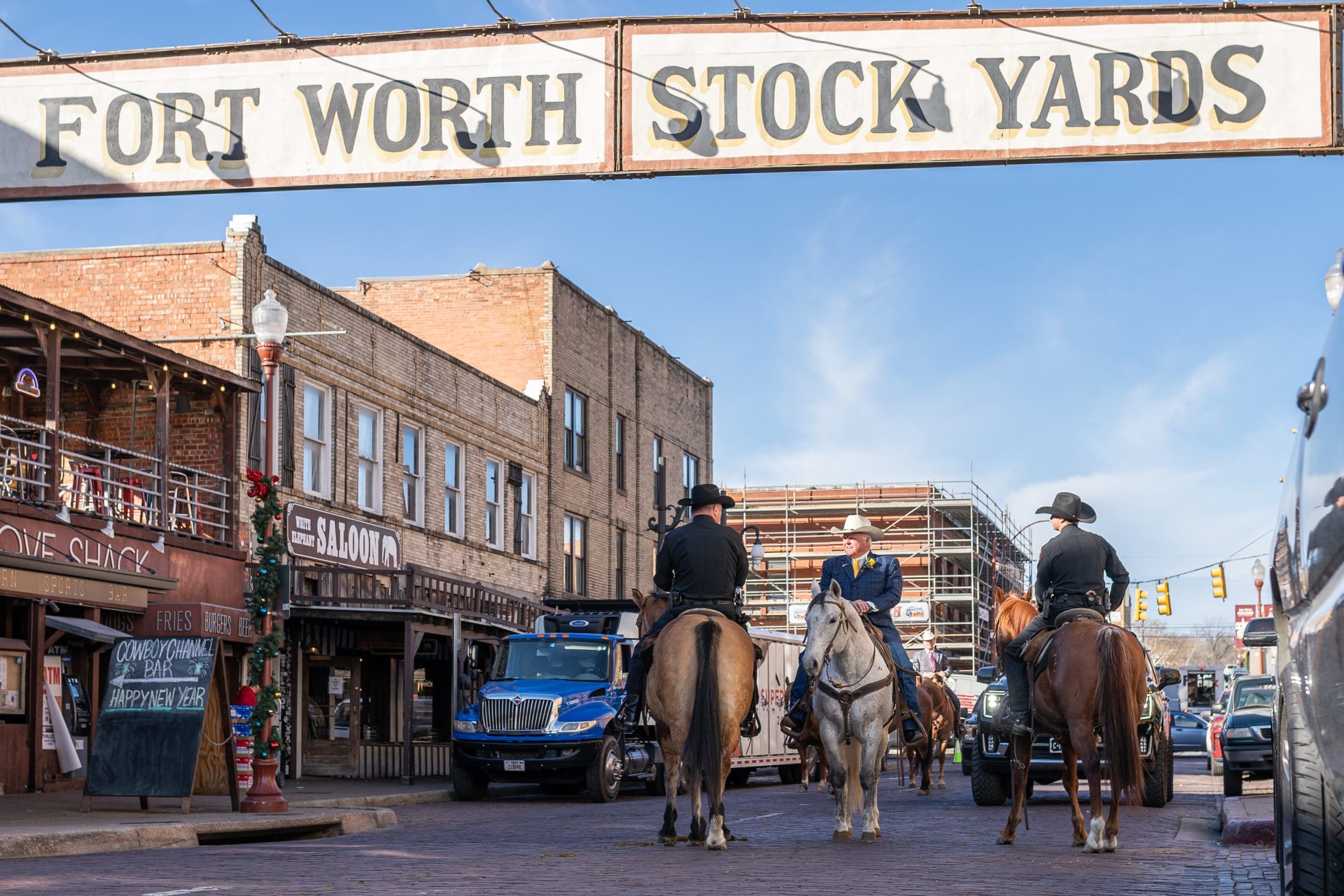
One of the reasons why the Stockyards area and downtown developed so quickly was all the activity taking place there. The original Stockyards Hotel and Stock Exchange Building were actually a single building (where Billy Bob's now stands), but it is not the original structure from the late 19th century. That, however, is where it was located.
Shortly after the Stockyards Hotel and Stock Exchange Building were constructed, it was decided to divide them into two buildings. The current Stockyards Hotel was originally the Fort Worth Club building, which was demolished and replaced by the Stockyards Hotel. It was originally called the Thannisch Building (on the Thannisch Block). The Stockyards Hotel was built as a luxury hotel primarily for important guests from the meatpacking companies who came here and wanted a nice place to stay.
There will be more about the Stockyards Hotel in a later chapter. As the ghost tour continued, we went around the corner and ended up at the famous Cattlemen's Fort Worth Steakhouse at 2458 Main Street.
Originally, this building housed one of the first insurance companies in the Stockyards area, and by the time it opened in the early 20th century, there was already a meatpacking plant there. Meatpacking workers arrived from Ireland or Germany with only the clothes on their backs and had to build homes and begin new lives. The Stockyards was a great location for an insurance company because workers could come in during their lunch break and get insured. But the building was too large, and the insurance company did not need all of it, so in 1947 it became Cattlemen's Fort Worth Steakhouse.
One of the interesting things about the buildings in the Stockyards is that they have basements, which is unusual in Texas, especially in this area so close to Marshall Creek. It is in the basement of this restaurant that some of the best ghost stories are told.
During a ghost hunt, some participants took lots of photos showing orbs in the basement.
There are plenty of stories—people often hear music coming from the basement when no one is there and no radio or anything similar is playing. The restaurant staff do not want to go downstairs alone; they use the buddy system because they are afraid. They say spooky things happen, doors open and close, and they hear things moving. At street level, glasses and liquor move for no reason, and the servers talk about things moving or hearing their names called, only to turn around and find no one there.
The manager is quite open about the hauntings and often tells stories about paranormal events. One of his favorites is about training a new guy, a huge former football player, to be an assistant manager. One morning, with tears in his eyes, the man told the manager, “They have to stop talking to me.” The manager replied, “Get used to it,” and the man quit.
Recently, a section of the restaurant had been closed because it was nearly closing time, and only two people remained in that area. The waiter brought the customers a tray, served their food, and loaded items from the table onto the tray. He had just walked away when the tray flew across the room with everything on it. The waiter returned, accustomed to such things, and said, “Probably just our ghost,” because he had no other explanation for the flying tray.
Another interesting thing about the place (besides the fact that the employees know about the ghost) is that they have a photo of their ghost on the wall. The photo was taken in the bar, where there is a mural, and the picture shows a guy in a bolo hat. Note: he is not the ghost, but besides the man in the bolo hat, there is a strange face in the photo.
For years, there was a dispute between the building's owner and the restaurant's owner. They were both rather quarrelsome, so I wonder whether one of them is the one still hanging around. If you look through old newspapers, plenty of colorful things happened at Cattlemen's. Who knows? Perhaps some of that colorful past is still unfolding today.
The next building on the ghost tour was established in 1922 and is still run by the original family—one of three businesses in the Stockyards that can make that claim. On the corner of Main and Exchange Street at the end of the block, if you walk up from Cattlemen's toward Exchange on the right side of the street, is the place where cowboys could have custom boots made and leave their cows by the creek.
Keep walking and you will come across the Tattoo Ranch tattoo parlor at 108 West Exchange Street, which was once a toy store. That is my favorite place, and they will give you a free tattoo if you want one. Our guide told us, “When I first came here, it was a toy store, and they had life-sized stuffed animals. We were outside around two in the morning, taking a break and conducting an investigation, and we looked inside and saw that balcony upstairs.”
She said the toy store manager had a desk upstairs with a four-drawer filing cabinet. They were working and talking when suddenly the top drawer rose onto its edge, balanced there, and then fell back into place. It happened several more times before it stopped. When the toy store closed, the tattoo parlor moved in, and the ghost hunter says its business hours are not suitable for paranormal investigations because it is open during the same hours when investigations are conducted. She spoke to the guy who sleeps there, and he says all kinds of strange things happen. He gave no details, just strange things and strange noises.
“I found one thing interesting when I approached him after the place opened,” she said. “He and another guy were upstairs by the bathroom talking about me, and the guy said, ‘You know, I don't believe in that ghost stuff,’ and just as he finished saying it, the light bulb simply shot out and shattered everywhere. He said, ‘Well, maybe I do believe.’ There is activity in that building.”
As we continued down the street, our guide, Schermerhorn, pointed out that the economy was improving because the bars were now open later. She pointed to the old Magnolia Furniture Store at 124 West Exchange Avenue and said it had been useful in the past because immigrants needed furniture as soon as they built their homes. They could walk there after work or at lunchtime and buy furniture. During the first year after the building was constructed, the Masons had their lodge on the upper floors. After a year, they built a lodge on Main Street and moved out. That was when Miss Ida Brown opened her business upstairs. She had her girls there (as in a brothel) and remained in business until the 1960s. In the 1960s, a fundamentalist Baptist preacher named Jay Frank Norris arrived and cleaned up Fort Worth. All the brothels in the Stockyards area were closed, and Miss Brown lost her business. Fortunately, when the authorities were deciding in the early 1970s whether to demolish the Stockyards or renovate it for its historical significance, they chose historical preservation, so the buildings were saved. Schermerhorn says that, as far as she knows (she has not been upstairs), it is now a European-style hotel with efficiency rooms and suites with shared bathrooms.
...to be continued...