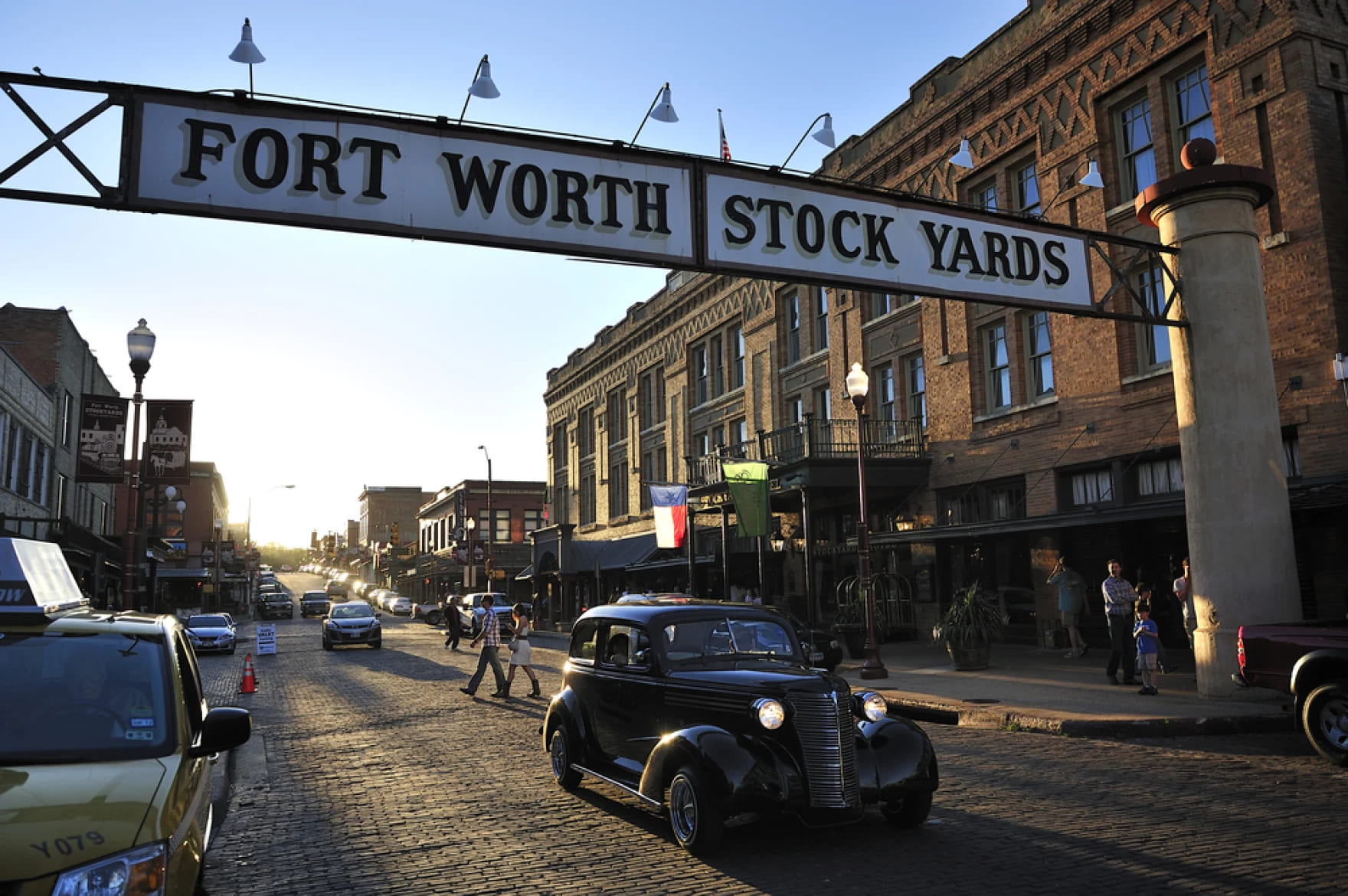
The lower part of the building has served for many years as the Cadillac Cantina (124 West Exchange Avenue) and is known to be haunted by spirits that the employees are happy to talk about. One night, the manager was alone downstairs in the basement, where he had his office. He knew he had locked everything, but he heard someone walking across the floor, so he went upstairs with a gun to find out who had broken in. No one was there. Because of this incident, the employees have a rule that no one may remain alone at night; at least two people always work together. Another strange thing that happens at the Cadillac Cantina is that when the employees count the money at night, the total is off by an unusual amount—for example, one evening they are $1.98 short, and the next evening they have that amount extra. I wonder whether those numbers mean something specific? There is also a story about three people who were closing up downstairs in the basement. They locked the doors but heard a noise upstairs. They went upstairs and found that all the furniture had been moved to the center of the dance floor. They were alone, and the restaurant was locked. “I think it was the furniture salesman rearranging his store to his liking,” the ghost hunter added.
The Longhorn Saloon across from the Cadillac Cantina was built in 1919 and has always operated under that name. A good indicator of the Texas economy is that when the economy is doing well, bars line the entire block all the way to the alley in the Stockyards area, and when it is not, the bars close. This particular bar has now been closed for a year, but when we walked past, we saw that the electricity was back on, which is a good sign.
Schermerhorn, our guide, said that she had never been inside the building, but a former bartender told her that there was activity there and that people had taken photographs showing spheres (orbs). The most interesting thing Schermerhorn has heard concerns an artist who had a studio in the basement and lived across the street in Ida Brown’s house. He told Schermerhorn that when he came to the studio, paint had been squeezed out of the tubes and his paintings had been moved or even painted on; he said that various things kept happening there.
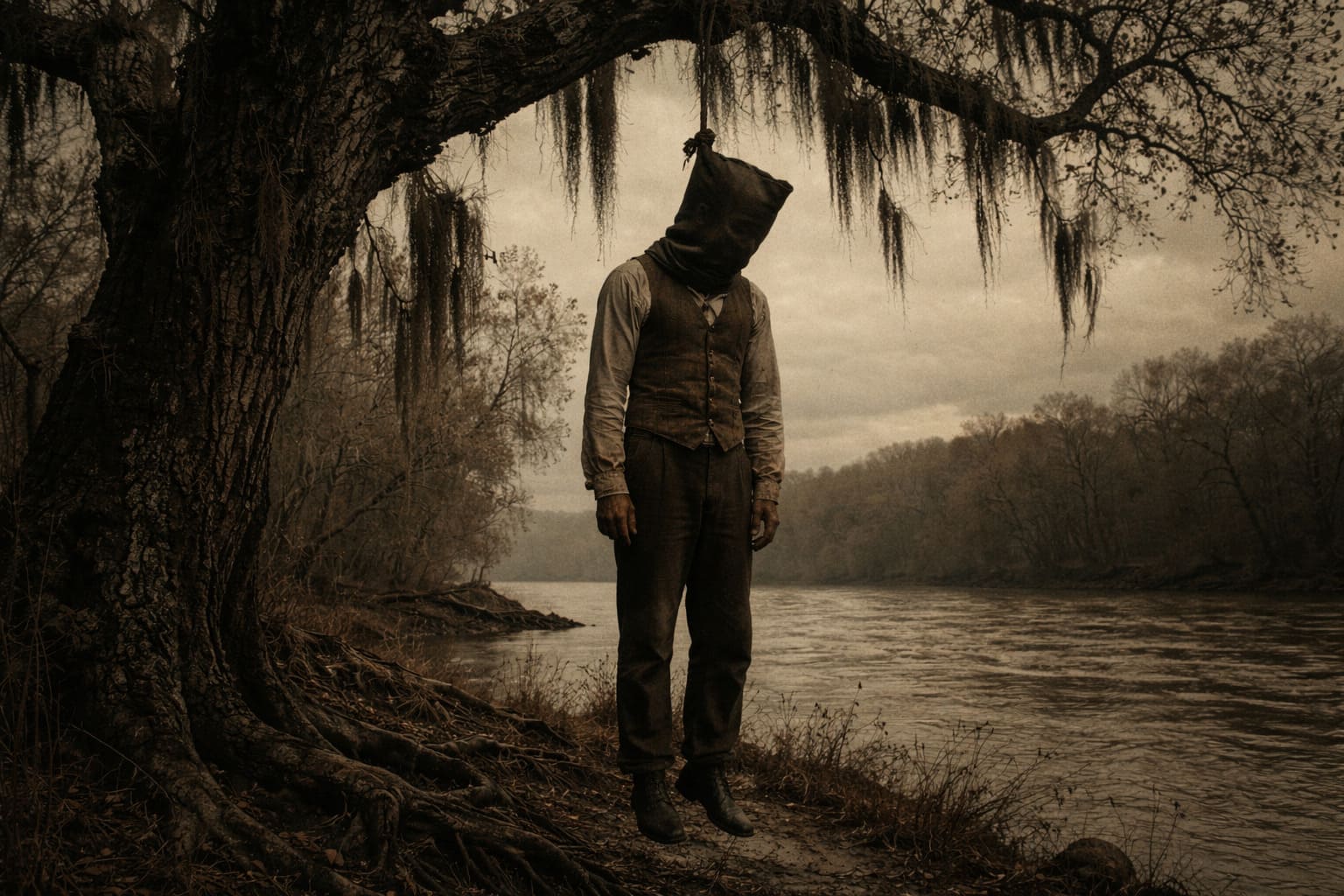
The story for which Schermerhorn still has no documentation (only an oral account) concerns the early 1920s, when three horse thieves stole horses from Marshall Creek. They were caught, brought to the basement of this building, and allegedly hanged. The artist remarked that it was probably those horse thieves who were playing tricks on him. Schermerhorn confirms that she is still trying to find documentation of the hangings because they were public events and did not happen so long ago that no records of them would exist.
The general store in the Stockyards area at 101 West Exchange Avenue has been many things over the years, from a dry goods store to a pharmacy. “It was a pharmacy for the longest time because the Stockyards area was like its own little town; in fact, it even broke away from Fort Worth and became Niles City for several years, then they realized that they really needed Fort Worth, but they always had their own pharmacy,” Schermerhorn said. It was the local pharmacy until the Walgreens chain arrived. When the chain moved into the Stockyards area, the pharmacy closed, and it has been a general store ever since.
Although no official investigation has been conducted in the store, mainly because it is entirely made of glass and the results would be questionable, there are reports of people talking and walking around upstairs when no one is there, since it is now used only for storage. Footsteps can also be heard on the stairs.
The next stop on the ghost tour was the Maverick building at 100 East Exchange Avenue. The original doors still remain. Of course, it should come as no surprise that there was once a brothel upstairs. The store itself has been many things, including a dry goods store, but Maverick Fine Western Wear was established in 1987 in this building, which was constructed in 1905. Over the years, the building has been home to a number of interesting businesses, but it has always been known as the Maverick and has always had a bar.
During the time of Bonnie and Clyde, it was Bonnie’s favorite gambling spot, and Clyde could stay at the hotel across the street (Stockyards Hotel) and watch her play. It has now been a clothing store for several years, and the upstairs is mainly used for storage, complete with lace curtains so that no one can look inside.
Interestingly, about ten years ago someone sensed the presence of a spirit in the building, a female spirit, and Schermerhorn says that with female spirits it is good to bring them a gift. People say that they occasionally smelled the scent of roses, especially on the third floor, so they took roses up to the third floor, where there was almost nothing. They placed the roses on a table, and no one went to the third floor that day. At the end of the day, they went up there and found the roses scattered all over the third floor. This confirmed that a female spirit was there. What is really interesting is that on some nights, when you walk past the building near the original doors, you can smell the scent of roses if you are sensitive (and that is not something you would normally smell in the Stockyards area). It has happened to Schermerhorn about three times during the tour.
The White Elephant Saloon at 106 East Exchange Avenue is also reportedly haunted. Before it became the White Elephant Saloon in the late 1960s, it was a cheap hotel across from a nice hotel. From around 1920 to the 1960s, it had no air conditioning or ventilation other than opening the windows. The Stockyards Hotel, which was the nice hotel across the street, did not like having the cheap hotel so close by, but it was considered more upscale than the brothels.
In the 1960s, when the Stockyards and Hell’s Half Acre in downtown Fort Worth were being cleaned up, the White Elephant Saloon was a historically significant place in the area, even though the building was not structurally sound and they considered demolishing it. Eventually, the owners took everything from the White Elephant Saloon exactly as it was and placed it on the walls at this current location. That is why everything in the White Elephant Saloon is significant today. In its heyday, the White Elephant was known as a place where cowboys could ride their horses inside to have a drink or eat without utensils—simply doing whatever they wanted. Today, it has been confirmed that a great deal of paranormal activity takes place there, which makes sense because it is a place from the 19th century.
Schermerhorn said that she still cannot get anything definitive from the owners to confirm the ghost stories. “We are getting to this end of the Stockyards, where not everyone wants to talk about spirits,” she said. “The people who work here will tell you that strange things happen, such as glasses and drinks moving and things frequently disappearing.
Schermerhorn also pointed out that there is a great deal of activity in the basement, where three violent deaths occurred. There was a shuffleboard game that got out of hand, and someone was killed. There was a pool game that ended in a fight, and a man was struck in the head with a pool cue and died. And there was a poker game during which someone cheated or was accused of cheating, and the other players smashed a beer bottle and gutted him. The managers also say that the basement is truly frightening.
The significance of the Bull Ring building at 112 East Exchange Avenue is similar to that of the White Elephant, except that the Majestic Theatre was also involved in the story. It is also where Ginger Rogers got her start. Her mother was a reporter for a Fort Worth newspaper, and there was a Charleston dance competition. Ginger entered, won, and thus officially began her career. When the Majestic Theatre was demolished, they took everything from inside the theater and brought it to this building.
Next to the Bull Ring building is a place called Knife Alley at 114A West Exchange Avenue. It was originally an alley, then they put a roof over it and added front and back doors. Today, Knife Alley has more electrical problems than anywhere else in the Stockyards, including outages and power surges, and the transformer has had to be replaced three times. The electric company has no idea why something there is clearly drawing so much power—something spirits often do.
... to be continued...