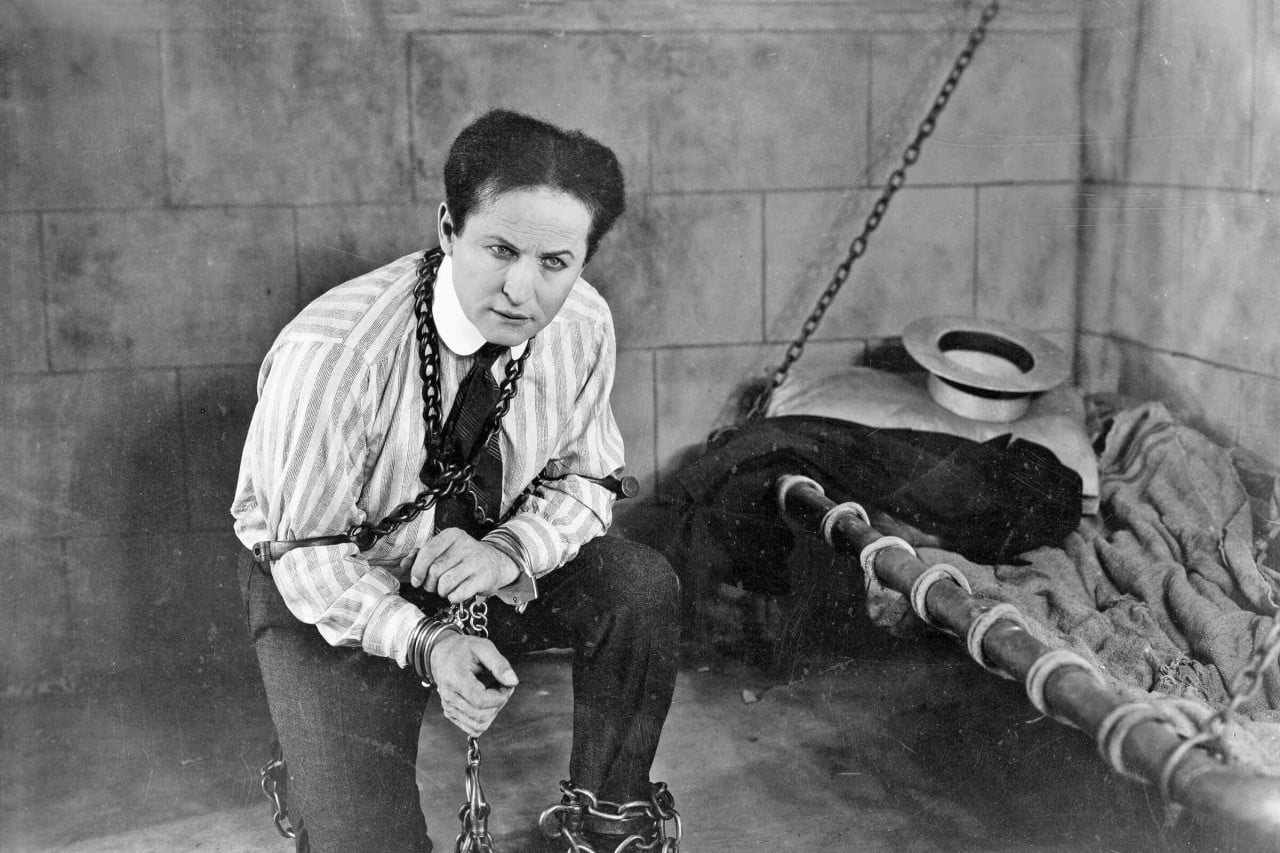
Harry Houdini (1874–1926) was the greatest entertainer of his time. The illusionist and escape artist, whose real name was Erich Weiss, built his own legend through spectacular performances in which he demonstrated an incredible ability to free himself from things that seemed impossible to escape: handcuffs, locked chains, straitjackets, bank vaults, and prison cells. Merely performing was not enough for him; he challenged others to expose his “tricks” or imprison him somewhere he would be unable to escape, and in countless performances he invited audiences to uncover his secrets. He took the ancient art of necromancy to a new level by inventing his own props, such as the famous “Chinese Water Torture Cell.” He entertained audiences on both sides of the Atlantic, and at a time when the average American earned $500 a year, he made $3,500 a week by risking not only his life but also his reputation every time he stepped onto the stage. It was said that throughout his entire career, not a single day passed without a newspaper article about him appearing somewhere.
But by 1916, he had already been performing for fifteen years, and his career was slowly drawing to a close. He played the vaudeville circuit. Big-city audiences had grown tired of his act, and he had also been overshadowed by the new wonder of the age, the cinema, forcing him to travel through smaller towns in the heartland, where people had heard of him but had never seen him perform live. In January 1916, he arrived in Fort Worth, a medium-sized city of 105,000 residents, for his first performance in Texas.
The Majestic Theatre on Commerce Street booked him for an entire week and rounded out the program with a variety of comedy and musical acts. Theatre manager Oscar Gould, however, was betting on the man nicknamed the “Elusive American” and expected him to fill the auditorium every night. The name Harry Houdini still had its magic. But the great Houdini also brought with him a host of demanding requirements. Every stage on which he performed had to accommodate the scenery he carried with him. The climax of his 1916 program was a dramatic escape from the “Chinese Water Torture Cell,” a tank containing thousands of liters of water into which he was lowered by pulleys and raised again after completing the act. As a promise of even greater danger, he offered one thousand dollars in cash to anyone who could prove that he had access to air while freeing himself from handcuffs and a straitjacket as he hung upside down underwater. The Majestic Theatre expected sold-out evening performances throughout the week, as well as a Monday matinee.
Public challenges were an important part of Houdini’s performances. The challenge that attracted the most attention was the one he issued to the local police in every city: no one could restrain him in a way that he could not escape from within five minutes. For some reason, the police in every city accepted the challenge, and Fort Worth was no exception. Houdini, however, never chose the easy way when he could make something more spectacular, so he raised the stakes even further. The police could restrain him with any combination of handcuffs, chains, and a straitjacket and could also suspend him in the air above the street. The clever entertainer thus added further risks while inviting all of Fort Worth to come and watch him potentially fail, taking street performance to new heights.
The Star-Telegram building at the corner of Throckmorton and Eighth Streets was chosen as the site of the grand spectacle. The newspaper was naturally willing to support anything that would boost circulation and give it an edge over the competition. In the run-up to the event, it promoted it like a match between two heavyweight boxers: “The skill of the Fort Worth police force pitted against the skill of the man who has escaped from everything on earth!” If that did not draw crowds to the corner of Eighth and Throckmorton, nothing would. Whenever Houdini’s name was mentioned, the Star-Telegram building was mentioned along with it. On Thursday afternoon, January 13, a crowd estimated at 4,000 people gathered to see how Houdini’s challenge would turn out. It was the city’s largest public event since President Theodore Roosevelt had visited in 1905. The crowd was so large that it spilled into the surrounding streets, and those in the back had to rely on information passed along by those in front. Those at the front watched as Police Chief Cullen Bailey and Detective Tom Blanton put Houdini into a straitjacket, fastened handcuffs around his wrists, and tied a rope around his ankles. A group of strong police officers hoisted him upside down to roof level, three stories above the ground, and then started the clock.
“The Great Houdini” naturally escaped from his restraints, accomplishing it in less than five minutes. As soon as the embarrassed-looking police officers lowered him to the ground, he smiled, bowed, and basked in the crowd’s admiration. He then invited those present to his final two performances at the Majestic Theatre. Meanwhile, through the obliging Star-Telegram, he received another challenge, this time from the packing department of the Washer Brothers department store. Three “expert” packers challenged Mr. Houdini to attempt to escape from “a solid wooden crate into which they would nail and bind him in such a way that he could not get out.” The master entertainer accepted the challenge, stipulating only that the crate must not be airtight. This new act was added to his final performance at the Majestic Theatre on Friday evening, January 14. Even if the show had not already sold out, this challenge guaranteed a full house of spectators eager to see how he would handle it. Would the master triumph once again? Or would the local challengers outwit him? It is difficult to say whom the audience was rooting for at the time. Unsurprisingly, the master once again answered the challenge with another astonishing feat. He then traveled to Dallas for another prearranged challenge, this time from the local police. He completed that one as well.
Houdini was so successful in Fort Worth that he returned to “Cowtown” in 1924, this time as a guest of the Ku Klux Klan. The “Man of Mystery” performed at Klan Hall on North Main on Saturday evening, October 18. At this late stage of his career, when he was fifty years old, he was less an escape artist and more a lecturer, determined to expose the frauds perpetrated by so-called “mediums” and spiritualists. Spiritualism had gripped America since 1848, when the Fox sisters, Maggie and Kate, claimed that they were able to communicate with the dead. Their fame grew throughout the following decades before they finally admitted that it had been a hoax. Spiritualism itself did not die, however, and found a new lease on life in “spirit photography.” After the First World War, when countless families longed to connect with their deceased loved ones, spiritualism enjoyed a second flowering, appealing to the same people who believed in clairvoyance, palmistry, and telepathy, and it was equally false. Houdini, an incomparable illusionist, devoted himself to exposing charlatans who preyed on gullible people through séances and spirit photographs. He found a willing ally in the popular magazine Scientific American, which promised a reward to anyone who could demonstrate a “spirit phenomenon” that could not be replicated through trickery. It was this campaign that brought Houdini to Fort Worth in 1924, along with the promise of a decent payday.
The residents of Fort Worth were as susceptible to spiritualism as anyone else, and the name “Houdini” remained a major attraction in the heartland. One of the most popular novels of the time, Robert W. Chambers’s “The Slayer of Souls,” was then being serialized in the Star-Telegram. Exposing spiritualist fraud became the second act of Houdini’s celebrated career, although he continued to bill himself as a “world-famous magician.” After arriving, he announced that he would not present his popular vaudeville program but would instead deliver a lecture entitled “Can the Dead Speak to the Living?” Because people nevertheless expected magic acts, advance publicity promised “30 minutes of inexplicable magic” before the actual exposure of spiritualist fraud. There was nothing unusual about the venue. Houdini was not a member of the Ku Klux Klan, but Klan Hall was an available auditorium with a capacity of more than 2,000, and the Great Houdini could still attract a large crowd.
Tickets cost 1 $, 1.50, and 2.50 dollars and could be purchased in advance at Renfro’s Drug Store. Although Houdini’s campaign against charlatans was sincere, the master entertainer never passed up a publicity stunt that would earn him more headlines. It cannot be proven, but one of those attending the lecture that evening was Dr. Howard R. Whiteside, a renowned spiritualist and president of Whiteside University in Los Angeles. He had come to Fort Worth to defend his cause and specifically to accept Houdini’s standing challenge, under which he was prepared to pay $6,000 to any spiritualist who could demonstrate something onstage that Houdini could not replicate. The organizing committee announced that Whiteside would join Houdini onstage at Klan Hall the very next evening.
At eight o’clock on Saturday evening, the show began before a capacity audience. After the opening portion, Whiteside took the stage, and the two men engaged in a war of words. Whiteside refused to make contact with the dead directly onstage, but they agreed on a compromise that also prolonged interest in Houdini’s stay in the city. The challenger, Whiteside, was to provide indisputable proof that contact with the dead was possible by producing a spirit photograph at a neutral location under strictly controlled conditions. Spirit photography supposedly could capture images of people from the other world on film using an ordinary camera. The Hotel Texas became the site of their “experiment.” It was the greatest contest of faith since Elijah challenged the priests of Baal in the Old Testament.
Each participant brought his own camera and film, which a local photographer loaded into the cameras under the watchful eyes of two journalists. In a darkened room, the photographer then photographed a green curtain while Houdini and Whiteside looked on. He subsequently developed both rolls of film and presented the photographs to everyone present. As Houdini had predicted, there were no ghostly images on them. Whiteside protested that all the “skepticism and hostility” in the room had created unsuitable conditions for the spirits to appear. Houdini boasted that he had exposed another fraud, and both men left town.
Whiteside’s career did not suffer from this failure. In 1927, he lectured in Dallas and told his listeners that “motion pictures from heaven” would soon arrive. A few years later, in Eastland, Texas, he was called by the defense in an insanity case as an “expert who understood the human mind.” After his testimony, however, the judge dismissed his expertise and declared that he was “qualified neither as an expert nor as a lay witness.”
As for Houdini, he never returned to Fort Worth. Two years after his 1924 visit, he died of a ruptured appendix. The injury occurred after he accepted a challenge intended to test his renowned abdominal strength by allowing a man to punch him in the stomach as hard as he could. He died on Halloween night in 1926. Ironically, the man who had spent his later years exposing spiritualists made a secret agreement with his wife that he would send her a sign from the other world. His faithful wife held séances every Halloween night for ten years, but she was unable to establish contact across the gulf between worlds. Harry Houdini has not appeared publicly in Fort Worth or anywhere else since his death.