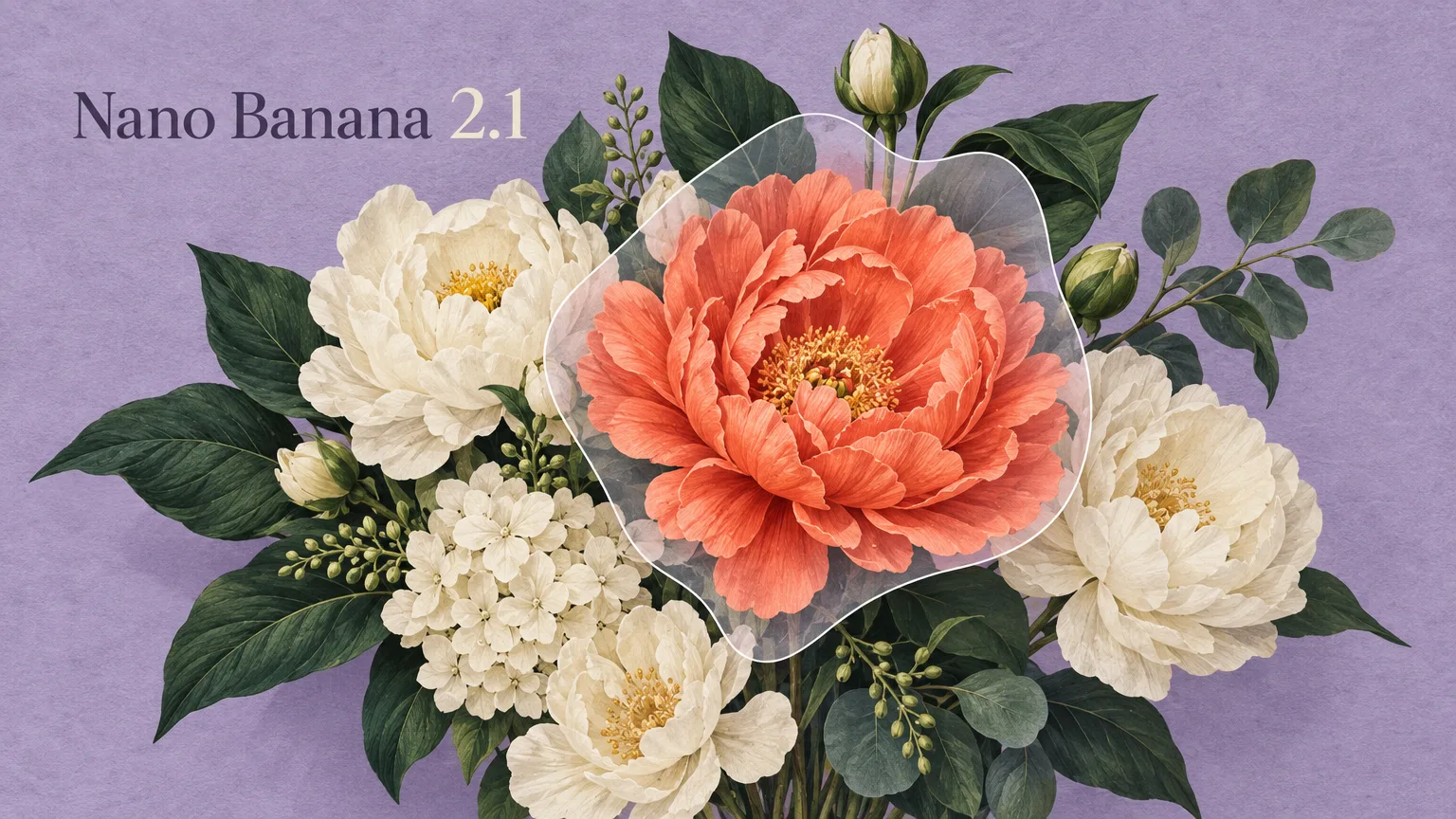
Google has released Nano Banana 2.1, an update to its Flash-series model for generating and editing images. The new version focuses on more precise changes to selected parts of an image without the need to recreate the entire image. It supports up to 14 reference images, including maintaining the consistency of up to four characters and the fidelity of up to ten objects.
Mask-based editing and more sophisticated scenes
When editing with a mask, the model is intended to modify the selected area of the image more precisely without having to regenerate the entire image. The update also focuses on composition: more sophisticated arrangements of visual elements and scene construction are complemented by more natural rendering with fewer visible artifacts.
However, Google lists deviations in characters' appearance from reference images among the persistent limitations. Edits specified using a mask or drawing may fulfill only part of the instruction, and when a structural change is requested, the original pose may be preserved. The model also sometimes confuses left and right; its 3D spatial reasoning and factual accuracy remain imperfect.
Output up to 4K and improved text rendering
Images can be created at 1K, 2K, and 4K resolutions. For wide outputs at 2K and 4K, the update improves realism and reduces artifacts that occur at tile boundaries. The changes also include improved text rendering.
For images in which small text is important, Google recommends 2K or 4K resolution: at 1K, small characters may be blurry. According to the company, long paragraphs remain among the types of content that the model has difficulty rendering accurately.
Three Thinking levels and search-based reference material
According to Google's documentation, Nano Banana 2.1 is built on Gemini 3.6 Flash and belongs to the Gemini 3 family. The previous Nano Banana 2 corresponds to the Gemini 3.1 Flash Image model. The new version offers a Thinking mode with three levels: minimal, medium, and high, with medium as the default setting.
The minimal level is intended for generation where a fast response matters. High is aimed at infographics, scenes with multiple subjects, and other prompts requiring more planning. When creating content, the model can also use results from Google's web and image search.
The context window is 131,072 tokens. In addition to text and images, the model also accepts video and PDF files.
Google's internal tests compare the new version with both version 2 and Pro
In Google's internal evaluation, human evaluators chose between pairs of outputs, and their preferences were converted into Elo scores. Nano Banana 2.1 with Thinking enabled achieved an overall preference score of 1050 Elo, while Nano Banana 2 scored 981 and Nano Banana Pro 935. A higher Elo indicates a stronger relative preference in this test; differences between scores are not percentage-point improvements in quality.
In the multi-character consistency test, Google reports 1106 Elo for version 2.1 with Thinking, compared with 1011 Elo for Nano Banana Pro. For the factual accuracy of infographics, the company reports a score of 0.521 for Nano Banana 2.1 with Thinking and 0.179 for Nano Banana 2.
The API is available, with more products being added gradually
Developers can use the model through the API under the identifier gemini-nano-banana-2.1. Google states that pricing and expected latency remain at the same level as Nano Banana 2.
The gradual rollout includes the Gemini app and AI Mode in Google Search. Among developer and creative tools, it covers Google AI Studio, Google Flow, and Stitch; Google Ads and the Gemini Enterprise Platform are also being added. Availability in individual products may vary depending on the account, region, and current rollout phase.