Sakana AI and collaborators at UC Berkeley have released MASS, a research method that combines the work of an agent team with fine-tuning a single language model. That model does the work, evaluates results and revises the team’s workflow. The researchers report that two cycles improved a 27-billion-parameter model with open weights on open-ended research tasks, without external labels or a stronger teacher during training.
One model, separate roles and a detailed plan
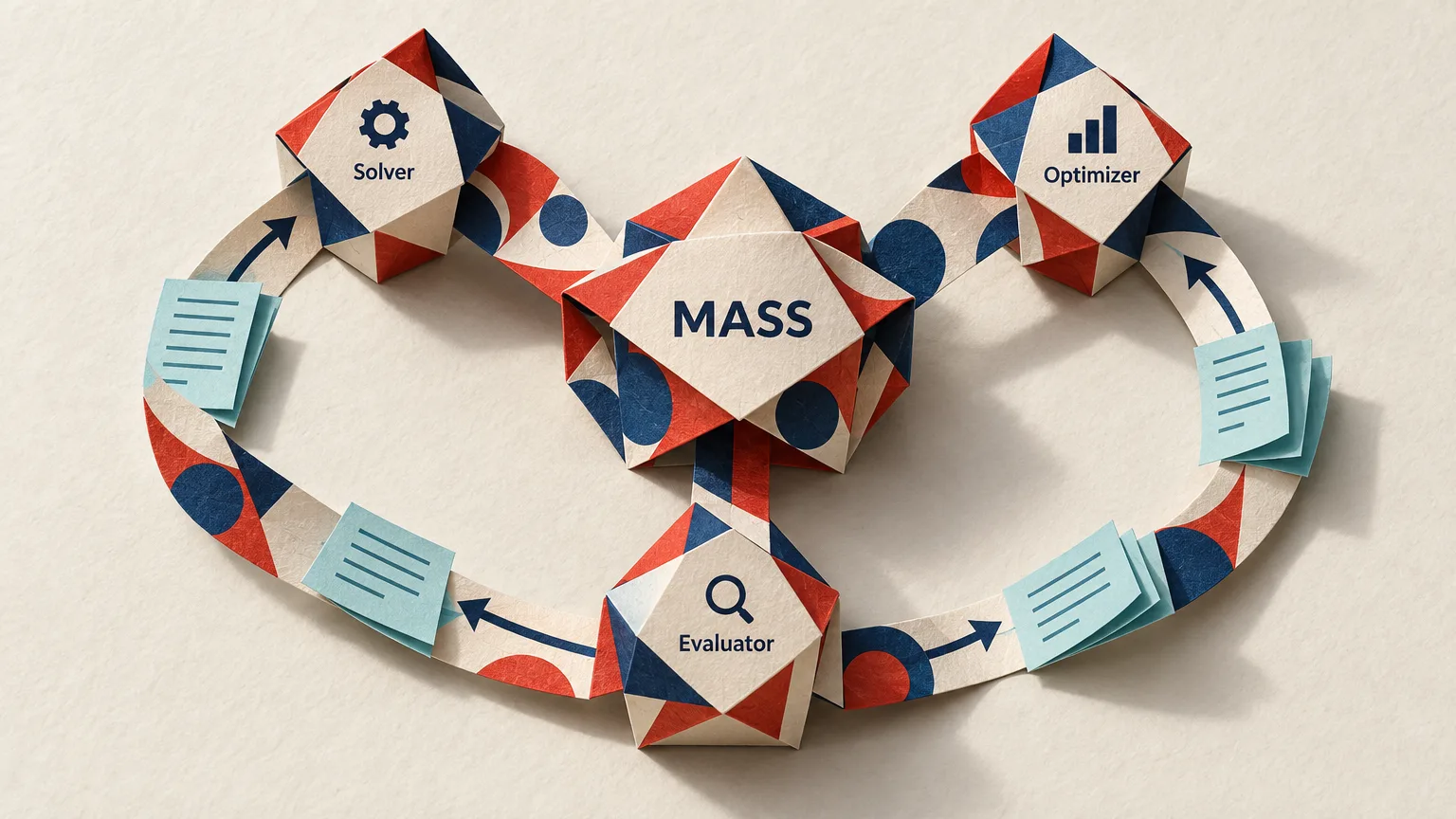
MASS stands for Multi-Agent Self-Supervision. In Sakana AI and UC Berkeley’s design, each role uses a separate call to the same model, rather than a different model. A team of task-solving agents performs the work, an optimizer revises the workflow, and an evaluator compares the completed results.
A written plan governs how the agents collaborate. It assigns responsibilities and instructions to each subagent and specifies the outputs, evidence and checks they must provide. It also sets the order of calls and the handoffs between agents.
The researchers observed that successful workflows developed more detailed requirements for outputs, checks and dependencies between agents as the search progressed. In a finance task, for example, a data specialist had to provide explicit data-leakage checks before downstream agents could access the data.
Finding a workflow before updating the weights
The authors describe a training process that alternates between two loops. In the inner loop, model weights stay fixed while the system retains the best workflow found so far for each task. It tests a new candidate, collects its messages and outputs, and asks the evaluator to compare them with the current best results. The optimizer uses that comparison to propose another revision.
In the outer loop, the researchers run the best workflow 18 times for each task. The current model compares the results in pairs, and a Bradley–Terry model converts those judgments into relative scores. They select up to 16 recorded runs per task, then use the conversations of the coordinating agent and subagents for LoRA fine-tuning.
Before fine-tuning, the researchers remove the written workflow plan from the coordinating agent’s prompt. Their design trains the model on coordination decisions recorded in successful conversations rather than on direct copies of the plan.
Results on research and software tasks
Sakana AI and UC Berkeley tested Qwen3.6-27B in the qwen-code coding-agent environment. Training covered 12 synthetic research tasks in finance, robotics and pharmacy, with three more synthetic tasks reserved for testing. The authors report that the pairwise win rate against the base model rose from 53.9% after the first cycle to 69.9% after the second; the second result applies to the held-out test tasks.
The researchers report that, after two cycles, MASS achieved 1.2–1.6 times the base model’s score per output token on MLR-Bench, DSBench, ScienceAgentBench and AstaBench. This metric measures performance relative to the amount of text generated, with the base model assigned a value of 1.0.
The same evaluation showed regressions on software benchmarks. The authors measured 0.96 times the base model’s score per output token on Terminal-Bench 2.0 and 0.94 times on SWE-bench Verified. The training set did not include software engineering tasks.
Single-agent comparisons and improvements across roles
In a separate comparison, Sakana AI and UC Berkeley report that the MASS-trained model reached a 68.3% win rate after processing 28.8 million training tokens. The strongest version trained on single-agent work reached 64.0% after 42 million tokens.
Although the training data consisted only of recorded task-solving runs, the researchers also observed improvements in the model’s optimizer and evaluator roles. Agreement between its internal evaluator and the external judges rose from 73% to 93% across cycles.
Another experiment kept the base model as the task solver but assigned both workflow optimization and evaluation to GPT-5.5. The authors report that this configuration found workflows that won on each of the 12 tasks in no more than five iterations. The improvement was smaller when only the evaluator was strengthened.
Open-source implementation and the limits of shared weights
The authors caution that separating the roles does not eliminate correlated errors, because the subagents share model weights. A mistaken assumption can pass through task execution, evaluation and optimization and be mistaken for progress. Workflow search may also fail to improve a strong plan consistently once it has found one.
An open-source implementation of MASS is available alongside the paper. The researchers used GPT-5.5 and Claude Opus 4.8 for external evaluation, but MASS had no access to their judgments during training. Reproducing that evaluation requires access to both models.