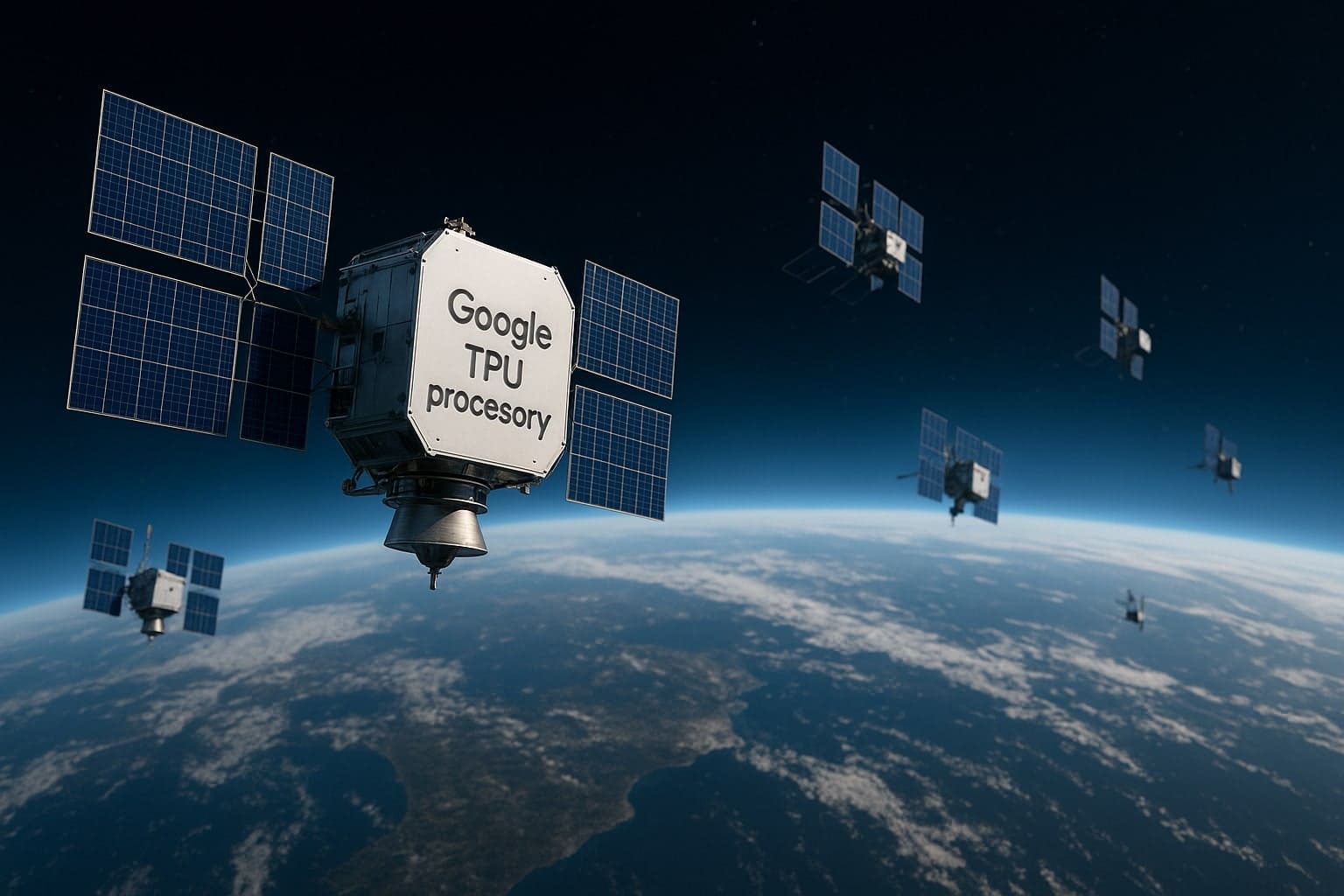
Google has unveiled an ambitious project called Suncatcher, which explores the possibility of equipping constellations of solar-powered satellites with TPUs (tensor processing units) and free-space optical links. This approach could one day enable machine learning computations to be scaled directly in space. The satellites would use solar energy, which is up to eight times more productive in the right orbit than on Earth. This would minimize the need for heavy batteries and ensure nearly continuous energy generation.
The Sun emits more than one hundred trillion times humanity's total electricity production. In a satellite constellation, solar panels would operate in a Sun-synchronous low Earth orbit, where exposure to sunlight is nearly constant. This design reduces dependence on terrestrial resources and limits environmental impact. The research focuses on the modular construction of smaller, interconnected satellites, which would allow the system to be easily expanded.
Challenges in Inter-Satellite Communication
Large machine learning tasks require work to be distributed across many accelerators connected by high-speed, low-latency links. The system requires inter-satellite links with capacities of tens of terabits per second, matching the performance of terrestrial data centers. Analysis suggests that this can be achieved using multi-channel transceivers with dense wavelength-division multiplexing (DWDM) and spatial multiplexing.
The received signal strength must be a thousand times higher than in conventional long-distance links. This is addressed by flying satellites in close formation at distances on the order of kilometers or less. The team has already tested a bench-scale demonstrator that achieved transmission speeds of 800 Gbps in each direction, or 1.6 Tbps in total, using a single pair of transceivers. This approach closes the link budget, which accounts for end-to-end signal losses in a communication system.
Managing Close Satellite Formations
The satellites must fly in a much more compact formation than current systems to provide high-speed links. The team developed numerical and analytical physical models to analyze orbital dynamics. They used an approximation based on the Hill-Clohessy-Wiltshire equations, which describe a satellite's motion relative to a circular reference orbit in the Keplerian approximation, and a JAX-based differentiable model for numerical refinement that accounts for additional perturbations.
At the constellation's planned altitude of around 650 km, the dominant influences are the non-spherical shape of Earth's gravitational field and, potentially, atmospheric drag. The models illustrate trajectories for an 81-satellite configuration in an orbital plane with a cluster radius of 1 km, where the distance between nearest neighbors oscillates between approximately 100 and 200 meters under the influence of Earth's gravity.
With satellites only hundreds of meters apart, only minor maneuvers will likely be needed to maintain stability at the required orbital altitude. The free-fall evolution of the constellation without thrust, modeled in detail for the required orbital altitude, includes a non-rotating coordinate system relative to the central reference satellite S0.
TPU Radiation Resistance
Machine learning accelerators must withstand the low Earth orbit environment. The team tested Trillium, Google's v6e Cloud TPU, in a 67 MeV proton beam to examine the effects of total ionizing dose (TID) and single-event effects (SEE).
The results are promising. The high-bandwidth memory (HBM) subsystems were the most sensitive, but irregularities appeared only after a cumulative dose of 2 krad(Si), nearly three times the expected dose of 750 rad(Si) over a five-year mission with shielding. No hard failures were attributed to TID up to the maximum tested dose of 15 krad(Si) on a single chip, suggesting that Trillium TPUs are surprisingly resilient for space applications. Radiation testing is critical for hardware in space, and Google's Trillium demonstrated better resilience than expected.
Launch Costs
High launch costs have historically been the main obstacle to large space-based systems. An analysis of historical and projected launch prices suggests that, if the learning rate is maintained, prices could fall below $200 per kg by the mid-2030s. At this level, the cost of launching and operating a space-based data center could be comparable to the reported energy costs of an equivalent terrestrial data center on a per-kilowatt-year basis.
This calculation includes publicly reported energy costs for the data center industry. Additional information from the internet indicates that falling launch prices, thanks to companies such as SpaceX, are making such projects more realistic, and Google plans to partner with Planet to launch two prototype satellites in early 2027.
Future Development Directions
The initial analysis confirms that the fundamental concepts of space-based machine learning computation are not ruled out by the laws of physics or insurmountable economic barriers. Significant engineering challenges remain, such as thermal management, high-speed communication with Earth, and the reliability of systems in orbit.
The next milestone is a learning mission in partnership with Planet, with the launch of two prototype satellites planned for early 2027. This experiment will test TPU models and hardware in space and validate optical inter-satellite links for distributed machine learning tasks.
Ultimately, gigawatt-scale constellations could use a more radical satellite design that combines new computing architectures adapted to the space environment with a mechanical structure in which solar energy collection, computation, and thermal management are tightly integrated. This approach would push the boundaries of what is possible in space, much as the development of complex systems-on-a-chip was driven by modern smartphones.
Source: research.google/blog