Try to remember your last conversation with a voice assistant. Did it feel natural? Or were you waiting for it to interrupt you mid-sentence, respond with a half-second delay, and make the entire exchange feel more like a satellite phone call from the 1990s? Google has decided to put an end to that. In March, it launched Gemini 3.1 Flash Live, a model designed to bring voice communication with artificial intelligence to where it should have been from the start.
What's new in the latest version
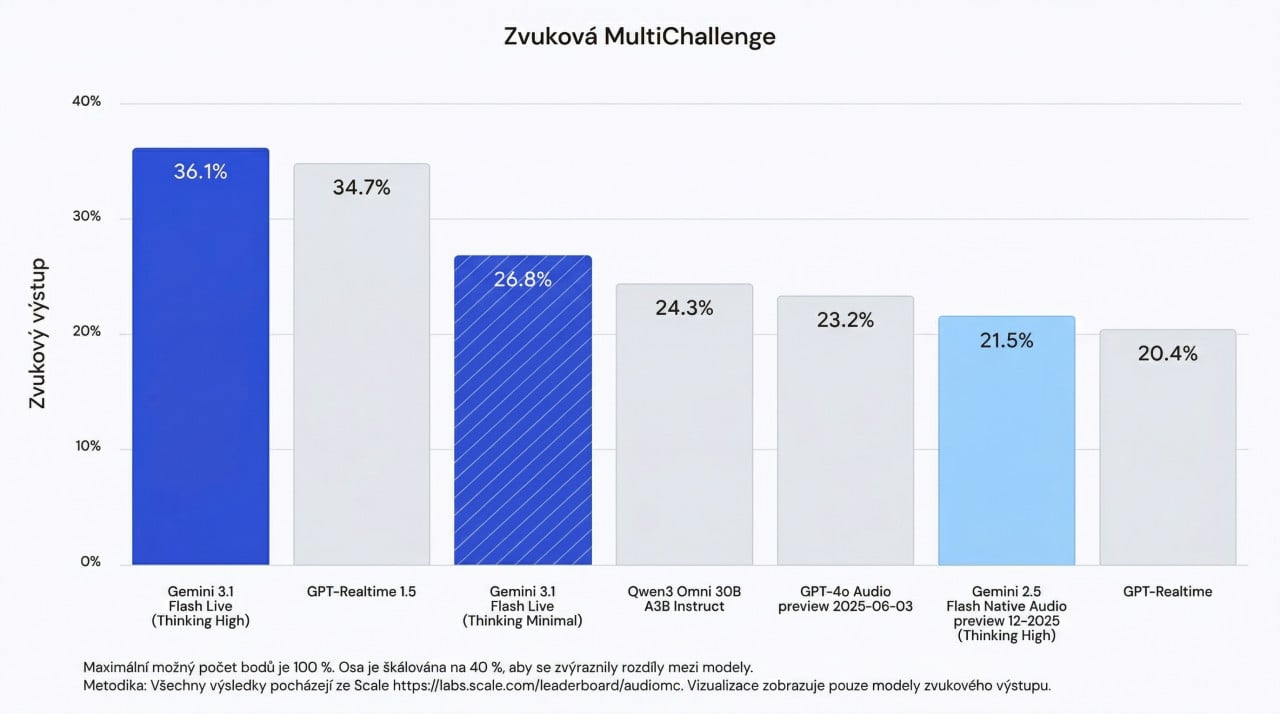
It's not enough to say that the model is "better." Let's look at the specifics. Gemini 3.1 Flash Live achieved a score of 90.8% on the ComplexFuncBench Audio benchmark, which tests complex, multi-step commands in real-world environments. That is a significant leap over the previous generation. On Scale AI's Audio MultiChallenge, the model achieved 36.1% with "thinking" enabled, with the benchmark deliberately simulating the interruptions and hesitations typical of real conversations.
But the numbers are only part of the picture. What matters is what this means in practice. The model can now distinguish your voice more effectively from background TV noise or traffic outside the window. It follows the given instructions even when the conversation veers off topic. And perhaps most importantly, it understands the tone, pace, and emphasis of speech in a way that previous versions simply could not.
Google made the model available through the Gemini Live API in Google AI Studio, and developers had been waiting for it. With just a few lines of Python code, you can create the foundation of a voice agent that responds in real time. The model supports more than 90 languages, so global deployment is not a problem.
The real-world use cases are compelling. Google's Stitch tool now lets users design user interfaces by voice, while the agent "sees" the canvas and provides feedback. Ato, a voice companion app for older users, uses the model's multilingual capabilities to make everyday conversations feel like genuine human connection. And game studio Weekend integrated the model into its RPG title Wit's End, where the voice-powered Game Master speaks with a theatrical charm that could not previously be programmed.
Verizon, The Home Depot, and LiveKit have all tested the model in their operations, and the feedback is clear: the natural flow of conversation is finally where it should be.
Gemini 3.1 Flash Image Preview: AI that sees and edits
Alongside the voice model, Google also released Gemini 3.1 Flash Image Preview, a model for generating and editing images. Cloud architect Lynn Langit, who tested it through early access, described the results as an architectural milestone.
Langit gave the model a simple command: "Remove the entire table and all the food. I'm in the middle; remove my hat. Dress me in an emerald green dress." The result? The model followed every individual instruction precisely, preserved the identities of the people in the photo, and transformed the entire group into a completely different visual style. No Photoshop, no graphic designer, no hour of work.

The model's ability to process complex, multi-step instructions while preserving the integrity of the subjects is exactly what distinguishes a genuinely useful tool from a toy. Langit also tested it on group photos featuring multiple people, varied lighting, and complex backgrounds. The model handled them successfully.
In addition, all images generated by Google contain an invisible SynthID watermark that can be verified through Gemini. Google applies the same approach to audio outputs from the Flash Live model. Protection against misinformation is therefore built directly into the model rather than added afterward.
Gemini Live and Search Live: AI for everyone
Gemini 3.1 Flash Live isn't just for developers. The model powers Gemini Live and now also Search Live, which expanded to more than 200 countries and territories this week. Users can have real-time multimodal conversations in their native language.
With the new model, Gemini Live responds faster and can follow the thread of a conversation for twice as long as the previous version. So if you think out loud and jump from topic to topic, the assistant won't lose track of you. It's a change you'll notice during your first longer conversation.
In doing so, Google is showing that voice AI is no longer a premium feature for technology enthusiasts and is becoming a tool worth using every day. And honestly? After listening to the first samples from the new model, it's hard to go back to what came before.