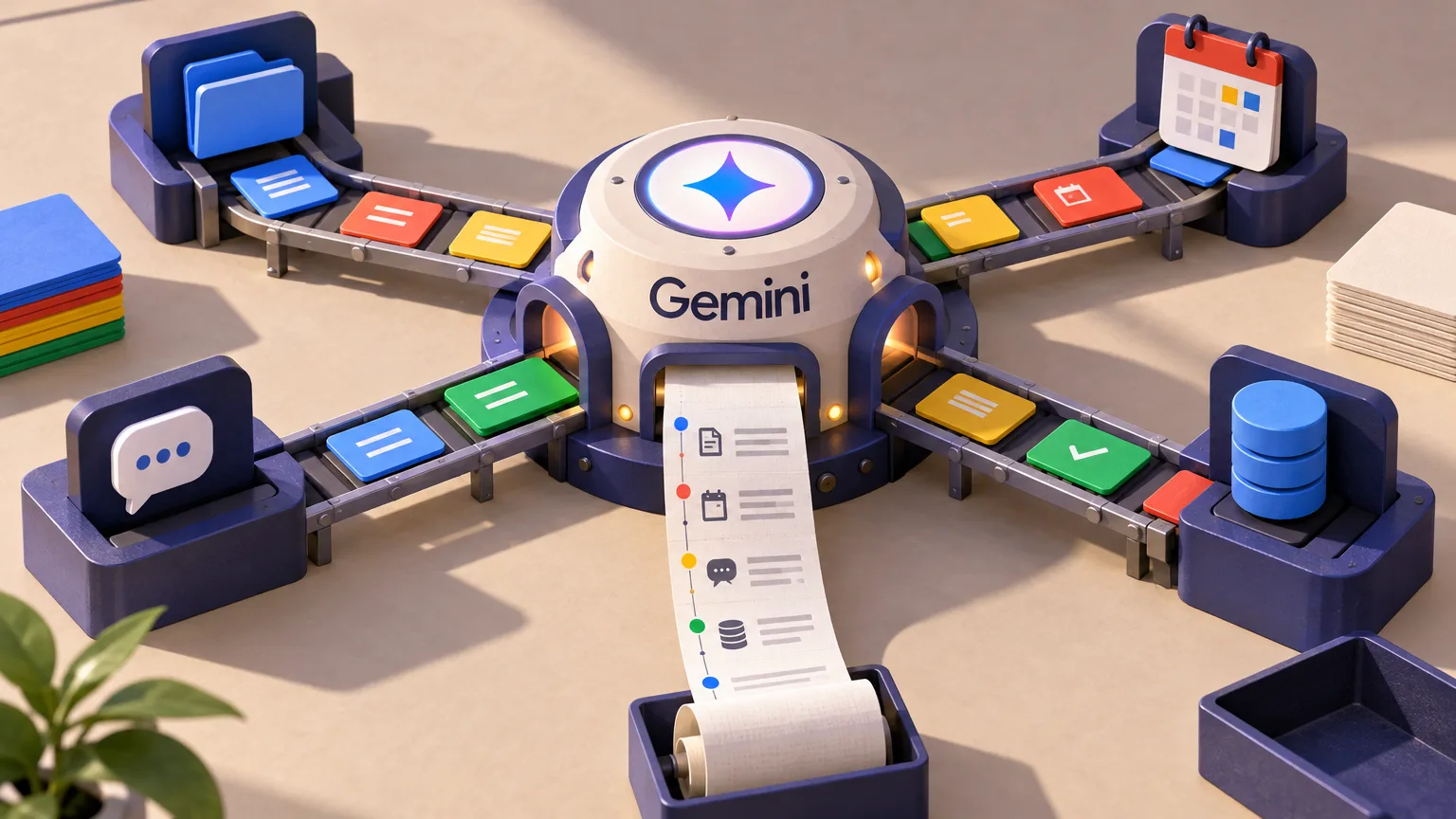
Google introduced a unified Gemini agent at a Google Cloud event, designed to answer questions and carry out tasks on users’ behalf from a single interface. It will target businesses first, working with internal systems and data and using tools to accomplish an assigned goal.
Goals rather than individual instructions
Google Cloud CEO Thomas Kurian described an approach in which users give the agent a goal rather than individual instructions. According to Kurian, Gemini is designed to plan its work, use custom skills and tools, and connect to a company’s internal systems.
Requests can include files or entire folders. Users can also attach projects prepared for specific workflows, including projects that combine files with skills.
Model selection is intended to be automatic by default, based on the task, but users can take over that choice. The options include third-party models, starting with Anthropic’s Claude models. Google plans to expand the selection to include open source models and other private models.
Connections to workplace apps, data and MCP
The listed connections include Google Workspace and Microsoft 365, along with Slack, Jira and Confluence. The agent is also designed to access Git and data systems including BigQuery, Databricks, Postgres and Snowflake.
The announced support also covers connecting to and working securely with any Model Context Protocol (MCP) server, whether inside or outside the company’s network.
Its own account and team context
Google says the agent will have its own Workspace account, email address and context, much like another team member. The company says it is designed to know which teams colleagues belong to, their time zones, who is responsible for approvals and what is on their work calendars.
Users will be able to involve the agent by tagging it or sending it an email. Other options will include sharing content with it and adding it to a group chat.
Task progress and audit records
A tasks inbox interface is intended to let users track the agent’s work. It will show Gemini’s thinking process, the delegation of subtasks to subagents and the loading of special skills. Code and task progress will also be visible.
As the agent takes action, it will create audit records that attribute those actions to its own identity rather than to a particular person.
Access from phones, computers and business services
The agent will be accessible from iOS and Android mobile devices and from Windows and Mac computers. Google also plans access through the command line and through Google Workspace, Microsoft 365, ServiceNow and Slack.
Google plans to offer the agent to consumers later. Sundar Pichai said the initial business focus would allow the company to address more demanding challenges around security, scale and performance. Early testers included sportswear brand On, Shopify and PayPal.
Google says a combination of multi-model orchestration, smart routing and real-time spending caps will help businesses better control their enterprise AI costs.