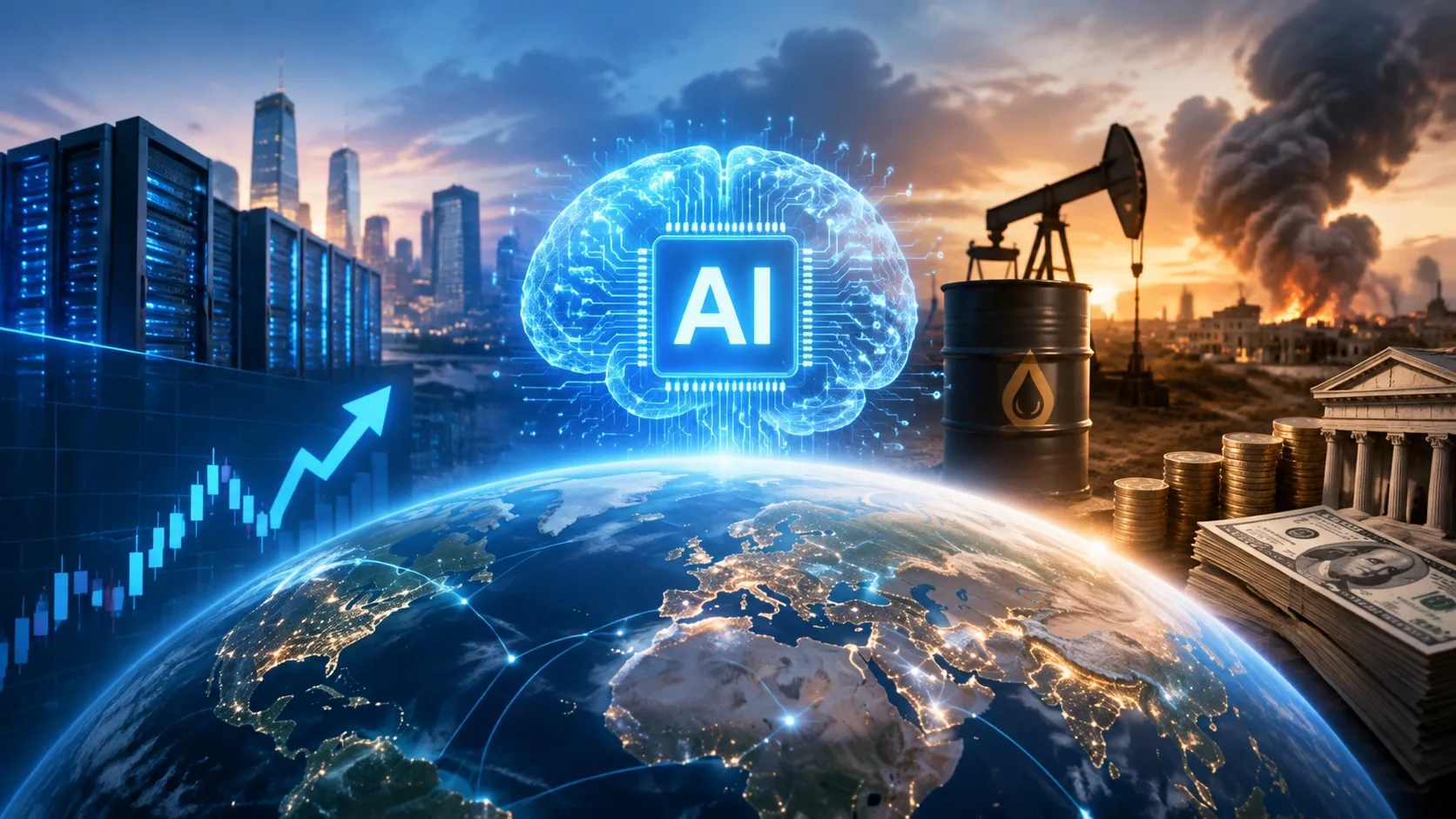
The International Monetary Fund (IMF), which monitors the state of the global economy and lends to countries in need, sent the world an unsettling message on Tuesday. The economy has so far performed better than expected. Much of the credit goes to the enormous sums that companies are pouring into artificial intelligence. However, that very trend could backfire. If companies stopped investing in AI, stocks would fall and the entire global economy would slow down. The fund also identified two other threats: a prolonged war in the Middle East and high government debt.
AI is driving the economy, but expensive oil is holding it back
The fund expects the global economy to grow by 3.1 percent this year. In July, it projected three percent, so it has slightly upgraded its estimate. Companies continue to build data centers on a large scale and purchase equipment for artificial intelligence. This is helping to offset the damage caused by more expensive oil. Its price has been driven up by the war in the Middle East. The fund presented its new global economic outlook report in Bangkok, Thailand, where it is currently meeting with the World Bank.
For next year, the fund expects growth of 3.4 percent. However, this applies only if the Strait of Hormuz, a narrow shipping route through which a large share of the world’s oil flows, reopens by March and shipping returns to normal by October 2027. If the war worsened and a barrel of oil remained above 130 dollars until spring 2027, the economy would grow roughly half a percentage point more slowly next year.
What if AI fails to meet expectations
The second threat directly concerns artificial intelligence. The IMF calculated what would happen if companies and investors concluded that AI was not delivering as much benefit or profit as they had expected. They would then stop investing in it, the prices of stocks and other assets would fall, and the world would lose 1.1 percent of its economic output by 2028. The United States would fare even worse, with its economy shrinking by 1.8 percent.
The fund’s second report, which monitors the stability of banks and financial markets, warns of the same danger. According to the report, governments should not be lulled into complacency by favorable conditions, because both AI investment and stock prices can reverse quickly.
At a press conference, the IMF’s Jason Wu described what such a downturn would look like. As soon as people begin to doubt whether AI can be profitable, technology company stocks will fall in value. Companies may then struggle to repay loans, and the money they were counting on in the future may never materialize. His colleague Athanasios Vamvakidis added that people outside the stock market would soon feel the effects as well. When people’s and companies’ stocks and other assets lose value, they feel poorer and begin to spend less. Stores then sell less, and the entire economy slows down.
It would also affect international trade, warned the fund’s chief economist, Silvana Tenreyro. Trade in goods used for artificial intelligence, such as chips and servers, grew by 29 percent between 2023 and 2025. Trade as a whole increased by only 8.3 percent. Without AI, she said, the increase would have been just 4.6 percent.
A major crisis is not yet imminent
Even if investment in AI did fall sharply, the world would probably not enter a recession, meaning a period in which the economy contracts instead of growing, according to the IMF. Petya Koeva Brooks of the fund’s research department said this in an interview with Reuters. IMF Managing Director Kristalina Georgieva explained that the fund believes in the economy’s resilience primarily because it has so far weathered a series of shocks and governments have generally made sensible decisions. At the same time, however, she warned against complacency. Do not take this resilience for granted; we must work for it, she said.
The facilities in Bangkok also hosted discussions about how artificial intelligence could facilitate cyberattacks. Authorities that supervise banks are taking the issue increasingly seriously. According to Reuters, US authorities are asking banks how they use advanced AI models. European authorities, meanwhile, want banks to have better-prepared plans in case they run into difficulties.
Debt repayments will eat into budgets
The third threat is debt. Governments have borrowed heavily in recent years, and it is now costing them more and more. If the war pushes prices higher, government borrowing will become even more expensive. More money will then flow out of budgets to cover repayments, leaving less for roads, schools, or business support.
Poorer countries are in the worst position. Nigerian Finance Minister Taiwo Oyedele, who leads a group of twenty-four developing countries, said that debt is preventing them from achieving growth that would benefit all their citizens. According to the cited estimates, developing countries collectively pay 500 billion dollars more for their loans than wealthy countries. On top of that, they are facing growing budget shortfalls.
The IMF is therefore urging governments to begin saving, even though voters do not like to hear it. It praised Britain as the only major wealthy country with a clear plan to borrow less in the coming years. At the same time, it warned the country not to abandon that plan. Britain’s new government is due to present its budget in a few weeks.
However, governments are not paying much attention to the fund, according to Josh Lipsky of the US-based Atlantic Council, who is observing the meetings in Bangkok. France, Germany, and the United States should all be saving, he said, but instead they are spending even more. Lipsky fears that governments will act only when some crisis forces them to do so.