

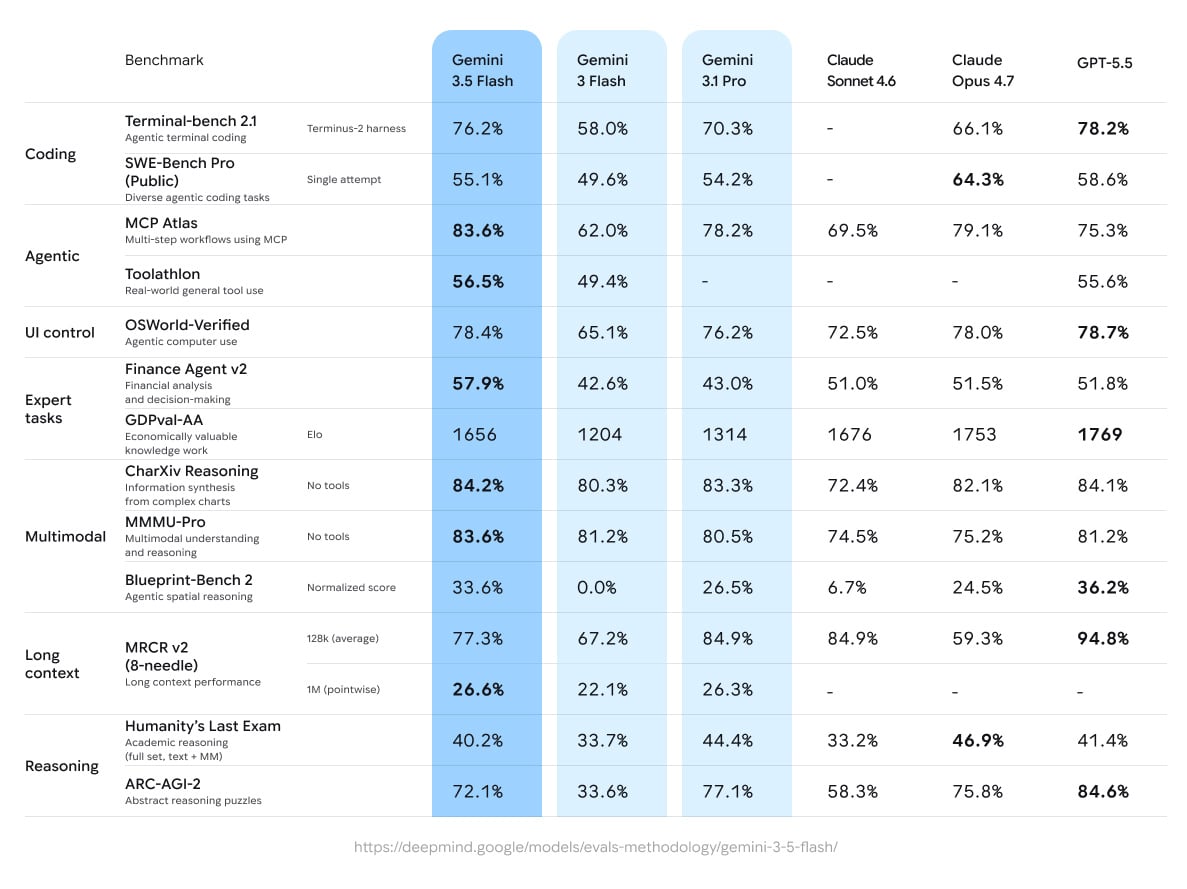
At the Google I/O developer conference, Google unveiled Gemini 3.5 Flash. The new model now offers an agent that can perform tasks on its own. Gemini 3.5 Flash achieved 83.6% on the MCP Atlas agentic benchmark, which measures the ability to handle multi-step workflows. That is higher than GPT-5.5 (75.3%), Claude Opus 4.7 (79.1%), and Claude Sonnet 4.6 (69.5%). In the Terminal-bench 2.1 coding benchmark, the model scored 76.2%, outperforming even Google's own older Gemini 3.1 Pro (70.3%). At the same time, Google says it delivers state-of-the-art performance at less than half the cost of comparable competing models and generates output tokens four times faster.
What's New in Gemini 3.5 Flash
“3.5 Flash offers an incredible combination of quality and fast response times. It outperforms our latest flagship model, 3.1 Pro, on nearly every benchmark.” Koray Kavukcuoglu, DeepMind's chief technology officer, said this at a press conference. Speed is the goal of the entire design. The model runs four times faster than other state-of-the-art models. Google has also developed an optimized version of Flash that is twelve times faster than the standard version at the same level of quality. For agentic work, where dozens of AI agents run concurrently on long-term tasks, speed is precisely what determines real-world usability.
From a technical perspective, 3.5 Flash introduces several specific new features:
- A 1-million-token context window and up to 65,000 output tokens
- Preservation of intermediate reasoning results across long conversations. The model automatically remembers interim conclusions, without requiring any API changes
- A new default reasoning level: the default setting has changed from “high” to “medium,” while the low level has been significantly improved for coding and agentic tasks requiring fewer steps
- Support for multimodal inputs such as text, images, video, audio, and PDFs
- Running code directly with images and combining tools within a single request
- Structured outputs with tools. Combining JSON mode with built-in tools such as search, URL context, or code execution
At the I/O conference, developer Varun Mohan gave a live demonstration in which agents collaborated to build a complete operating system in Antigravity, Google's new developer platform. The model can run autonomously for several hours. If it reaches a decision point that requires human input, it pauses and asks.
Comparison With Competitors: Where It Leads and Where It Lags
In the SWE-Bench Pro benchmark (diverse coding tasks), Flash achieves 55.1%, while GPT-5.5 scores 58.6% and Claude Opus 4.7 reaches 64.3%. Here, Flash lags behind both. The GDPval-AA benchmark, which evaluates economically valuable knowledge work, paints a similar picture: Flash scored 1656, compared with 1769 for GPT-5.5 and 1753 for Claude Opus 4.7.
In other words: Google leads in agentic work and general tool use, but there is still room for improvement in advanced coding performance. Tulsee Doshi, Google's director of product, described the intended division of labor: the soon-to-be-available 3.5 Pro model will serve as the orchestration layer and planner, while Flash will handle the role of sub-agents where speed and powerful tool use matter.
Flash also introduces enhanced cybersecurity protections as well as improved safeguards against content that falls into the CBRN category (chemical, biological, radiological, and nuclear threats). At the same time, it is better tuned to answer sensitive questions rather than refuse them.
Availability
As of May 19, the model has been deployed virtually everywhere at once.
For general users:
- Gemini app – 3.5 Flash is the new default model, available globally through the model selector
- AI Mode in Google Search – available worldwide from launch
- Gemini Spark – a new 24/7 agentic assistant (beta, currently available to test users and AI Ultra subscribers)
For developers:
- Gemini API via Google AI Studio – available with a free tier of approximately 1,500 requests per day
- Google Antigravity 2.0 – a new desktop application for agent-focused development, with a CLI tool and SDK for custom workflows
- Vertex AI and Gemini Enterprise – for enterprise customers
- GitHub Copilot – the model is generally available and is gradually being rolled out to Copilot Pro, Pro+, Business, and Enterprise plans with a 14x premium-request multiplier
The model identifier in the API is gemini-3.5-flash and it is backward-compatible with projects calling Gemini 3 or 3.1.
As for subscription pricing, Google introduced a new AI Ultra plan for $100 per month with five times higher Antigravity usage limits than the Pro plan. The flagship AI Ultra plan dropped from $250 to $200 per month. The basic AI Plus plan starts at $7.99, while AI Pro starts at $19.99 per month.
Gemini 3.5 Pro is not yet publicly available. Google is already using it internally and plans a broader launch in June 2026.


