

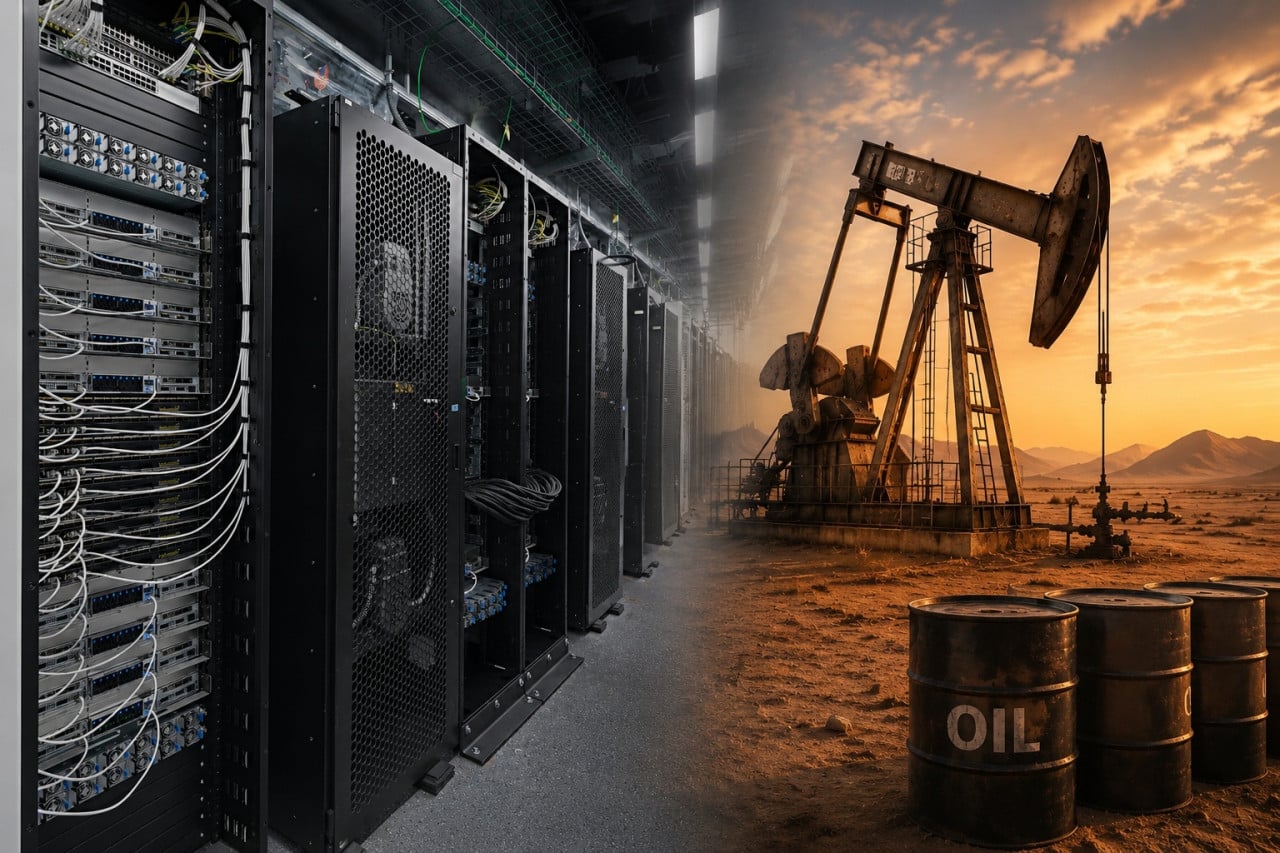
In 1973, the oil embargo changed the world. Overnight, something that had functioned as ordinary infrastructure became a strategic resource that was fought over, stockpiled, and traded. Today, exactly the same thing is happening with computing power for artificial intelligence. Only instead of oil, it is GPU chips.
Companies are stockpiling them. Speculative investment funds are investing in them. Governments are restricting their export. And the first mechanisms for trading computing power like a commodity are beginning to emerge in the markets. What exactly does this change mean, and why do most AI teams still make a fundamental mistake when choosing infrastructure?
Why GPUs have become something governments and corporations fight over
For many years, computing power developed predictably. Every six months, it became faster and cheaper, and developers could simply wait. That changed when large language models demonstrated that computing power is the main driver of artificial intelligence capabilities. Training GPT-3 required hundreds of so-called petaflop-days of computing power. Newer models such as GPT-4 or Gemini Ultra required significantly more. Every step up in model quality means an exponential increase in the computing power required for training.
As a result, demand for cutting-edge artificial intelligence chips, particularly the NVIDIA H100 and the newer H200 and B100 models, has completely outstripped supply. Why can this not be fixed quickly? Manufacturing a chip at the highest level is one of the most complex production processes in the world. NVIDIA designs the chips, but their production depends on the advanced manufacturing processes of Taiwan-based TSMC. The entire supply chain, from chip design and packaging to deployment in a data center, takes years. Building a modern artificial intelligence data center requires 50 to 150 megawatts of power and can easily take 18 to 36 months.
On top of that, US export restrictions introduced from 2022 onward are further fragmenting global supply. The impact on prices was very swift. When H100 chips entered the market, renting them on cloud platforms cost roughly $2 to $4 per GPU per hour. By the end of 2023, prices on the open market had climbed to $8 or more, sometimes even higher. This is how commodity markets behave when supply is disrupted.
A commodity or not? This is where opinions diverge
This is where an interesting debate begins. From the outside, it is tempting to reach a simple conclusion: GPUs are standardized, prices are comparable across providers, and an H100 is an H100. The commodity logic fits. But Robert Brooks IV, Chief Commercial Officer of cloud infrastructure company Lambda and one of its founding members, disagrees.
"If you visited a data center while it was being built, rather than after it was completed, the answer would be obvious," Brooks says. One of Lambda's larger projects had 3,000 people working on it simultaneously. Thousands of mechanical, electrical, and plumbing components must fit together for a single GPU cluster to operate reliably. Behind every API call is a physical reality where Brooks personally wears steel-toed boots and a hard hat.
The aviation analogy is apt. No one buys a ticket without knowing which airline they will fly with and what aircraft they will be on. Computing customers should ask exactly the same questions: which data center, what tier, who operates it, and whether it is a repurposed former cryptocurrency facility.
Two teams, the same budget, and a completely different outcome
Lambda researchers described a specific scenario that shows exactly what is at stake. Two teams provision 8,192 GPUs for a large training run. The same model, the same dataset, the same budget.
The first team gets a facility purpose-built for artificial intelligence, sufficient power density, liquid cooling, high-performance network infrastructure, and engineers who have tuned similar training runs before. Guaranteed system availability is 99.995%, with fully redundant power and cooling. They achieve the target performance in four days.
The second team ends up in a standard facility with less redundancy, air cooling, and a support team that knows how to restart nodes but has never diagnosed a training failure across thousands of GPUs. After three weeks, the second team has not completed a single useful training objective. Meanwhile, the bill for compute time has been running the entire time.
These are not merely theoretical scenarios. In its own Model FLOPs Utilization research, Lambda documented how compute utilization during the training of the Llama-3.1-70B model was increased from 23.83% to 50.20%. Neither the model nor the dataset changed. The infrastructure configuration did. With a difference like that, something that would have taken months takes only weeks, and the computing bill is immediately cut in half.
Where the real problem lies: three layers that make the difference
Computing power for artificial intelligence does not depend on the chips alone. Lambda identified three areas that determine whether a model is created in weeks or months.
The location and quality of the data center are crucial because most fundamental characteristics cannot be changed once the cluster has been built. Data centers are divided into four tiers. Tier 3 is designed for concurrent maintenance, while Tier 4 adds fault tolerance so that a single equipment failure or distribution interruption does not affect operations at all. Lambda works exclusively with Tier 3 and Tier 4 facilities.
How the cluster is designed determines what you ultimately get. The number of GPUs is only one input. The real product is uninterrupted accelerator time. This depends on power, cooling, network infrastructure, storage, orchestration, and engineers who can optimize the workload for the given cluster. Compute density is limited by the entire facility, not merely by the electricity supply agreement.
Who tunes the cluster is the third and most frequently overlooked layer. Artificial intelligence infrastructure is evolving faster than data centers can respond. GPU generations, cooling requirements, and power demands change every 12 to 13 months. Teams that extract full performance from clusters work simultaneously across three levels: physical infrastructure, systems engineering, and machine learning workload optimization. Most providers cover only part of this.
Governments, funds, and the first futures markets
Computing power is attracting interest that was previously reserved for physical commodities. NVIDIA became the world's most valuable company in 2024, partly because it sits at the crossroads of the entire AI supply chain. US export restrictions on advanced artificial intelligence chips are explicitly designed to prevent China from accumulating enough computing power to train the most advanced models. The G7 is discussing coordination on AI chip supply chains.
Mechanisms similar to futures contracts are beginning to emerge in financial markets, allowing buyers to secure access to computing power in advance at a fixed price. The logic is the same as with oil: you know that in six months you will need a large GPU cluster for a training run, and you do not want to risk either a price increase or a lack of availability. Companies such as CoreWeave sign long-term computing power supply agreements with AI labs that function economically just like conventional supply contracts.
For companies that only use computing power rather than operating it themselves, all of this means one thing: choosing an infrastructure provider is no longer a technical detail but a strategic decision that will affect speed, costs, and whether the project is successfully completed at all.
Sources: thedeepview.com and mindstudio.ai


