

Introducing Gemini 2.5 Deep Think: Deep Reasoning for Mathematics and Code
Hello to all artificial intelligence enthusiasts! Google has just launched something truly exciting—the Deep Think feature in the Gemini app, which pushes the boundaries of how AI handles complex tasks. This tool is intended primarily for Google AI Ultra subscribers and is based on the advanced Gemini 2.5 model. It is like giving AI more room to explore multiple ideas at once, leading to better results. Let’s break it down step by step, using facts directly from the available sources, and add some related details about how this model is influencing research and everyday use.
What Does Deep Think Offer, and Why Is It Worth Discussing?
Deep Think is an advanced variant of the Gemini 2.5 model that recently achieved gold-medal-level performance at the 2025 International Mathematical Olympiad. This version, now being tested by selected mathematicians such as Michel van Garrel, can spend hours reasoning through complex mathematical problems. However, the version in the Gemini app is optimized for faster responses and everyday tasks while internally achieving bronze-medal-level performance on the IMO 2025 benchmark.
This new feature builds on feedback from testers and research breakthroughs, making it better than the version originally announced at the I/O conference. It is available to Google AI Ultra subscribers, who pay $250 per month, and Google is gradually making it available to developers through the API as well. Available information shows that Deep Think is part of the broader Gemini 2.5 model family, in which, for example, the Flash version offers lower latency and cost, making it ideal for fast tasks such as classification or translation.
How It Works: Parallel Thinking and Longer Processing Time
Deep Think mimics the human approach to problem-solving by exploring multiple paths simultaneously. The model generates several ideas at once, evaluates them in parallel, modifies or combines them, and then selects the best solution. It also uses extended reasoning time, allowing for a deeper exploration of hypotheses and the creation of original responses.
Google has applied new reinforcement learning methods that teach the model to use these longer thought processes effectively, making it a more intuitive problem solver. This is a major leap beyond older models, where reasoning occurred linearly. Related research details suggest that Deep Think can run multiple "agents" to work in parallel, which increases computational demands but produces more creative results in fields such as science and design.
Strengths and Test Results
This model excels at tasks requiring creativity, planning, and gradual improvement. For example, in iterative design, it can build complex structures step by step, such as improving the appearance and functionality of web applications or creating detailed voxel art—for example, a pagoda in a garden with cherry blossoms—where it outperforms the standard Gemini 2.5 Flash and Pro versions.
In science and mathematics, it helps formulate conjectures or analyze complex literature, accelerating discoveries. Mathematicians such as Michel van Garrel use it to test theories. It also excels in programming when developing algorithms, where it considers trade-offs and time complexity.
Benchmarks confirm this: Deep Think leads in tests such as LiveCodeBench V6 for competitive coding and Humanity’s Last Exam for knowledge in science and mathematics. It is compared with models such as Gemini 2.5 Pro, OpenAI 03, and Grok 4, standing out in reasoning, coding, and mathematics.
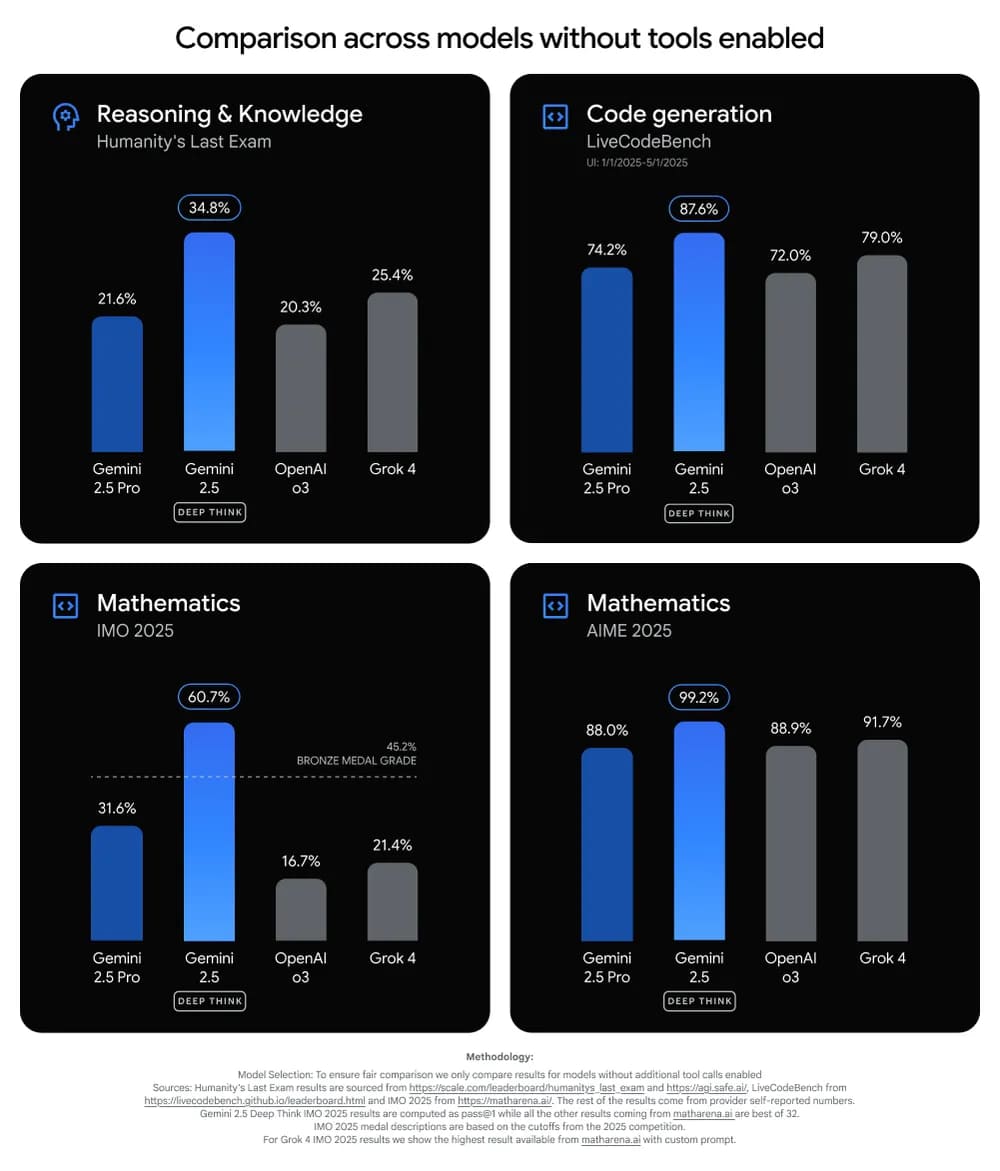
Other related facts show that Deep Think outperforms competitors in creativity and multi-step problem-solving and is designed to integrate with tools such as code execution and search.
Focus on Safety and Ethics
Google integrates safety throughout the development process. Deep Think has demonstrated better content safeguards and a more neutral tone than previous versions, although it sometimes refuses harmless requests. The team analyzes risks associated with increasing complexity and applies safeguards, with details available in the model card.
How Can You Start Using Deep Think Right Now?
For Google AI Ultra subscribers, Deep Think is available in the Gemini app—simply switch to the 2.5 Pro model and activate the feature in the toolbar. It supports tools such as Google Search and produces longer, more detailed responses, with a daily prompt limit. A version for testers will soon be available through the API.
This is a major step toward creating AI that helps advance knowledge discovery. Related updates suggest that Deep Think could soon expand into enterprise applications.


