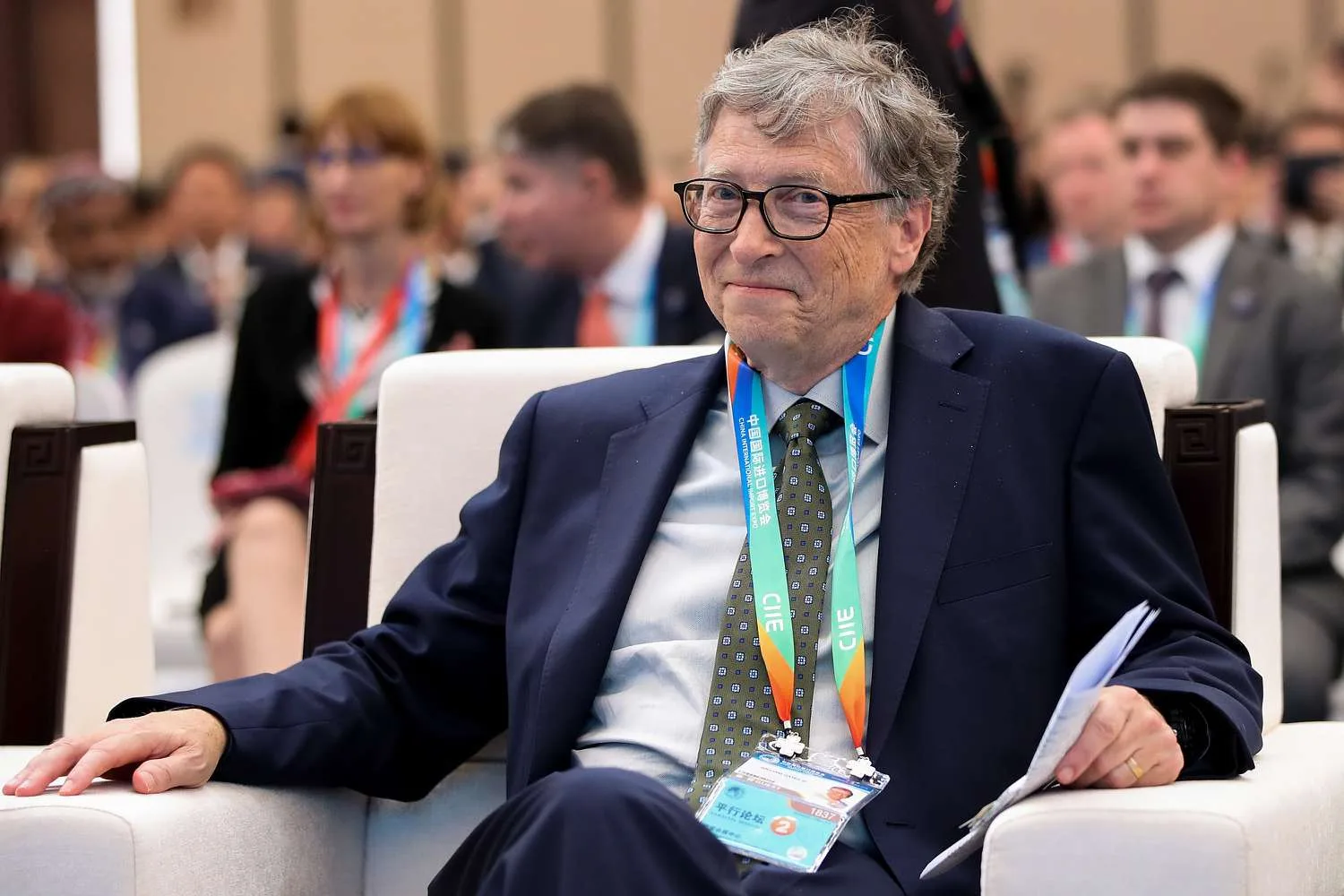
Bill Gates has published an extensive essay on artificial intelligence on his Gates Notes website titled “The turbulent AI era is here. The choices we make now are critical.” It is his first lengthy reflection on the subject in three years. He presents two proposals that have received little attention in the debate so far. The first is taxing robots and so-called tokens, which represent the actual operation of language models. The second is designating certain professions that should continue to be performed exclusively by humans. Gates refers to them as Human Reserved.
This time, everything will be different
The Microsoft founder bases his essay on a comparison with earlier technological breakthroughs in which he himself played a part. A computer in every home transformed people’s professional and personal lives. However, this transformation took decades because software had to be developed, prices had to fall, and people and companies had to learn how to use the new tools. According to Gates, artificial intelligence can replace human reasoning and quickly take over work in law, customer support, medicine, programming, and manufacturing. Increasingly capable robots could then compete with humans in construction and hospitality by the end of the decade.
At the same time, Gates does not spare politicians from criticism. In his view, there is little evidence that leaders, experts, and communities are paying sufficient attention to the problems ahead. There is no plan for entering the AI era. The government’s response would therefore have to be more extensive than the institutional changes made after the September 11, 2001 terrorist attacks.
Work that a machine can do but should not
Gates compares the idea of reserved professions to nature reserves. These are places where we could build houses and roads, but we do not because the loss would be too great. He wants to apply the same logic to the labor market.
He divides the reasons for protecting professions into two groups. The economic reason arises when the arrival of machines puts large numbers of people out of work who would find it difficult to retrain. You cannot tell a 55-year-old who has spent their entire life working in construction to go work in a nursing home and expect them to find it fulfilling. The second reason is purely emotional. In healthcare, a robot could technically inform a patient that they have an incurable disease, but according to Gates, it still should not do so.
Gates also shares a personal experience. His father received round-the-clock care before dying of Alzheimer’s disease in 2020. According to Gates, there was something irreplaceably human in the care provided by healthcare professionals that no robot could or should replace.
He considers childcare and jury service clear candidates for protection. However, he would not ban AI in education and healthcare. A protected profession in those fields would mean that a person uses artificial intelligence as an assistant to improve their performance. Protection would take two forms. Some roles would remain permanently reserved for people, while elsewhere it would involve temporary protection for workers nearing the end of their careers, for whom retraining is unrealistic. He has tried to calculate how much work could be preserved in this way. In the most extreme scenario, he arrived at a ceiling of around 40 percent of jobs and, in his own words, could not get any higher.
A tax on robots and tokens
The second proposal targets tax laws. An employer pays payroll taxes for a new employee, while the purchase of a robot can usually be written off immediately as a business expense. The tax system thus incentivizes companies to replace people with machines. According to Gates, a special tax would slow the shift away from human labor. It would also provide money for retraining and strengthening the social safety net. However, it would have to be designed so as not to hinder beneficial uses of AI, such as making medicines and education more affordable.
Governments will also need the money for fiscal reasons. A decline in the number of working people will reduce tax revenues, while demand for welfare benefits and retraining will increase. Gates’s essay was also published shortly after U.S. national debt surpassed $40 trillion. Gates adds that support must be directed toward those who need it most. That means people who have lost their jobs or part of their income because of automation, as well as the regions most severely affected.
Three risks described by Gates
The first risk is the permanent disappearance of jobs. Young people will suffer the most as entry-level positions vanish. According to Gates, telephone and online customer support, software development, and paralegal work will be the first to disappear. Construction and hospitality will then shift toward robots by the end of the decade.
The second problem is that fraudsters and criminals will become more powerful. Artificial intelligence will enable even people with minimal skills to attack individuals, companies, and governments. This will include fraud, disinformation, deepfakes, and surveillance. Gates also places bioterrorism in this category. The technology used to develop medicines will also make it easier to design new deadly diseases.
Third, Gates recalls that as a child he had to work hard on his social skills. He doubts that he would have made the same effort if he had had an artificial companion at hand. These applications speak exactly as a person wants them to, never get angry, and never push them anywhere. As a result, they can be addictive and deprive people of real-life experiences of interacting with others.
The positive benefits of technology
Gates remains optimistic about the benefits of AI in healthcare, education, and agriculture. He also highlights its use in public administration. Families often get lost in applications for student loans, health insurance, or food assistance. Artificial intelligence could greatly simplify these processes. If such relief affects millions of lives, it will have an enormous impact. The essay itself states that AI will either be the greatest equalizer of opportunity in history or the greatest source of injustice.
What politicians must ensure
Gates wants governments to act immediately rather than wait for market solutions. He proposes three steps. The first is the creation of new domestic and international institutions to guide the transition to artificial intelligence. The second is the introduction of protected professions so that machines do not replace people without good reason. The third step is to adjust taxes so that it is not profitable for companies to replace employees with robots and AI. Gates also calls for international coordination, including with China. However, he points to difficult questions about who will decide which professions are protected and how to respond if some countries permit full automation. He himself describes the probability that the entire transition will go badly as very high.
Criticism of Gates
Gates first proposed a tax on robots about ten years ago and faced harsh criticism for it. Former U.S. Treasury Secretary Larry Summers wrote in 2017 that Gates was seriously mistaken and that such taxation risked sliding into protectionism that would hinder progress. Robert Seamans of NYU Stern argued at the time that the tax would discourage companies from investing. This would reduce economic growth and, in industries where machines complement people, would lead to less hiring and slower wage growth. Gates is familiar with these objections. He responds by saying that critics fail to account for the broader value of work to both individuals and society. In his view, accelerated innovation will allow us to afford a little inefficiency as the price of maintaining employment.
For now, the public is largely on his side. According to a Pew Research survey from August 18, 71 percent of American adults believe that AI will reduce the number of jobs over the next two decades, compared with 64 percent in 2024. Only five percent expect there to be more jobs. Among young people, 73 percent of respondents expect worse career prospects.
Many questions remain unanswered. These include which professions would fall into the protected category, who would decide, what would prevent companies from circumventing the rules, and how countries would protect their domestic labor markets from full automation abroad. The website TechCrunch adds that both proposals would significantly affect the profits of major AI labs, which may be why they have received little attention so far TechCrunch. Gates himself also leaves the door open in his essay to slowing development. He considers the open letter Pacing the Frontier, in which industry employees call for restraint, a good idea, but doubts its long-term sustainability.
Sources: theguardian.com and fortune.com