

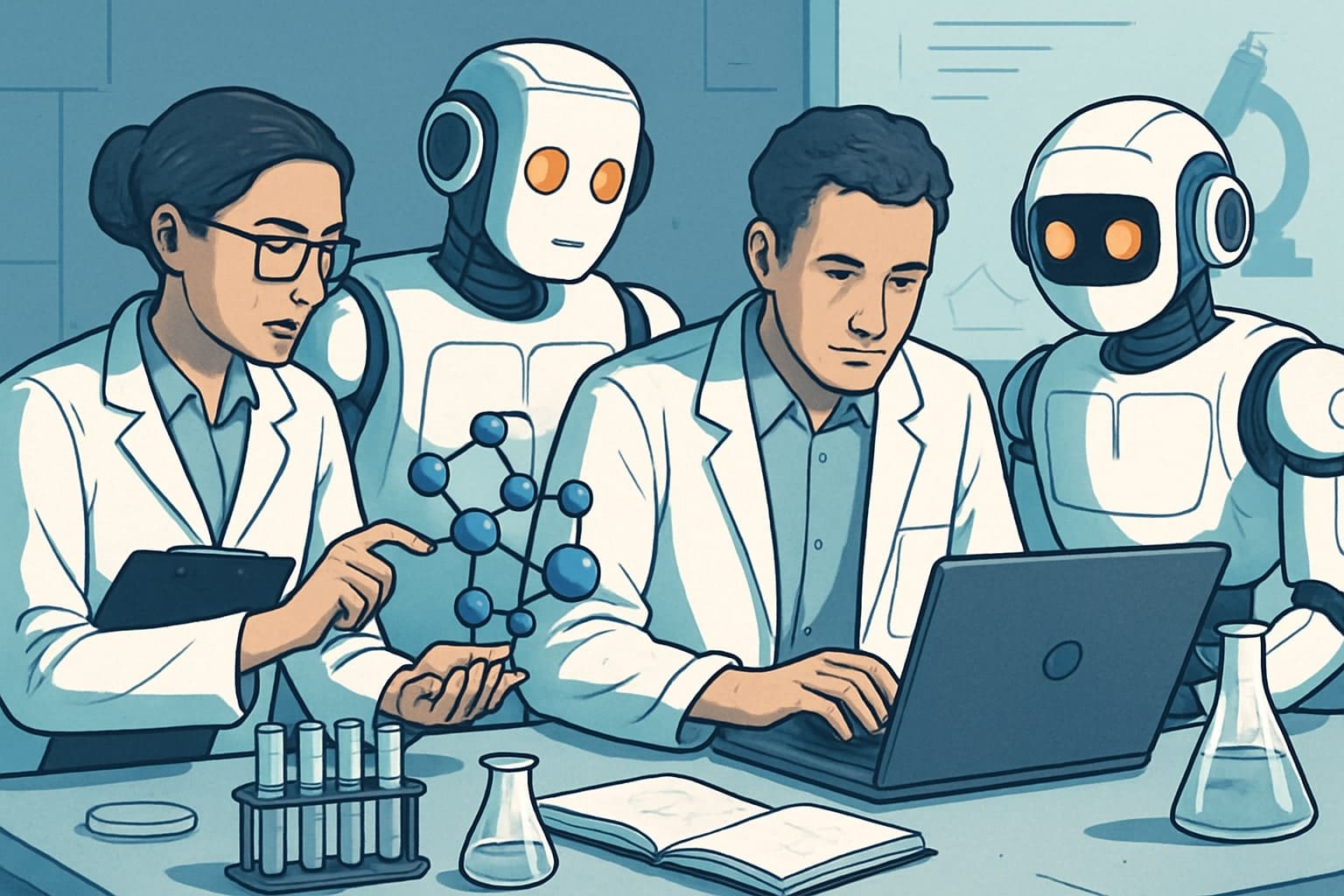
FutureHouse Introduces AI Agents to Accelerate Scientific Research
In May 2025, the nonprofit organization FutureHouse, founded by former Google CEO Eric Schmidt, introduced a new platform featuring "superintelligent" AI agents focused on scientific research. This publicly available platform offers four specialized AI tools designed primarily to accelerate research in biology, chemistry, and related scientific fields.
Four Specialized AI Agents
FutureHouse introduced a quartet of AI agents, each with a unique focus:
- Crow - specializes in rapid searches of the academic literature. It can quickly answer technical questions using freely available scientific articles. It is optimized for concise API responses, making it ideal for quick queries and integration into research workflows.
- Falcon - focuses on in-depth literature searches. This agent can synthesize information from hundreds of full-text articles and from specialized databases such as OpenTargets. The result of its work is comprehensive overviews that would take human researchers much longer to produce.
- Owl - specializes in detecting precedents and research novelty. Its main task is to determine whether specific experiments or topics have already been explored, thereby helping researchers avoid redundant work and focus on genuinely uncharted areas.
- Phoenix - focuses on chemical research. It designs new compounds, predicts chemical reactions and their outcomes, verifies synthetic procedures, and analyzes costs. It is an invaluable assistant for researchers in organic chemistry and related fields.
Unique Platform Features
According to official information from FutureHouse, the platform is characterized by several key features:
- Access to high-quality data: The agents use an extensive corpus of open-access scientific articles as well as proprietary databases. This allows them to automate complex workflows in chemistry and biology that require deep specialized knowledge.
- Transparent reasoning: Each agent uses multistep reasoning processes. Users can follow how conclusions were reached step by step, increasing trustworthiness compared with "black box" models.
- Automated research processes: Using the API, researchers can connect multiple agents and automate tasks such as continuous literature monitoring or contextualizing experimental results at scale.
Eric Schmidt, founder of FutureHouse, said in an official statement: "Our goal is to democratize access to advanced AI tools for scientific research. We believe these tools can significantly accelerate scientific discoveries in critical areas."
Potential Applications
The platform offers a wide range of applications for scientific research: Identifying unexplored mechanisms in disease pathways, Systematically searching for contradictions or gaps in existing research, Critically analyzing experimental methods beyond abstracts, Designing new drug compounds with constraints related to novelty or cost-effectiveness, Planning organic synthesis routes with real-time cost analysis (Phoenix).
Critical Perspectives on AI in Scientific Research
Although FutureHouse presents its platform as groundbreaking, some academics have expressed concerns about the growing trend of using AI in scientific research. According to a March 2025 TechCrunch article, some scientists criticize AI startups for using the peer-review process for marketing purposes. Professor Catherine Raymond of MIT said in an interview with TechCrunch: "There is a worrying trend in which companies present preliminary results as groundbreaking discoveries without proper scientific validation. This can undermine the integrity of the scientific process." Other critics point out that despite the impressive capabilities of these AI tools, significant limitations remain. FutureHouse's AI agents have not yet independently produced any major new discoveries, and experts remain cautious about claims that the current generation of AI can fully replace the human intuition or creativity necessary for genuine scientific breakthroughs.
FutureHouse states that its tools outperform researchers with PhDs on some tasks – according to its benchmarks, they provide more accurate results than other leading models. These tools are apparently already being used for rapid hypothesis generation and data analysis. Dr. Michael Chen, head of the research team at FutureHouse, told TechCrunch: "Our AI agents are not designed to replace scientists, but to enable them to focus on more creative and intellectually demanding aspects of research. Routine but labor-intensive tasks such as literature reviews can be significantly accelerated." The FutureHouse platform is now publicly available through both a web interface and an API, enabling integration into research workflows at scale. The organization plans to continue developing its tools and adding new features based on feedback from the scientific community.


