

Today, as the global economy is shaken by tariff wars and rising costs, China is turning to artificial intelligence (AI) and robots to maintain its position as the world’s largest manufacturing powerhouse. These technologies are already transforming factories and ports across the country.
Why is China rushing to adopt AI in factories?
China faces major challenges: its population is shrinking, young people are avoiding factory work, and foreign tariffs imposed by President Trump threaten exports. The average wage in Chinese factories is now much higher than in countries such as India, and the shortage of skilled workers could reach as many as 30 million people. The country is therefore focusing on AI, which makes it possible to produce more goods faster, more cheaply, and with fewer workers.
In 2024, China installed 295,000 industrial robots, nearly nine times more than the US and more than the rest of the world combined. The total number of operational robots in China exceeded two million, a world record according to the International Federation of Robotics. Of the 131 factories recognized by the World Economic Forum as leaders in the use of technologies such as AI, 45 are in mainland China, while only three are in the US.
Leading figures such as Hu Wangming, chairman of one of the largest steel conglomerates, emphasize that adopting AI is essential. His company Baosteel, which is listed on the Shanghai Stock Exchange, had identified 125 ways to use AI by the end of last year and plans to reach 1,000. Zhang Yunming, vice minister of industry and information technology, said that adopting AI is "a mandatory task, not an optional one."
For President Xi Jinping, strong factories are the key to a strong economy that enhances national power in competition with the US. Manufacturing accounts for a quarter of China’s gross domestic product in value-added terms, far above the global average. The risk is that AI will destroy more jobs than expected, but Chinese leaders believe that the declining population – which is expected to fall by 200 million people over the next three decades – will offset this and increase productivity without increasing unemployment.
Examples from factories
One example is Midea, one of the world’s largest manufacturers of home appliances, which competes with companies such as Whirlpool and LG Electronics. At its washing machine factory in Jingzhou, a city of five million people on the Yangtze River, AI functions as the "factory brain," managing the entire operation like a central nervous system.
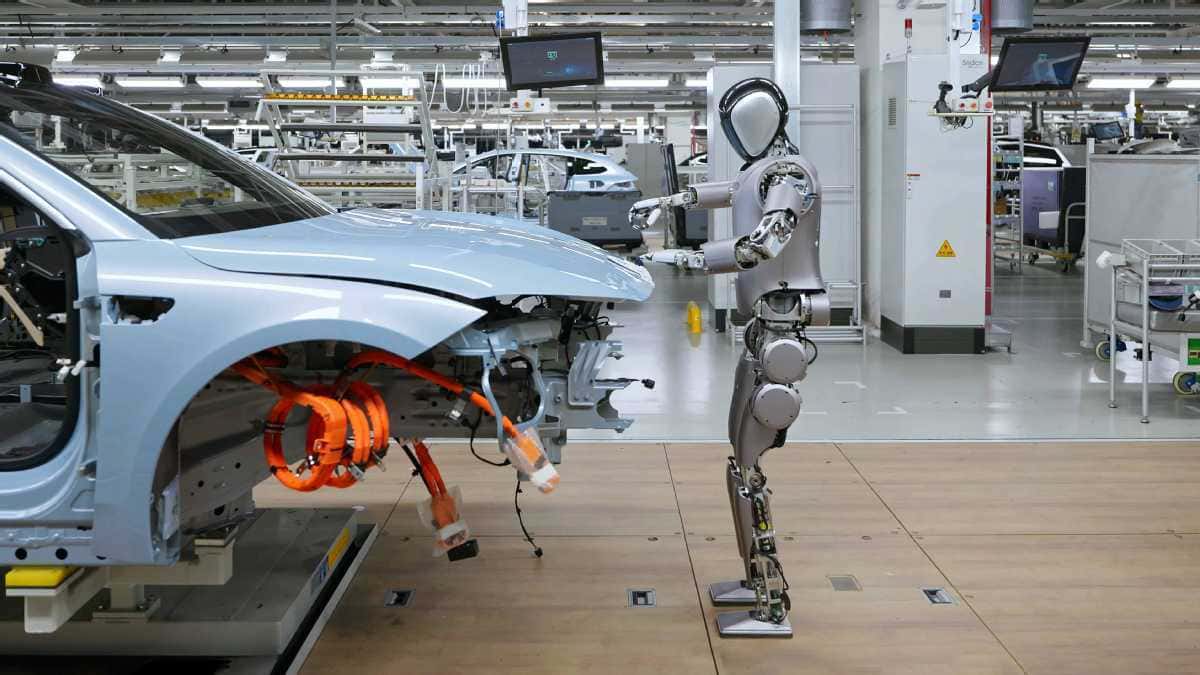
Midea acquired the German robotics company Kuka nearly a decade ago, and today its robots operate under the supervision of this AI system. The brain manages 14 virtual agents that communicate with one another to find the best way to perform tasks and send commands to robots on the factory floor. Humanoid robots carry pressed components for inspection, where a 3D camera checks their quality. If something fails, the AI system finds a solution.
On the dryer assembly line, AI identifies the model and ensures that robots tighten the screws correctly, providing flexibility similar to human labor and increasing productivity. The workers who remain wear AI glasses that detect errors based on inspection history – processes that used to take 15 minutes now take 30 seconds. As a result, revenue per employee at Midea rose by nearly 40% between 2015 and 2024.
Xi Wei, director of Midea’s humanoid robotics center, who holds a doctorate from the University of Maryland and lived in Silicon Valley, explains: "You feed it data and let AI figure it out." The Jingzhou factory is a step toward "dark factories," where everything runs around the clock with minimal lighting.
Another example is Bosideng, a winter jacket manufacturer founded by billionaire Gao Dekang in the 1970s with a team of 11 villagers. Today, the company has annual revenue nearly four times higher than the Canadian brand Canada Goose. In partnership with Zhejiang University, it launched its own AI model for creating designs and virtual clothing. The first AI-designed jacket went on sale last year, and the time required to produce a sample fell from 100 days to 27 days, while development costs decreased by 60%.
At Conch Group’s cement plant in Wuhu, about 320 kilometers west of Shanghai, the company is working with Huawei on AI tools. Conch, which supplied cement for projects such as the Three Gorges Dam and the Burj Khalifa skyscraper in Dubai, uses AI to predict the strength of clinker more accurately – a key cement component produced by heating limestone at high temperatures.
The AI model predicts clinker strength with an accuracy of more than 85%, compared with 70% for manual estimates, making it possible to adjust raw material ratios and avoid defective products. Along miles of conveyor belts, AI monitors malfunctions and helps the company respond more quickly. The result? A 1% reduction in coal consumption, representing annual savings of nearly CZK 6.9 million on a single production line. By the end of 2026, the company is targeting a 2% reduction, which, if expanded across the entire company, could save tens of millions of dollars annually, equivalent to hundreds of millions of Czech korunas.
Development was not easy – it required a great deal of trial and error, underscoring that AI is being implemented gradually.
AI in ports: Faster exports without people
Xi Jinping places particular emphasis on modernizing ports, which are crucial to China’s manufacturing dominance. At the Port of Tianjin, one of the country’s largest, operators are working with Huawei on a fleet of autonomous trucks and the OptVerse AI Solver system, which optimizes millions of variables, such as ship arrival times and crane capacity.
Planning that used to take 24 hours now takes 10 minutes. Last year, they launched PortGPT, an AI model developed with Huawei that analyzes videos and images and could replace human security officers. Half of the world’s 20 most efficient ports by vessel turnaround time are in mainland China, including Tianjin, according to the World Bank and S&P Global Market Intelligence.
Yang Jiemin, vice president of the state-owned company behind the port, says automation reduces staffing requirements by 60% compared with traditional ports. More than 88% of large container-handling equipment is automated. China’s advantage? No independent unions to slow down changes – unlike in the US, where unions such as the International Longshoremen’s Association negotiated a ban on full automation through the end of 2030.
In Tianjin, a video for visitors ends with the words: "We are the future."
This development is helping China counter threats such as US export controls on chips. Companies such as Huawei are developing their own models, including Pangu, and surveys show that 83% of Chinese people view AI as beneficial, twice the share in the US. Zhao Yueling contributed to the article.


