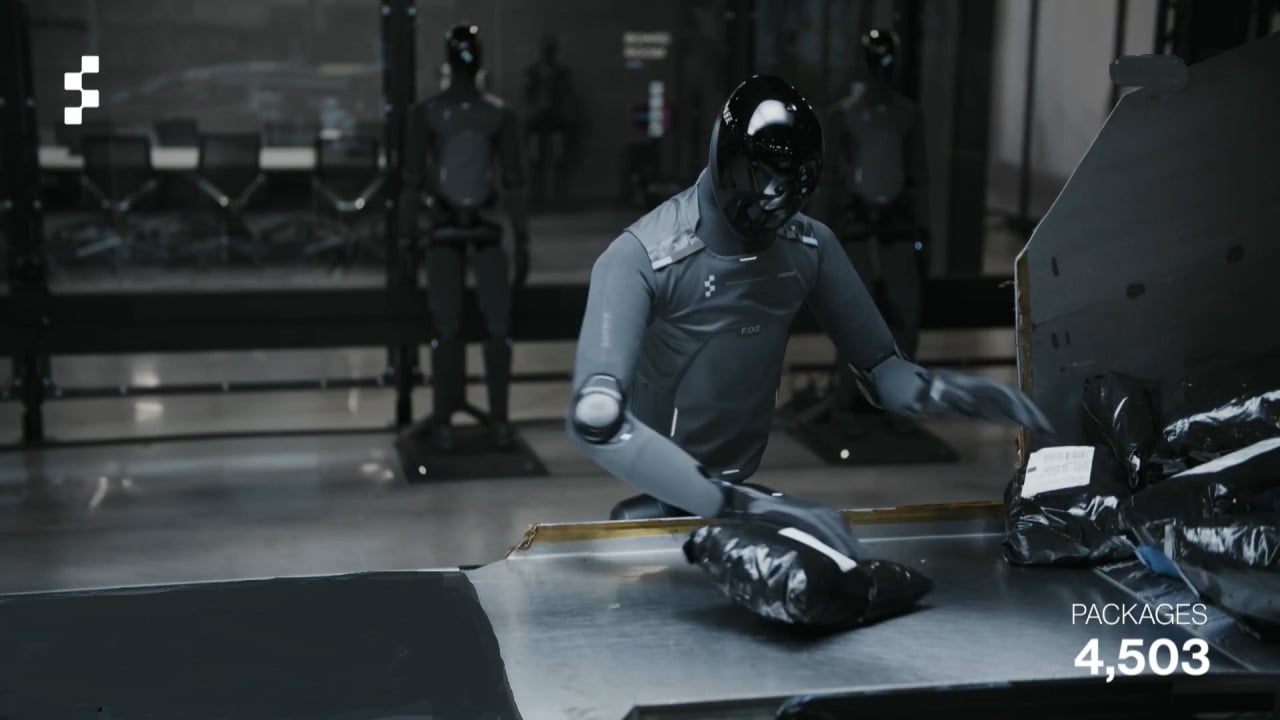
American robotics company Figure AI broadcast a live stream watched by millions of people around the world. On screen were robots sorting packages in a real warehouse for eight hours straight without any human intervention.
The live stream on the X platform garnered more than 10 million views. The broadcast ultimately ran for more than 14 hours. Brett Adcock, founder and CEO of Figure AI, commented on the event: “Watch a team of humanoid robots begin a full 8-hour shift at human performance levels. Fully autonomous, running on the Helix-02 system.” This achievement is the result of years of development and hundreds of thousands of lines of code.
The challenge that triggered the live stream
The idea for the eight-hour live stream arose from an argument online. Robotics industry veteran Scott Walter publicly stated that humanoid robots would be useless until they could make it through an entire work shift without human assistance. Adcock replied that Figure does this every day. And he promised to show it live. The camera crew was reportedly contacted that same evening.
This turned an internal technical demonstration into a public test. Adcock himself admitted that previous tests had shown robots performing the same task for one hour, while with an eight-hour broadcast there was “a high chance that something would go wrong.”
It was a simple task: scan the barcode on a package, pick it up, and place it barcode-side down on a conveyor belt so that a scanner farther down the line could read it. The average time per package was three seconds, the same as for a human.
Behind this result is the Helix-02 model, a unified neural network that controls the robot’s entire body. There are no separate modules for walking, balance, and manipulation. It is a complex system that processes input from cameras on the head, cameras on the palms, tactile sensors on the fingertips, and sensors throughout the body. Everything is translated directly into movement. The robots also do not require cloud computing. Everything runs locally, directly on the robot.
The robots handle their own failures
This was precisely what surprised observers the most. According to official specifications, the Figure 03 has a battery life of around five hours. An eight-hour shift therefore could not be completed by a single robot. Figure consequently deployed a team of robots with an autonomous rotation strategy. When one robot’s battery falls below a certain level, it requests a replacement on its own. Another machine took its place at the conveyor belt without any human intervention.
What happens when a robot detects a technical fault? It diagnoses itself and walks to the maintenance area, where it requests a replacement unit. Production continues in the meantime.
How the Helix-02 model works
To clarify what Helix-02 actually is: it is not merely a software update, but a fundamental overhaul of how the robot moves and thinks.
The original Helix, introduced in 2025, could control the robot’s upper body using a neural network. Helix-02, launched this January, extends this control to the entire body. Walking, balance, and fine manipulation all function as one seamless system.
At the heart of it all is the so-called System 0, a learned whole-body controller trained on more than 1,000 hours of human motion data and enhanced with a sim-to-real transfer technique. System 0 replaced exactly 109,504 lines of hand-written C++ code with a single neural network. Adcock said: “We could never have accomplished a quarter of what you saw today with code-based heuristics.”
Essentially, this means that the robot moves more naturally, responds more flexibly to unexpected situations, and can handle tasks that were previously impossible. These include unscrewing bottle caps, precisely dispensing liquid from a syringe, or using touch to retrieve small, irregular objects from a crowded bin.
Figure 03 and the plan for continuous operation
Figure AI already has experience with real-world industrial deployments. The previous generation of the robot, Figure 02, was tested at the BMW Group plant in Spartanburg, South Carolina. The robots worked 10-hour shifts, moved more than 90,000 parts, and supported production associated with more than 30,000 BMW vehicles. After the eleven-month deployment, the team identified the wrist as the weakest point. It worked on addressing the issue in the new generation.
The current model, Figure 03, stands approximately 170 cm tall, weighs 61 kg, and can carry loads of up to 20 kg. Its maximum movement speed is 1.2 meters per second.
However, the company’s long-term goal is even more ambitious than an eight-hour shift: continuous operation 24 hours a day, 7 days a week. Figure AI has reportedly already achieved 24 hours of uninterrupted autonomous operation, which the company itself described as “uncharted territory”.
Figure AI is also developing robots for the home. On its figure.ai website, the company states that Figure can perform household chores such as laundry, cleaning, and washing dishes completely autonomously. The Helix system allows the robot to learn and adapt to the changing environment of an ordinary apartment or house.
Figure AI currently has a valuation of 39 billion dollars. Figure’s direct competitors include Tesla with its Optimus robot, Agility Robotics, and Apptronik. Chinese companies AgiBot and Unitree together account for an estimated 58% of current humanoid robot deployments worldwide. Meanwhile, Chinese manufacturer AGIBOT has surpassed 10,000 units delivered, with half of them delivered in just three months.
Sources: interestingengineering.com, faithtechate.com and techradar.com