

Demis Hassabis, CEO of Google DeepMind, and Koray Kavukcuoglu, CTO of Google DeepMind and Chief AI Architect at Google, speak on behalf of the Gemini team. Today, they are taking another major step toward AGI (artificial general intelligence) and releasing Gemini 3.
It is the world’s best model for multimodal understanding (processing text, images, video, audio, and code) and the most powerful agentic and vibe coding model. It delivers richer visualizations and deeper interactivity, all built on state-of-the-art reasoning. The Gemini 3 era begins with the release of Gemini 3 Pro in preview, available immediately in Google products for learning, creating, and planning. They are also introducing Gemini 3 Deep Think—an enhanced reasoning mode that pushes performance even further—and giving safety testers access before releasing it to Google AI Ultra subscribers.
State-of-the-art reasoning with depth and nuance
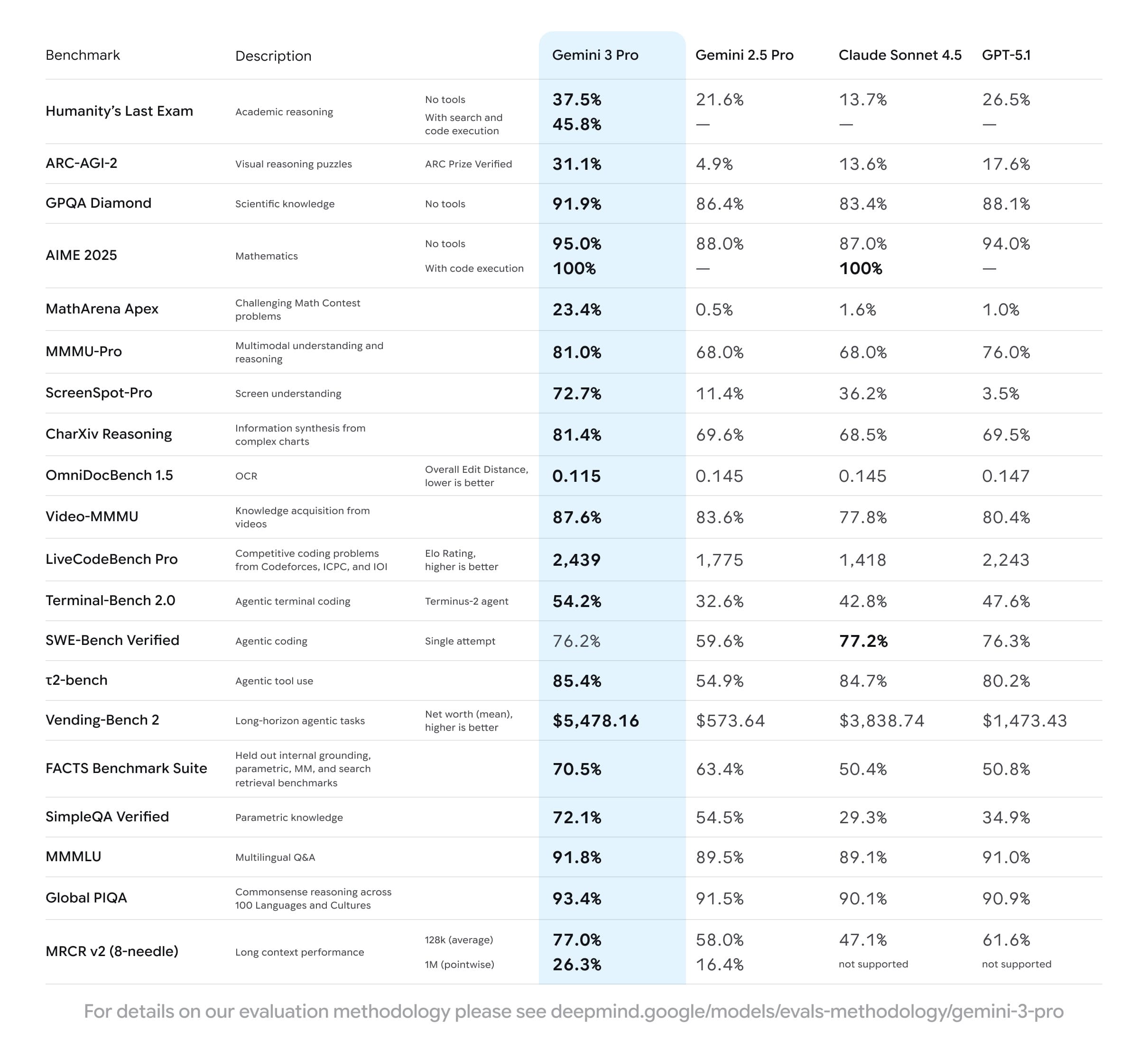
Gemini 3 Pro brings ideas to life through state-of-the-art reasoning and multimodal capabilities. It significantly outperforms 2.5 Pro across all major AI benchmarks. It topped the LMArena leaderboard with a breakthrough score of 1501 Elo. It demonstrates PhD-level reasoning with the highest scores on Humanity’s Last Exam (37.5% without tools) and GPQA Diamond (91.9%). It sets a new standard in mathematics with 23.4% on MathArena Apex.
Beyond text, it redefines multimodal reasoning with 81% on MMMU-Pro and 87.6% on Video-MMMU. It achieves 72.1% on SimpleQA Verified, representing major progress in factual accuracy. Gemini 3 Pro can therefore solve complex scientific and mathematical problems with high reliability.
It brings a new level of depth and nuance to every interaction. Its responses are smart, concise, and direct, offering genuine insight instead of clichés—telling you what you need to hear. It works as a true thinking partner, providing new ways to understand and express information, from explaining complex scientific concepts by generating code for visualizations to creative brainstorming.
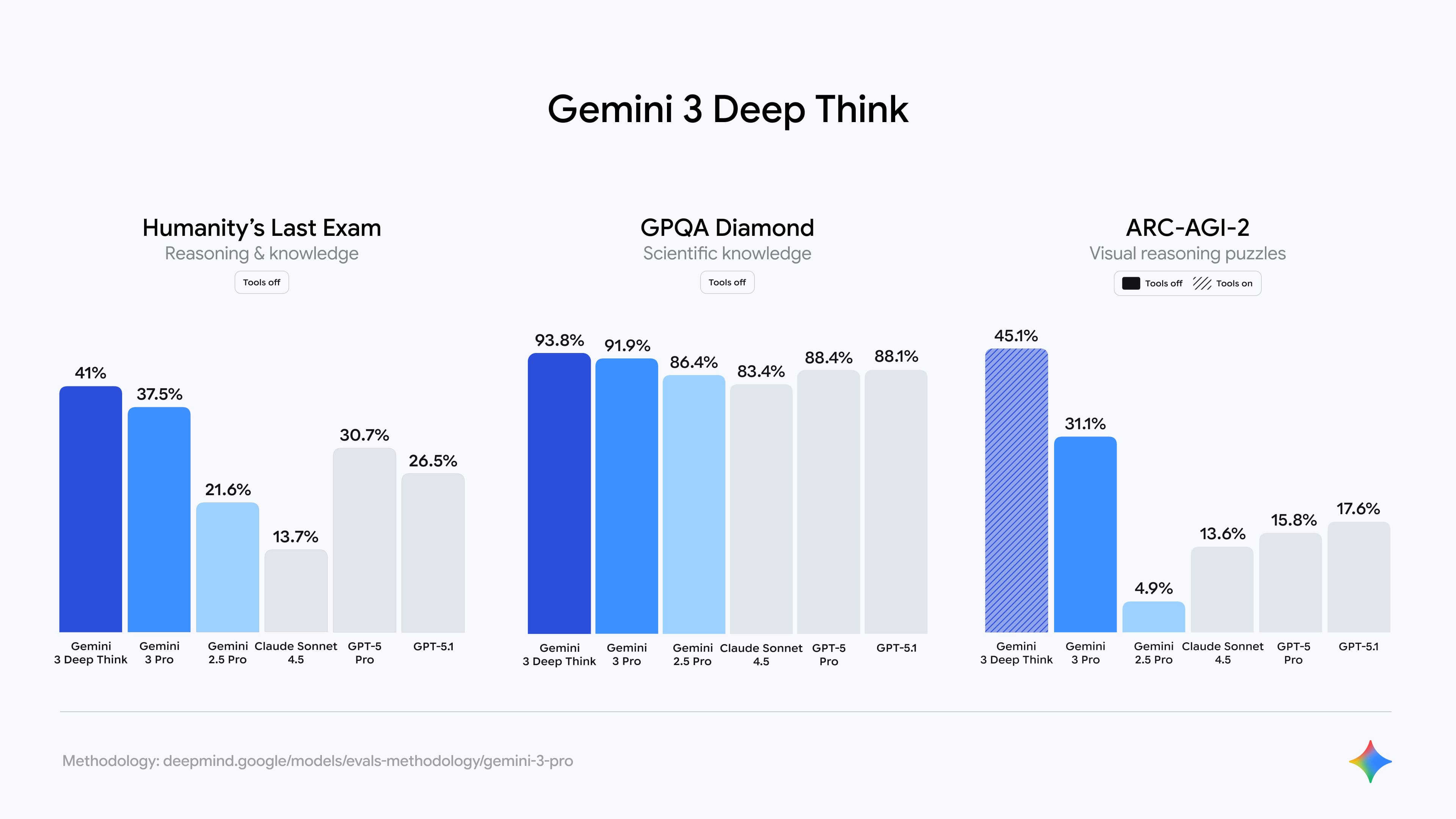
Gemini 3 Deep Think pushes the boundaries of intelligence even further, delivering a step change in reasoning and multimodal understanding for solving more complex problems. In tests, it outperforms Gemini 3 Pro on Humanity’s Last Exam (41.0% without tools) and GPQA Diamond (93.8%). It achieves 45.1% on ARC-AGI-2 (with code execution, ARC Prize Verified), demonstrating its ability to solve novel challenges.
Gemini 3 helps you learn, create, and plan
From the beginning, Gemini was built to synthesize information on any topic across different modalities. Gemini 3 advances multimodal reasoning to help you learn in ways that suit you by combining state-of-the-art reasoning, vision, spatial understanding, multilingual performance, and a context window of 1 million tokens (units of data).
For example, if you want to cook according to a family tradition, Gemini 3 can decipher and translate handwritten recipes in different languages into a shared family cookbook. Or, when exploring a new topic, it can take academic papers, long video lectures, or tutorials and generate code for interactive flashcards, visualizations, or other formats to help you master the material. It can even analyze a video of your pickleball match, identify areas for improvement, and create a training plan for your overall fitness.
To help you better understand information from the web, AI Mode in Search now uses Gemini 3 for new generative UIs (user interfaces), such as immersive visual layouts and interactive tools and simulations, all generated based on your query.
For creation, it builds on the success of 2.5 Pro and fulfills the promise of bringing developers’ ideas to life. It excels at generating from scratch and handles complex prompts to create richer, more interactive web UIs. It is the best vibe coding and agentic coding model—making products more autonomous and increasing developer productivity. It topped the WebDev Arena leaderboard with 1487 Elo. It achieves 54.2% on Terminal-Bench 2.0, which tests the ability to use tools to control a computer through a terminal, and significantly outperforms 2.5 Pro on SWE-bench Verified (76.2%), a benchmark for coding agents.
You can now create with Gemini 3 in Google AI Studio, Vertex AI, Gemini CLI, and the new Google Antigravity platform. It is also available on third-party platforms such as Cursor, GitHub, JetBrains, Manus, Replit, and others.
A new platform for agentic development
With the rapid growth of the Gemini 3 model’s intelligence comes an opportunity to redefine the developer experience. Today, they are releasing Google Antigravity, a new agentic development platform that enables developers to work at a higher, task-oriented level.
It uses Gemini 3’s advanced reasoning, tool use, and agentic coding capabilities to transform AI assistance from a tool into an active partner. At its core, Google Antigravity is a familiar AI IDE (integrated development environment), but agents have their own dedicated interface and direct access to the editor, terminal, and browser. Agents can now autonomously plan and execute complex, end-to-end software tasks simultaneously while validating their own code.
In addition to Gemini 3 Pro, Google Antigravity is integrated with the latest Gemini 2.5 Computer Use model for browser control and the state-of-the-art Nano Banana image editing model (Gemini 2.5 Image).
Since the launch of the agentic era with Gemini 2, progress has been made in both coding agents and longer-horizon planning. Gemini 3 demonstrates this by topping the leaderboard on Vending-Bench 2, which tests long-term planning through the management of a simulated vending machine business. Gemini 3 Pro maintains consistent tool use and decision-making throughout the simulated year, leading to higher returns without straying from the task.
This means Gemini 3 can provide better assistance in everyday life. By combining deeper reasoning with better, more consistent tool use, it can take actions on your behalf across complex, multi-step workflows—such as booking local services or organizing your inbox—all under your control.
Google AI Ultra subscribers can try these agentic capabilities in the Gemini app with Gemini Agent right now. The capabilities will soon expand to other Google products.
Building safely with Gemini 3
Gemini 3 is the safest model yet and has undergone the most comprehensive safety evaluations of any Google AI model. It has reduced sycophancy (flattery), greater resistance to prompt injections, and better protection against misuse for cyberattacks.
And this is only the beginning of the Gemini 3 era. Starting today, Gemini 3 is rolling out: to everyone in the Gemini app and to Google AI Pro and Ultra subscribers in AI Mode in Search; to developers through the Gemini API in AI Studio, Google Antigravity, and Gemini CLI; and to businesses through Vertex AI and Gemini Enterprise.
For Gemini 3 Deep Think, they are taking extra time for safety evaluations and input from testers before releasing it to Google AI Ultra subscribers in the coming weeks. They plan to release additional models in the Gemini 3 series soon so that people can do more with AI.
A note from Google’s CEO
Now comes Gemini 3, the most intelligent model yet, bringing together all of Gemini’s capabilities to bring any idea to life. It is state-of-the-art in reasoning and understands depth and nuance—whether that means subtle cues in a creative idea or breaking down the complex layers of a problem. It better understands the context and intent of a request, so you get what you need with fewer prompts. In two years, AI has evolved from reading text and images to reading the room.

Starting today, Gemini 3 is being deployed across Google products at scale. This includes AI Mode in Search with more sophisticated reasoning and new dynamic experiences. For the first time, Gemini is coming to Search on day one. It is also coming to the Gemini app, to AI Studio and Vertex AI for developers, and to the new Google Antigravity agentic development platform. Gemini 3 pushes the boundaries, and in this new chapter they will continue advancing intelligence, agents, and personalization to make AI truly useful for everyone.


