

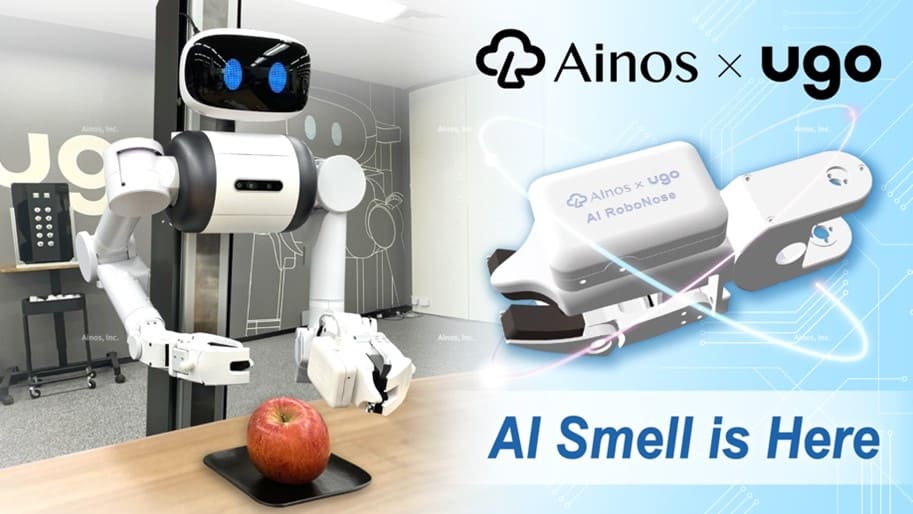
Ainos and UGO Breakthrough Opens a New Era of Intelligent Robots
Humanoid robots can now perceive the world similarly to humans – including smells.
In 2025, something many considered a distant future became a reality: a robot capable of sensing smells just like a human. Ainos and UGO have created a world first – the first commercially deployed humanoid robot equipped with fully functional digital olfaction. This technological breakthrough pushes the boundaries of artificial intelligence and drastically expands the potential of robots for everyday use.
From Tentative Attempts to Digital Olfaction
While the human sense of smell is a complex system capable of distinguishing thousands of different odors, transferring it into the digital world has long been a challenge. Previous attempts to create "electronic noses" worked reliably only under laboratory conditions. What makes the AI Nose technology unique worldwide is precisely that it operates continuously and reliably in real-world environments. "Electronic olfaction is much more complex than the other artificial senses," explains Aaron Hsu, CEO of Ainos. "While a camera captures visible light in three basic colors, odors are composed of dozens of volatile organic compounds at different concentrations. This represents a much more complex challenge for data processing." Ainos developers had to solve a problem that had troubled scientists for decades. Traditional gas detection technologies were either too specific (focused on one particular substance) or insufficiently sensitive for practical use under changing conditions. The revolutionary solution was to combine state-of-the-art gas sensors with advanced machine-learning algorithms.
How Exactly Does Robotic Olfaction Work?
The AI Nose technology uses a network of specialized sensors that detect volatile organic compounds (VOCs) and other chemical substances in the surrounding air. When gas molecules interact with the surface of the sensors, electrochemical reactions occur, generating electrical signals. These signals are immediately collected and analyzed using sophisticated machine-learning algorithms. The system then identifies specific patterns in the data that correspond to particular odors – creating what are known as "Smell IDs" (odor identifiers). "Just like a fingerprint, every odor is unique," explains Dr. Linda Chen, Ainos' lead researcher. "Our system has been trained on thousands of different odor signatures and can identify them with an accuracy exceeding 98%, even in environments with many interfering factors." A fundamental improvement over previous attempts is the ability to learn and adapt. AI Nose continuously improves its "odor library" based on new experiences, enabling it to refine detection and classification even for previously unknown odors.
A Partnership That Changed Robotics
The integration of this technology into humanoid robots was made possible through a partnership with UGO, a leading manufacturer of advanced robotic systems. Together, the companies developed a miniaturized version of AI Nose that can be elegantly built into the robot's structure. "Olfaction was the key missing link in robotic perception," said Ken Matsui, CEO of UGO. "By integrating AI Nose, we are giving our robots the missing sense that will fundamentally change the way they move and interact with the real world." The technological breakthrough is the result of more than four years of intensive research and development. Researchers had to overcome a number of obstacles, including miniaturizing the sensory system, optimizing energy consumption, and creating an algorithm capable of operating in real time directly within the robot without the need for a constant connection to cloud servers.
A Revolution Across Many Industries
The new technology will find applications in a wide range of fields and significantly expand the capabilities of robots:
- Industrial Safety
Robots equipped with AI Nose can detect gas leaks or anomalous chemical substances much earlier than humans or traditional sensors. This can save lives during industrial accidents or chemical leaks. It is particularly valuable in environments where concentrations of hazardous substances may be below the detection threshold of conventional sensors but still pose a health risk during prolonged exposure. - Healthcare
In hospitals and care facilities, robots with digital olfaction can monitor hygiene conditions, detect signs of infections, or track air quality. Research even suggests possibilities for the early diagnosis of certain diseases, such as the early stages of Parkinson's disease, diabetes, or various types of cancer, which manifest through specific odor signatures. - Home Assistants
In homes, robots can check the freshness of food, detect mold, identify pollutants in the air, or recognize dangers such as leaking gas or a developing fire. This opens up a new dimension of care for seniors and people with disabilities. - Public Safety
At airports, train stations, and other public places, robots with AI Nose can identify potentially hazardous substances, explosives, or other security threats. In addition, they can monitor air quality and contribute to protecting public health.
"Adding the sense of smell to robots changes the paradigm of what these machines can do," explains Matsui. "It is as if a blind person suddenly began to see – they gain an entirely new channel of input about the world around them."
Real-World Deployment
The first commercial deployments of AI Nose technology are already underway in industrial and commercial buildings. It is expected to become a standard component of advanced home assistants and service robots over the next 2-3 years. For ordinary users, this means their household robots will be able to provide much more comprehensive services – from alerting them to spoiled food in the refrigerator to detecting mold behind walls that cannot be detected by the human sense of smell but may cause health problems.
Technological Challenges
Despite all the advances, many challenges remain for developers. One of them is further miniaturization and reduction of energy consumption, which would enable the technology to be deployed in smaller devices such as mobile phones or wearable electronics. "Our goal is to create a universal solution for odor detection that would be available at various scales and price points," explains Hsu. "From industrial applications and home robots to personal electronics." A robot capable of analyzing odors could theoretically also obtain sensitive information about people's health, lifestyles, or activities.
A Future with Robots That "Feel"
Ainos and UGO plan to expand the capabilities of AI Nose in the coming years. One of the goals is to create a global "odor library" – an extensive database of digital odor signatures that would enable even more accurate odor identification and classification. Another area of research is the development of much more sensitive sensors capable of detecting odors at levels of several parts per billion – similar to the most sensitive animals on Earth. "We are only at the beginning of the journey," Hsu concludes. "In ten years, digital olfaction technologies will be as common as smartphone cameras are today. They will change the way we perceive and interact with the world around us."
The breakthrough in robotic olfaction represents one of the most significant advances in robotics of the past decade. By integrating Ainos' AI Nose into UGO humanoid robots, these machines are gaining an ability previously reserved only for living organisms. This technology not only expands the capabilities of artificial intelligence but also brings robotic systems closer to the holistic perception of the world that humans possess. With every sense we add to robots, their interaction with their surroundings becomes more natural and their usefulness grows exponentially. In an era when artificial intelligence is becoming increasingly sophisticated, digital olfaction represents another step toward creating truly versatile and autonomous machines that can assist us more effectively, safely, and in a much broader range of situations than ever before.


