

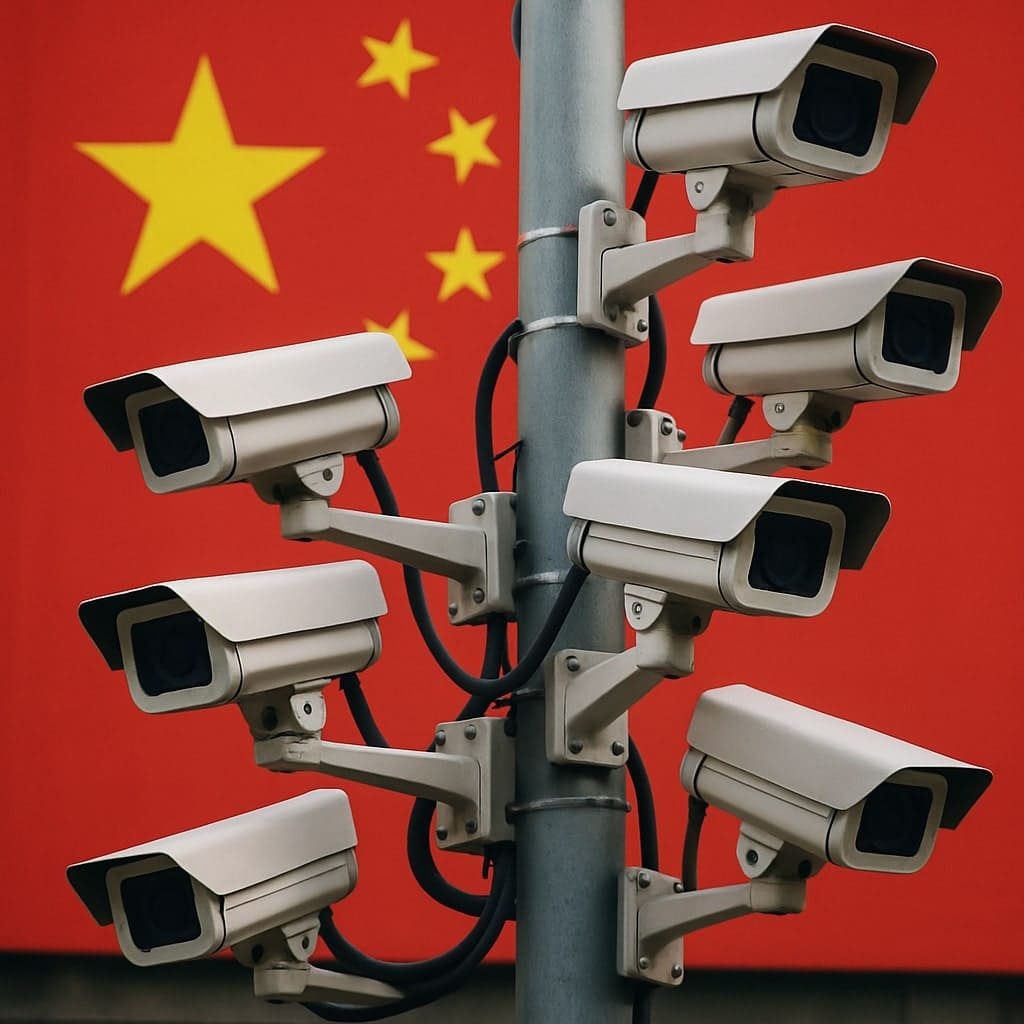
China and AI-Powered Camera Surveillance: Digital Surveillance in the 21st Century
In the streets of Chinese cities, from overcrowded megacities to provincial centers, hundreds of millions of digital eyes discreetly monitor everyday life. China has built the world's most extensive network of artificial intelligence-powered surveillance cameras, a system so ambitious and technologically advanced that it has no precedent in human history. With an estimated 560 million active cameras in 2021, representing approximately one camera for every four residents, China has become the global epicenter of mass surveillance. This technological web interconnected by artificial intelligence has not only changed the way law enforcement is carried out—it has transformed the very nature of social organization and state control in the world's most populous country.
The Origins of the Digital Panopticon
The massive expansion of camera systems in China began as early as the start of the new millennium, but the real boom came around 2010, when the government introduced its "Safe Cities" (Xueliang, literally "Sharp Eyes") project. The original aim was to improve security in large urban agglomerations by installing an extensive network of cameras. The system underwent a fundamental transformation after 2015, when the government began implementing facial recognition technologies and other methods of biometric identification. What began as routine camera monitoring gradually evolved into a complex system capable of identifying and tracking individuals in real time. "The transition from passive monitoring to active surveillance was gradual, but very thorough," Liu Wei, a former engineer for one of the technology companies involved in developing surveillance software, explains to me. "At first, it was simply a matter of cameras recording footage for possible later use. Today we are talking about an interconnected ecosystem capable of analyzing your every movement in real time."
The Technological Evolution of Surveillance
Today's Chinese surveillance system is a technological marvel that inspires both admiration and concern. An estimated 200 to 300 million security cameras are deployed across the country, roughly one camera for every 4–6 residents. Their density in urban centers is even higher. The cameras themselves, however, would be merely passive witnesses without advanced artificial intelligence analyzing all the footage. Facial recognition systems are capable of identifying individuals within seconds, even in crowds of thousands. During a test conducted by BBC reporters in Beijing, a wanted person was found in a city of seven million in just seven minutes after their photograph was entered into the system. Chinese technology companies such as Hikvision, Dahua and SenseTime are among the global leaders in the development of security technologies. Their products are so advanced that they can identify people not only by their face, but also by their gait, physique, or even by the way they hold a mobile phone. "In recent years, there has been significant improvement in identifying people even when their faces are partially covered," says Zhang Minghao, a technology analyst from Shanghai. "The systems now use multimodal analysis—they combine facial recognition with movement analysis, identification by clothing, and other factors. The COVID-19 pandemic and the wearing of masks paradoxically accelerated the development of these technologies."
From East to West: Use in Practice
Surveillance technologies have found applications in virtually every aspect of Chinese society. They are most visible in urban centers, where they monitor public spaces ranging from shopping malls and parks to intersections. In many Chinese cities, such as Shanghai and Shenzhen, systems automatically identify pedestrians crossing on a red light. Their faces are subsequently displayed on large screens near crossings, often accompanied by their name and part of their national identification number. This form of public shaming is intended to serve as a deterrent. "The first time I saw my face on a screen after crossing the road on a red light, it was a shock," recalls Chen, a 34-year-old Shanghai resident. "Now it is a normal part of life. People think twice about breaking the rules when they know they will be identified immediately." Facial recognition cameras have become a routine part of everyday life. They are used when entering residential complexes, checking in at train stations and airports, and even paying in shops and restaurants. Some KFC fast-food restaurants have introduced a "Smile to Pay" system, in which customers pay simply by smiling at a camera that identifies them and connects them to their payment account. The greatest controversy, however, concerns the use of surveillance technologies in Xinjiang, where the Uyghur minority is under intense scrutiny. Cameras monitor entrances to mosques, shops, and homes. The system alerts authorities to "suspicious behavior," such as frequent gatherings of people or unusual purchasing patterns.
A Perfectly Interconnected System
What makes the Chinese system unique is not merely the number of cameras or the accuracy of recognition, but above all their interconnection. All data is stored in centralized cloud databases, allowing authorities to reconstruct an individual's movements over the past several weeks. "The system works like a time machine," explains Professor Wang from Peking University. "If you have a photograph of a wanted person, you can find out not only where they are right now, but also where they have been in the past, whom they met, and what their activities were." This data is further linked to the social credit system, which was launched nationwide in 2020. Citizens' behavior captured by cameras—from crossing on a red light and littering in the street to visiting liquor stores—affects their social score. A low score can lead to restrictions on the ability to travel, obtain credit, or enroll children in prestigious schools.
Between Safety and Surveillance: What Do Ordinary Chinese People Think?
Chinese citizens' attitudes toward ubiquitous surveillance are surprisingly mixed. Research suggests that the majority of the urban population views cameras as a positive contribution to security. "Ten years ago, I was afraid to walk alone in the street at night," says Lin Mei, a 42-year-old accountant from Guangzhou. "Today I feel much safer. I know that cameras deter potential criminals and that if something happened, the police would have recordings." Many Chinese people argue that they have no reason to fear surveillance if they are not doing anything wrong. "It's like having a police patrol on every corner, but much more effective," remarks Wang, a student from Beijing. "If you obey the law, you have nothing to fear." However, there is also a growing group, particularly among younger and more educated residents of larger cities, expressing concerns about invasions of privacy. Discussions about the limits of surveillance occasionally appear on social networks such as Weibo and WeChat, although they are quickly censored. "The problem is not what we are doing now, but what may be considered problematic in the future," says a young lawyer from Shanghai, speaking anonymously. "History changes, politics change, but the records remain."
The Future Under Constant Surveillance
Chinese authorities continue to expand and improve their surveillance system. The latest generation of technologies already integrates predictive algorithmic models that attempt to predict potential crimes or unrest before they occur—a concept known as "pre-crime" prevention. In some cities, systems capable of detecting "abnormal behavior" are being tested—for example, when someone moves around for too long without a clear destination or when a large number of people unexpectedly gather. Such situations automatically trigger alerts for security forces. The next step is the integration of additional data sources. Experimental systems combine visual data from cameras with information about internet use, payment transactions, and communication via social media, creating a comprehensive digital profile of every citizen. The Chinese surveillance model offers a fascinating yet disturbing glimpse into a possible future of society, where technology surpasses the traditional limitations of human oversight. While it brings undeniable benefits in terms of security and efficiency, it also raises fundamental questions about the boundaries of privacy and state power. As one Chinese commentator who wished to remain anonymous remarked: "We are building a cage out of ones and zeros. It is perfectly invisible until you try to lean against it."
The Situation in the Czech Republic: Limited Surveillance Under the Rule of Law
While China is building an unprecedented digital surveillance network, the Czech Republic has taken a markedly different path. Camera systems are common here in urban centers, shopping malls, and transport hubs, but their use is subject to strict regulations arising from European legislation. Facial recognition cameras appear in the Czech Republic only to a limited extent, for example at Václav Havel Airport for automated passport control, and their deployment requires clear legal justification. Unlike the Chinese model, where data flows into centralized databases, Czech systems operate primarily locally and are used with time-limited retention of recordings. "The European Union's regulatory framework, particularly the GDPR and forthcoming artificial intelligence legislation, makes the emergence of a Chinese-style system practically impossible," explains cybersecurity expert Jan Kolouch. Public debate about camera systems regularly resurfaces in the Czech Republic, with a significant portion of the public and experts favoring a model in which the right to privacy takes precedence over mass surveillance. While surveillance technologies are expanding at a dizzying pace in China, the Czech approach remains grounded in the principles of protecting citizens' fundamental rights.


