

90% of Developers Use AI Daily, but Trust in Its Outputs Remains Low
Google Cloud has released its annual DORA report on the state of AI-assisted software development. Based on a survey of nearly 5,000 technology professionals from around the world, the report reveals a dramatic increase in the use of artificial intelligence among developers. According to the data, as many as 90% of these professionals now incorporate AI into their daily work, representing a 14% increase compared to the previous year. Developers, including both programmers and product managers, spend an average of two hours a day working with AI. This adoption spans a wide range of tasks, from code generation and reviews to testing and automation.
The Daily Reality of Working with AI
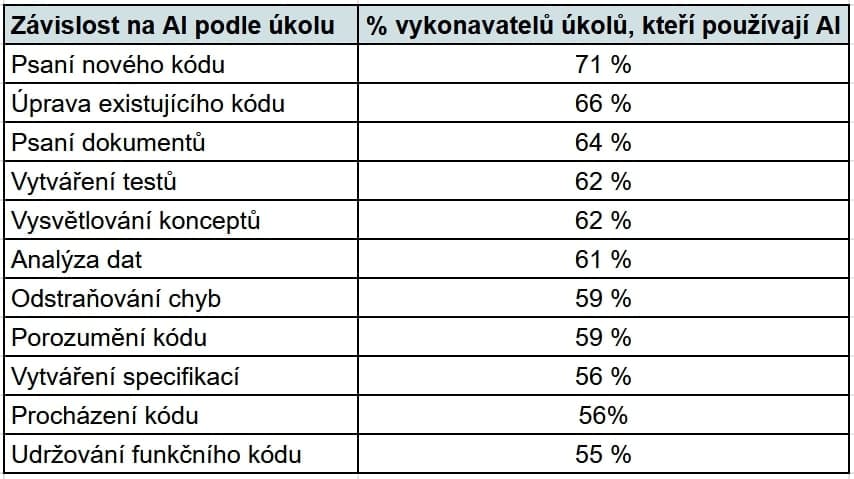
The report highlights how AI has become an integral part of the workflow. As many as 65% of respondents report a strong reliance on AI tools—37% use them moderately, 20% extensively, and 8% extremely heavily. For example, tools for code suggestions, automated checks, or test generation are now common in many companies. In a blog post, Ryan J. Salva, senior director of product management at Google Cloud, describes how this has changed the way software is created. As a result, teams are now releasing more applications and software, increasing overall development throughput.
Productivity and Quality vs. Doubts
Although AI is rapidly making its way into everyday practice, it brings visible benefits. More than 80% of developers appreciate the productivity boost provided by these tools. Better still, 59% have seen an improvement in code quality—AI helps detect errors earlier and suggests effective solutions when given the right prompt. This data comes directly from the survey, in which respondents describe how AI speeds up routine tasks and allows them to focus on more complex parts of a project. The report thus confirms that AI is not merely a passing trend, but a genuine tool that increases efficiency in the real world of software development.
The Trust Paradox: They Use It but Do Not Trust It
Here comes the biggest surprise—the so-called trust paradox. Even though developers use AI extensively, their trust in its outputs is not high. As many as 30% of respondents trust it only a little or not at all: 23% "just a little" and 7% "not at all." Conversely, only 24% have a high level of trust—4% "very much" and 20% "a lot." This discrepancy suggests that AI serves more as a support tool that speeds up work, while final decisions remain in human hands. Developers therefore integrate AI into their workflows but always check its outputs to ensure that the software works correctly. This approach protects against errors and keeps human judgment at the center of the process.
Seven Team Archetypes and Their Impact on Organizations
The report goes even further and analyzes how AI affects different types of teams. It identifies seven archetypes, ranging from "harmonious high-performing" teams that fully leverage AI for growth to those trapped in a "legacy bottleneck," where old systems hinder progress. AI acts as a mirror: in cohesive organizations, it increases efficiency, while in fragmented ones, it exposes weaknesses. This helps companies understand why some teams benefit more than others and focus on fostering a workplace culture in which AI supports team dynamics rather than disrupting them.
DORA AI Capabilities Model
To help companies, Google introduced the new DORA AI Capabilities Model. This model describes seven key practices that combine technical and cultural elements to maximize the benefits of AI. These include automated code generation, intelligent testing, incident prediction, as well as building AI literacy within teams, establishing ethical guidelines, and promoting continuous learning. The model emphasizes that adoption alone is not enough—companies must change their processes and culture for AI to realize its full potential. The report thus offers practical guidance on overcoming challenges such as integration with existing systems and ensuring security.
This DORA 2025 report shows that AI is becoming a core part of software development infrastructure. Massive adoption combined with caution may actually be an advantage: developers gain speed and efficiency, while human oversight ensures quality. For companies, this represents an opportunity to transform their teams if they follow the model's recommendations. Overall, it points to a world in which AI does not replace people but enhances their capabilities in everyday practice.


