


The internet as we know it is slowly changing. Much of what we see online no longer comes from people, but from machines pretending to be us. This idea is called the Dead Internet Theory (Dead Internet Theory) and first appeared several years ago on forums such as 4Chan or Agora Road’s Macintosh Café. Back then, it sounded like a conspiracy theory, but with the development of generative artificial intelligence (AI), it is becoming a reality. Researchers now say that the online world is beginning to resemble what the theory warned about—much of the content is automated and mimics human activity.
According to the Imperva’s 2025 Bad Bot Report, bots surpassed human traffic for the first time in history. In 2024, automated systems accounted for 51% of all web traffic. And that is not all—according to Graphite, AI-generated articles surpassed those written by humans for the first time at the end of 2024. Alex Turvy, a sociologist who studies interactions on social media, told Decrypt that many signals suggest the internet looks different from what we think.
Bots are changing how we perceive the online world
When we talk about AI bots changing the internet, we mean the increase in non-human traffic across the web and the growing amount of automated or AI-generated content on platforms. Alex Turvy explains that the main problem is not that there are fewer people online, but that automated activity is destroying the basic signals we use to determine who is real. Machines can imitate these signals, leading people to begin doubting everything. Some withdraw, while others move to semi-private or closed spaces.
People are now retreating to places such as Discord or private group chats, where they can be more certain about who they are talking to, Turvy says. When the usual signals stop working, they look for other ways to verify who is on the other side. This shift toward privacy makes the public internet quieter, even though overall human activity remains the same.
A February 2025 article in the Asian Journal of Research in Computer Science describes social platforms as machine-driven ecosystems. The researchers state that bots generate 40–60% of web traffic. These automated systems engage in data collection, spam, and manipulation, creating artificial interactions that look like genuine human behavior. Bots are often used to inflate numbers such as likes, shares, and comments, creating the illusion of vibrant online activity.
Turvy adds that this shift is difficult to overlook because technology has caught up with reality and financial incentives have aligned. A September 2025 report by Galaxy Interactive found that automated activity now dominates major social platforms. Analysts say the rise in AI-generated material is fueling this trend, with more repetitive, low-quality, or spam content attributed to automation appearing on platforms such as Reddit, YouTube, and X.
Despite Elon Musk’s promises to deal with bots on X, one study estimates that up to 64% of accounts on X may be bots, which are responsible for 76% of peak traffic. The same study estimates that up to 95 million Instagram accounts—9.5% of the total—could be fake or automated.
AI-generated content is flooding the web
As synthetic content spreads, researchers tracking the trend say the change is visible in the numbers. Deedy Das, a partner at Menlo Ventures who studies this trend, told Decrypt that about half of the internet is written by AI. In a post on X dated December 25, 2024, Das wrote that the Dead Internet Theory, the conspiracy that the internet is mostly full of bots, is happening. AI-generated content is slowly killing the internet—Reddit posts, Pinterest, Google results, Facebook videos, and Spotify music. And most people do not even realize it.
Dead Internet Theory, the conspiracy that the internet is mostly bots, is happening.
— Deedy (@deedydas) December 25, 2024
AI generated content is killing the internet slowly.
Reddit posts.
Pinterest.
Google results.
Facebook videos.
Spotify music.
And most people don't even know it's happening. pic.twitter.com/W6KfeR1Zeh
Das adds that chatbots and AI tools summarize that material and feed it back. Ultimately, you are reading machines summarizing other machines. While Turvy believes that the growth of bots on social platforms will lead people to move into smaller, more intimate spaces, Das is unsure whether the ideal of the early web will return. People no longer write blogs very much because they cannot be discovered, and if they do, people assume they are AI-generated. Most conversations now take place on platforms built around performance rather than sincerity.
Das says the bigger problem is software that behaves like people. The foundations of the internet assumed that there was a person on the other side—CAPTCHAs, logins, two-factor codes, everything. Now software can imitate all of this perfectly, and there is no common rule for what should count as an agent.
The rise of AI agents is accelerating the changes
If the internet feels dead today, the spread of AI agents (autonomous programs that respond to commands and perform tasks on the web on behalf of users) will only accelerate it. These agents browse websites, search, shop, trade cryptocurrencies, and interact with platforms in ways that look like human activity.
Nirav Murthy, co-founder of Camp Network, a company focused on blockchain for intellectual property, says this pattern is driven as much by economics as by technology. Agentic AI can remix material at machine speed and almost for free. That output is fed back into circulation. Accounts begin to look different but behave the same. Engagement rises, diversity falls, and once you add human checks, the numbers fall apart.
As users hand more control over to agents, machines rather than people will take over a greater share of everyday online activity, deepening the automated environment they encounter online. Online ecosystems follow incentives, Murthy says. When fake engagement is cheap and rewarded, you do not just get more bots. You get automated content assembly lines chasing clicks.
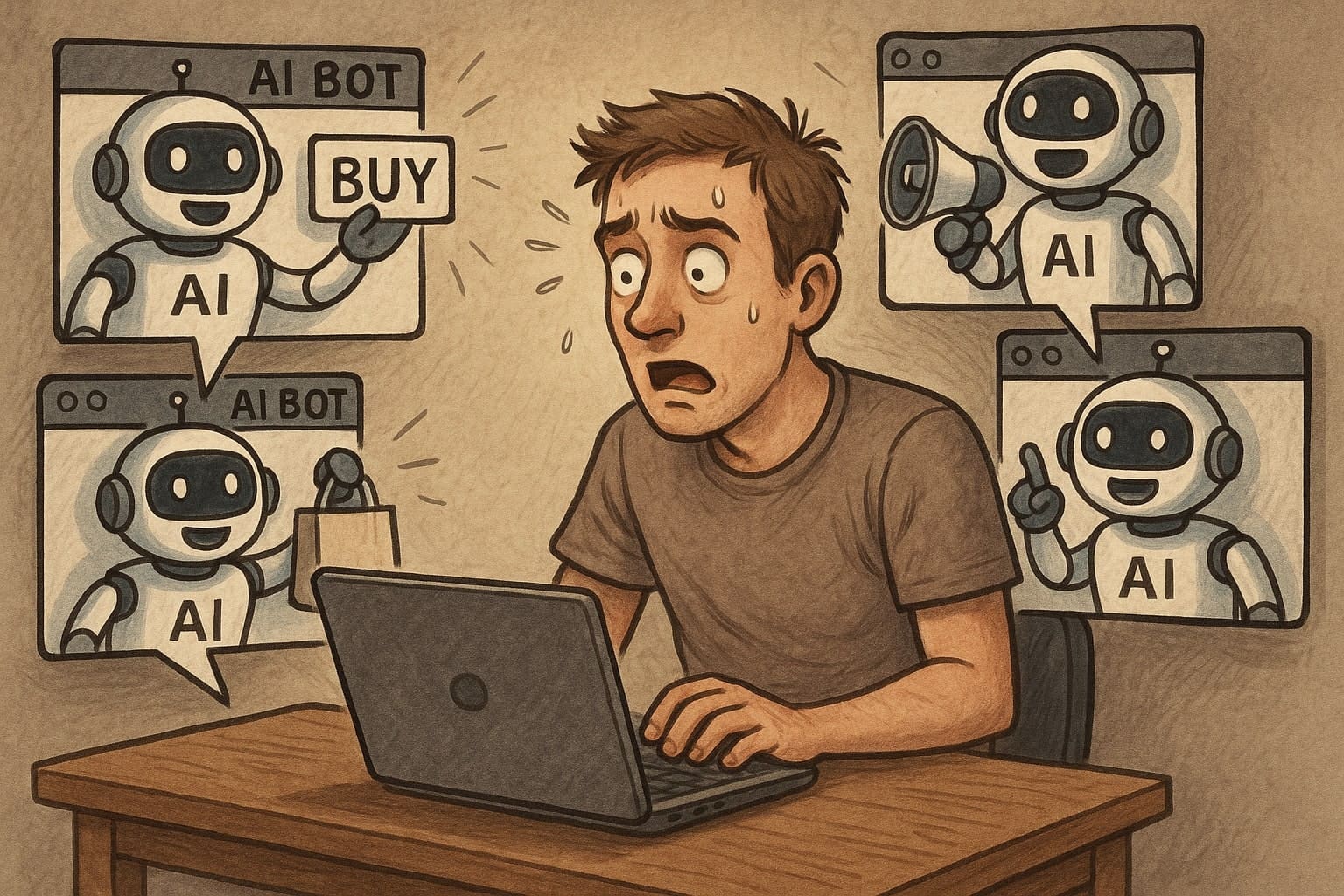
This conflict is visible in real-world use. Earlier this month, Amazon sent Perplexity a cease-and-desist notice after discovering that its Comet browser was shopping on Amazon by disguising automated agents as human shoppers. Anthropic recently said it had blocked the first AI-driven cyberattack, when state-backed Chinese hackers used its Claude Code agent in attempts to breach 30 companies.
Das says the greatest risk to companies and platforms arises when AI agents are deployed at scale. When companies operate fleets of these systems, you get millions of requests that behave like users. That is harder to see and harder to stop.
The next wave is AI-generated video. Tools such as OpenAI’s Sora 2 or Google’s Veo 3 can create realistic clips and deepfakes from text prompts, adding to the volume of polished but synthetic content on social platforms.
Both Murthy and Turvy agree that financial incentives are driving the flood of AI bots online, and verifying humanity may become AI’s next challenge. Humanity has become just another signal that can be faked for money, Turvy says. What is missing now is the messiness that used to prove someone was real.
A growing number of blockchain projects, including World (formerly Worldcoin), Proof of Personhood, and Human (formerly Gitcoin) Passport, are introducing systems designed to verify humanity by linking online activity to a verified person. If you reward genuine creators and make fraud expensive, people will still have a place online, Murthy says.
Source: decrypt.co


