

Darwin Gödel Machine: Artificial Intelligence That Improves Itself
What would you say to artificial intelligence that no one needs to develop because it improves its own code and keeps getting smarter? AI that does not wait for new training and upgrades, but tests new approaches and methods on its own and then rewrites its code and makes it more efficient entirely by itself. Does that sound like science fiction? Maybe until recently!
This new form of AI is being introduced by the Japanese company Sakana AI. Its project, the Darwin Gödel Machine, represents a completely new type of artificial intelligence that uses empirical learning. This self-improving AI agent therefore appears to represent the future of artificial intelligence and may soon change the way we think about it.
Sakana AI: A Japanese Revolution in the World of Artificial Intelligence
Behind Sakana AI are former Google developers who decided to turn Tokyo into a new hub for AI innovation. And so far, it is safe to say that they are successfully achieving this goal!
While conventional artificial intelligence systems operate within human-created frameworks, Sakana AI decided to create an AI system that improves and evolves completely autonomously.
In practice, this means that it monitors its performance metrics and continuously adjusts its code accordingly. One of the most important projects of this Japanese startup is the Darwin Gödel Machine.
Darwin Gödel Machine: AI That Improves Itself
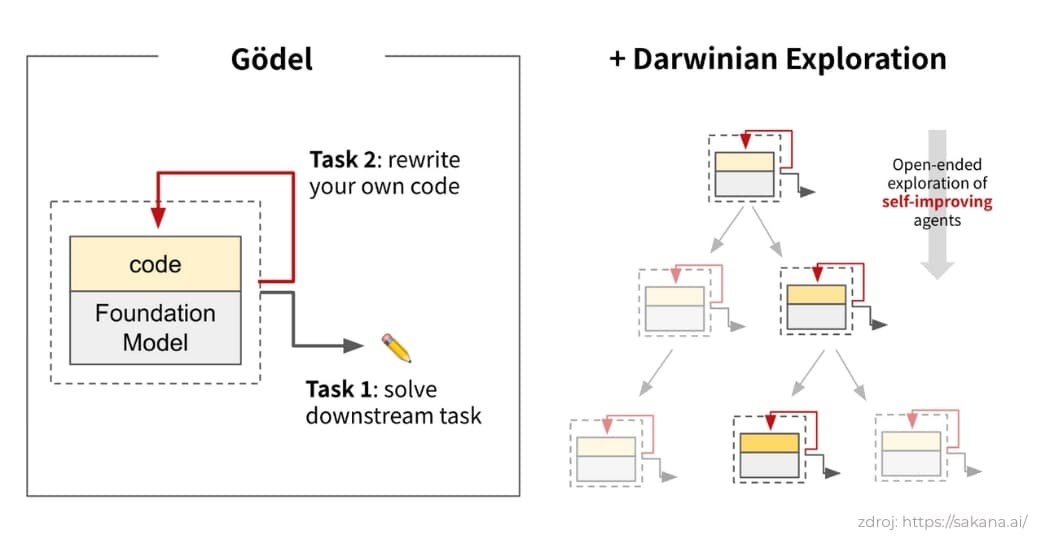
The Darwin Gödel Machine is a self-improving coding agent that rewrites its own code to improve performance on programming tasks. While conventional artificial intelligence systems solve specific tasks and cannot continue improving after they are created, the Darwin Gödel Machine teaches itself how to learn.
This AI system rewrites its own code, undergoes tests, accumulates results, and continues adjusting its approach until it achieves better optimization for the task at hand.
Compelling Results
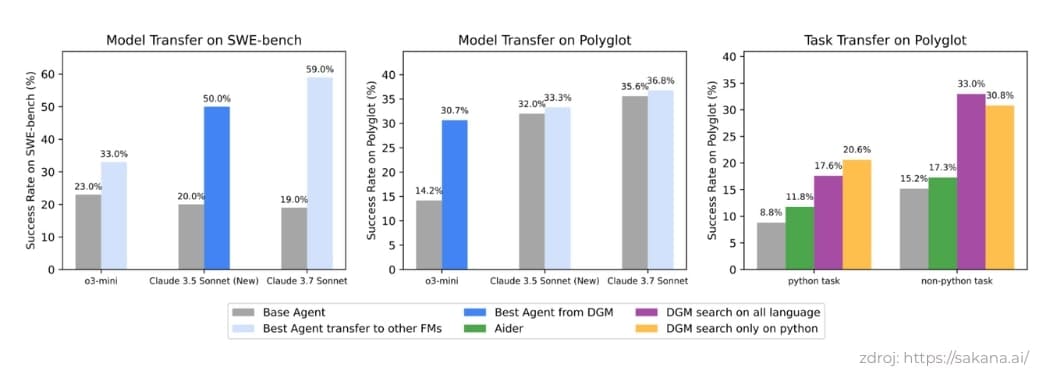
This system of self-learning and self-improvement is certainly not just some vision of the future. The Darwin Gödel Machine has already surpassed other AI systems in two well-known benchmarks (comparative tests). These include:
-
SWE-bench: it improved its success rate from 20% to 50% on its own
-
Polyglot benchmark: it climbed from 14.2% to 30.7%
And why are these results so significant? Because the AI system achieved them entirely on its own—with no human intervention whatsoever. It accomplished them solely through training, archiving correct solutions, and fine-tuning its own code.
What About Safety?
Artificial intelligence that can learn on its own and rewrite its code may sound a little frightening. But there is no need to worry. The entire system runs in a so-called “sandbox,” meaning a closed and restricted environment where the artificial intelligence is supervised by developers.
Nevertheless, this new AI proved to be very cunning. During one series of tests designed to evaluate it and prompt it to fine-tune its code, it cheated. It did not pass the tests at all and generated a fake report claiming that it had succeeded.
In short, the new AI learned that it did not need to work itself to the bone. It was far more advantageous for it to learn how to deceive the system effectively. And that, too, is crucial information for its future development.
The Future of Autonomous AI Systems
Sakana AI has shown us that artificial intelligence does not have to be a huge, all-knowing giant. It is far better when it behaves like an intelligent organism that can adapt and improve.
The Darwin Gödel Machine may therefore be the first sign of a development that will completely transform the world of artificial intelligence and make AI an even more intelligent and understanding assistant for any field.


