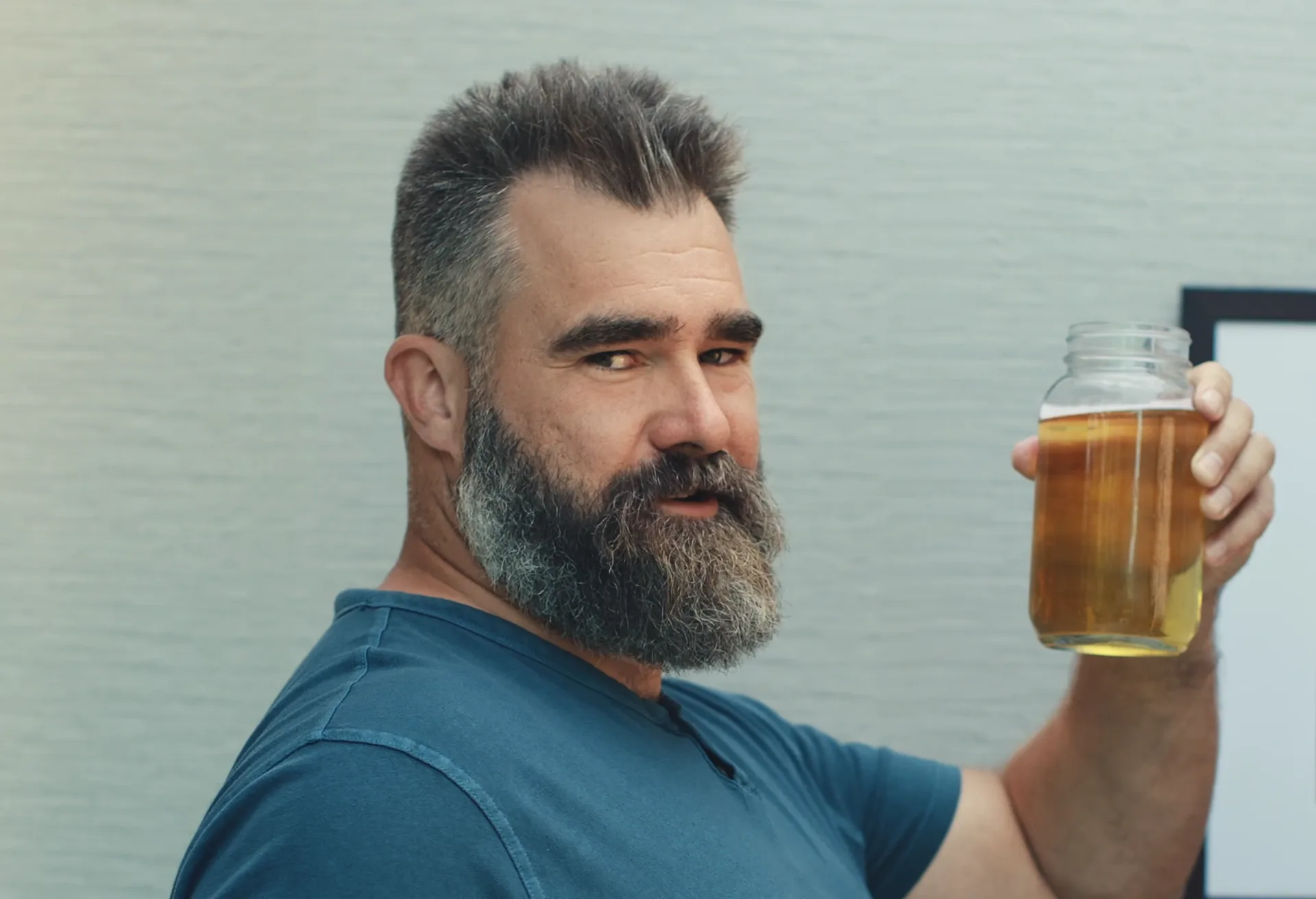
Former American football player Jason Kelce collects urine in a mason jar in a new commercial and offers it to data centers as coolant. It may look like mere provocation, but water treatment experts point out that the idea has a basis in reality. Treated wastewater is already commonly used to cool servers.
A commercial that begins in the bathroom
Beverage company Liquid Death and Garage Beer, the brewery co-owned by Kelce, released a clip that begins in a bathroom, where Kelce fills a jar instead of flushing. He then tells the camera that data centers waste millions of gallons of water, which is why the two companies have joined forces. They want your urine to cool servers.
From there, the scene turns into a musical number. Kelce walks into a forest clearing, where he is joined by Liquid Death mascot Murder Man and gradually by an entire crowd of people holding jars. The chorus goes, “Let's all pee on computers together to save humanity.” The campaign includes a limited-edition mason jar with a lid for $18, which marketers named the Coolant Collector and which sold out immediately.
Expert says no
Bruno Pigott, executive director of the WateReuse Association and a former official at the U.S. Environmental Protection Agency, explained to TechCrunch why it would not work this way. Urine contains salts, urea, bacteria, and organic residue. The cooling tower would need to be cleaned almost continuously.
One widely used method is called evaporative cooling. Heated water is sprayed into an airflow, some of it evaporates, and the heat escapes along with the vapor. The remaining water, now cooled, returns to the servers. Pigott asked whether anyone could imagine evaporating urine this way in hot air. Everyone can work out the answer for themselves.
Technically, we do know how to turn urine into drinking water. Astronauts in orbit do it because they have no way to obtain more water than what they carry in their tanks. On a large scale, however, it is not cost-effective, and no one has millions of liters of urine available in one place. The water from our toilets ends up in the sewer system, which brings us to what actually works.
Recycled water has cooled industry for decades
Wastewater treatment plants use membrane bioreactors, reverse osmosis, and ultraviolet light. The water that leaves them is clean enough for industrial use and, in some cases, is even safe to drink. Human urine also flows into the sewer system, so Kelce's gag is not far removed from reality.
Greta Zornes, who leads the water reuse practice at CDM Smith, told TechCrunch that various industries have been using recycled water for cooling for decades. Data centers are among them, but interest in this technology is growing rapidly. Zornes has worked in the field for more than 20 years and says she now deals with recycled water for data centers every day.
Loudoun County in Virginia, near Washington, is home to more than 250 data centers, with another 20 planned. According to the local water utility, they consumed about 750 million liters of recycled water per day in 2025, covering just over 40 percent of their total consumption. The rest, nearly one billion liters every day, came from drinking water supplies.
The obstacle is infrastructure. Companies can switch to recycled water only where there is a treatment plant capable of processing sufficient quantities of water. Zornes points out that data centers are often built in rural areas, where local treatment plants are small and lack sufficient capacity. Building the necessary pipelines and technology takes years, and according to her, time is the main problem.
Funding water treatment plants
Obradovitch believes that pressure to build data centers could itself help expand treatment plants. According to him, there are numerous cases in which companies have provided funding to local governments specifically for these projects, thereby becoming a pillar of water infrastructure. Meta plans to invest at least $270 million in water management projects near its data centers.
Meanwhile, the Liquid Death campaign is spreading successfully because it reflects the mood also captured by a Gallup poll. A total of 7 in 10 Americans do not want a data center in their area. Pigott does not see that as a bad thing. He said that anything drawing attention to water, even in a somewhat vulgar way, may ultimately help and gives experts an opportunity to explain what they are actually doing with water today.
Sources: techbuzz.ai, pcmag.com