Anthropic has released Claude Sonnet 4.6, a mid-tier model whose performance is catching up with the current flagship, Opus. And the best part? The price remains the same.
Second major model in two weeks
Anthropic released Claude Opus 4.6 just 12 days before the arrival of Sonnet 4.6. This pace of development would have been unimaginable just a year ago. The company, founded in 2021 by former OpenAI researchers, now competes with OpenAI and Google—and it certainly is not slowing down.
But this sprint also has a downside. Software company stocks are sinking like a stone. The iShares Expanded Tech-Software Sector ETF (IGV) has fallen by more than 20% since the beginning of the year. Investors are worried, and honestly, they have good reason to be. When AI can code, analyze documents, and operate a computer, what will be left for traditional software?
What can the new Sonnet 4.6 actually do?
The new model delivers significant improvements in several areas. Coding, computer use, design, processing long documents, and planning agentic tasks—Anthropic has taken all of these to a new level.
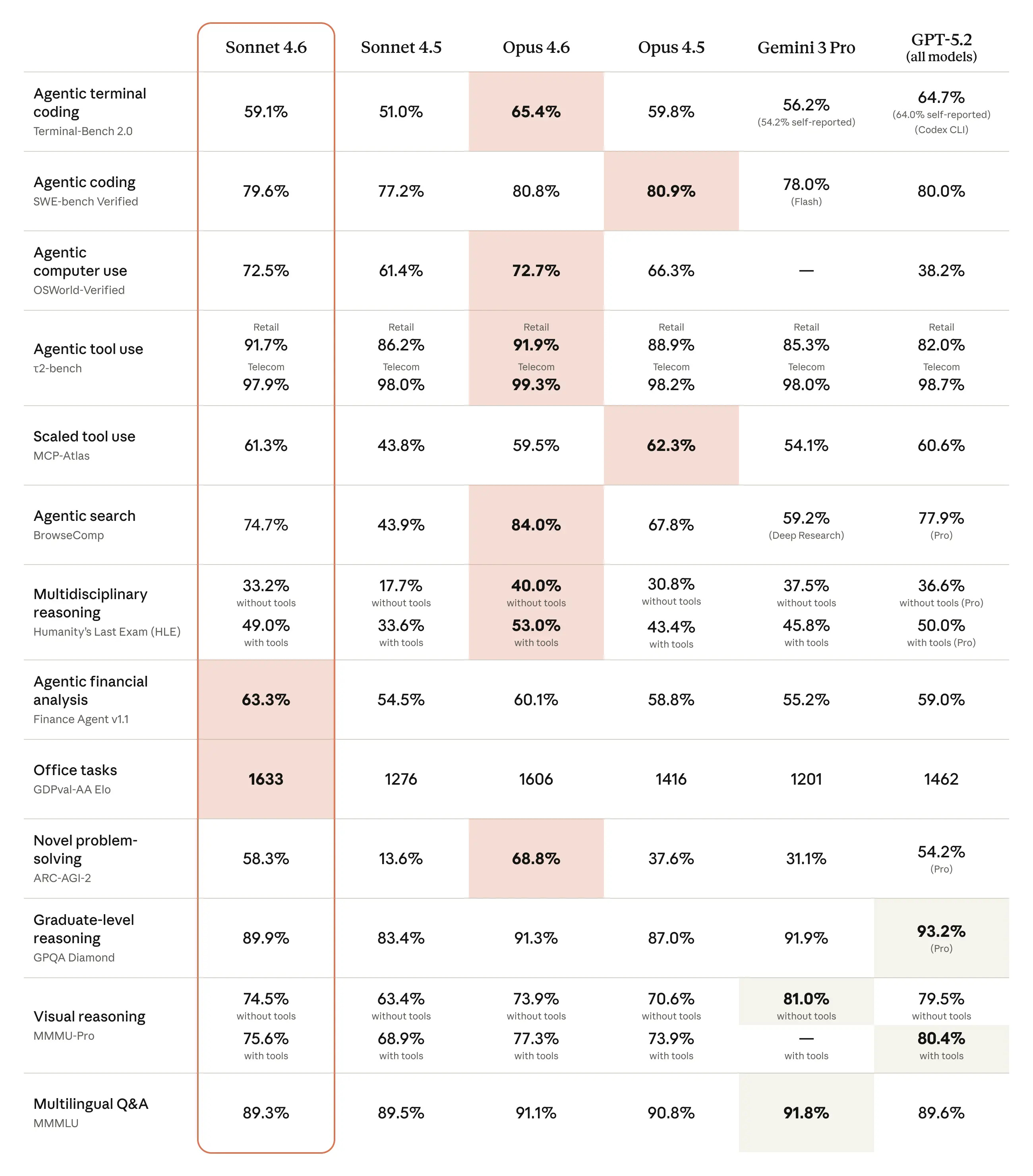
Developers who had access to the beta version preferred Sonnet 4.6 over its predecessor in 70% of cases when working in Claude Code. An even more surprising figure? 59% of users preferred Sonnet 4.6 over Opus 4.5—the model that, until recently, was the best Anthropic had to offer. Less overengineering, fewer hallucinations, and better instruction following.
Sonnet 4.6 also comes with a 1-million-token context window in beta. This means a single prompt can accommodate an entire codebase, dozens of research papers, or extensive contracts. And the model can actually navigate them intelligently—not merely search through them mechanically.
AI-controlled computers
In October 2024, Anthropic was the first company to introduce a model capable of operating a computer like a human—clicking a mouse, typing on a keyboard, and browsing websites. At the time, the company itself admitted that this was an experimental feature that was “sometimes cumbersome and prone to errors."
Sonnet 4.6 rewrites this chapter. On the OSWorld benchmark, which tests hundreds of real-world tasks in environments such as Chrome, LibreOffice, and VS Code, Anthropic’s models have made dramatic progress over the past sixteen months. Early users report that the model can navigate complex spreadsheets or complete multi-step web forms at a human level.
One insurance company—Pace—measured 94% accuracy in computer use on its internal benchmark. That is a figure that could transform business.
At the same time, Anthropic has strengthened its defenses against so-called prompt injection attacks—situations in which malicious content on the web attempts to trick AI into taking unwanted actions. Sonnet 4.6 is significantly more resilient in this regard than its predecessor.
Free for everyone—and the price for developers remains the same
This may be the most important news for everyday users. Claude Sonnet 4.6 has become the default model for both the Free and Pro plans on claude.ai and in Claude Cowork. The free tier now also includes file creation, connectors, skills, and context compaction.
For developers, the API price remains the same as for Sonnet 4.5—$3 per million input tokens and $15 per million output tokens. Opus performance at the price of Sonnet.
The company recently closed a $30 billion funding round at a valuation of $380 billion—more than double its valuation last September. Claude Sonnet 4.6 is available on all plans, through the API, and on major cloud platforms. Developers can access it using the identifier claude-sonnet-4-6.