


It kept it under lock and key for months. Now Anthropic has finally released it to the public. The company behind the Claude artificial intelligence has launched the Fable 5 model, the first publicly available version in the Mythos series, the most powerful class of models the company has ever built. Alongside it, Anthropic is also offering an unrestricted version called Claude Mythos 5, but only to a select group of vetted organizations.
Why the caution? According to Anthropic, Mythos can quickly uncover vulnerabilities in critical infrastructure, from banking platforms to energy grids. When the company unveiled the model in April, it restricted access to a small group of partner institutions. Critics accused it at the time of exaggerating the threat to attract attention. But the companies that tested the model have since confirmed its capabilities.
The Fable 5 model and strict rules
Fable 5 is built on the same foundation as Mythos 5. The difference lies in the safeguards. If you ask the model about sensitive topics in cybersecurity, biology, or chemistry, the query is automatically handed over to the weaker Opus 4.8 model, which Anthropic released in late May. Attempts to extract the technology at scale will meet the same fate, as the company has uncovered extensive efforts to extract its models for training competing artificial intelligence systems in authoritarian countries such as China.
How robust are those safeguards? Anthropic hired external experts who spent thousands of hours trying to bypass them. It also ran a bug bounty program for discovered security flaws. In the end, no one managed to fully unlock the model.
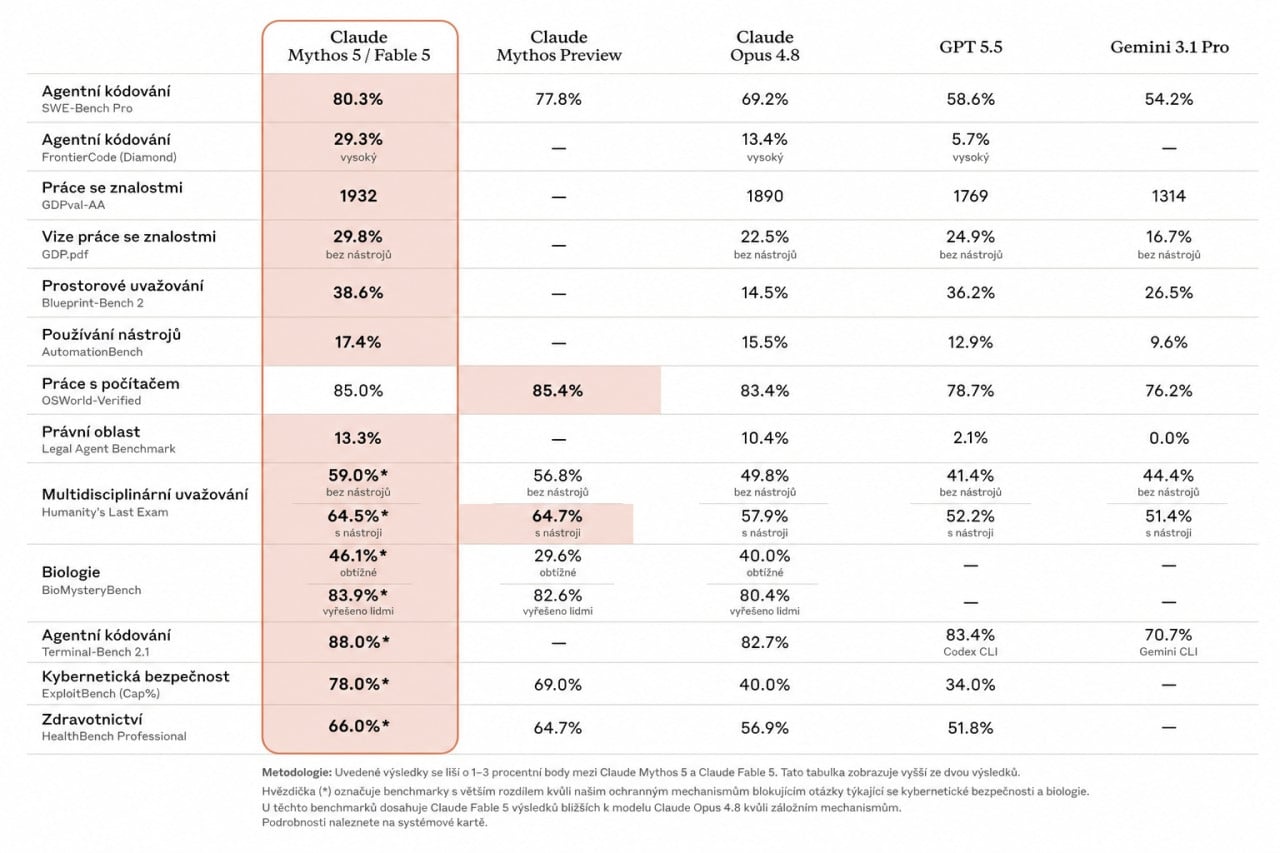
In every other respect, this is the most capable model Anthropic has ever made available to the public. The company recommends it for writing and debugging code, complex research questions, and image analysis. The test results bear this out. On SWE-Bench Pro, which evaluates autonomous programming, Fable 5 scored 80.3 percent, while Opus 4.8 achieved 69.2 percent. On the hardest section of Cognition’s FrontierCode benchmark, it scored 29.3 percent, more than double the result of Opus 4.8 and several times the score of the competing GPT-5.5.
A simple rule applies: the longer and more complex the task, the greater the lead Fable 5 maintains. The model can work independently for longer than any previous Claude model. It also performs exceptionally well outside programming. On Hebbia’s financial benchmark, which focuses on reasoning at the level of senior analysts, it achieved the highest score of all the models tested.
It sees better than ever and can even finish Pokémon
Fable 5 completed Pokémon FireRed from start to finish using only raw screenshots, without maps or navigation aids. Older Claude models needed a complex support system just to play at all. Customers are seeing the practical impact: one chief technology officer said that applications requiring a hundred prompts a year ago can now be handled by the model on the first try.
Ethan Mollick, a prominent artificial intelligence researcher at the University of Pennsylvania, demonstrated what this means in everyday use. According to him, Fable 5 surpassed virtually every other public model he had ever used, and by a noticeable margin. The model worked for him for up to twelve hours straight on multi-page assignments.
Mollick also used a single prompt in Claude Code to create several video games. A classic Snake game in which you race around the screen eating apples. Strata, where you wander through endless underground tunnels and light lanterns. And even Duino, based on Rainer Maria Rilke’s famous poetry cycle Duino Elegies, in which a solitary figure walks through a nighttime landscape as verses appear on the screen. The graphics are nothing special, certainly. But the fact that these games exist and work at all, generated from a single prompt, is remarkable in itself. Software projects that once required entire teams can now be created from a single instruction.
Mythos 5, but only for the chosen few
The second model, Mythos 5, is the same system, but with safeguards removed in certain areas. Anthropic is deploying it through the Project Glasswing program in cooperation with the U.S. government, replacing the earlier Claude Mythos Preview. At the beginning of June, the select group expanded to around two hundred organizations in more than fifteen countries, and it is expected to keep growing.
What makes it exceptional? It has the strongest cyber capabilities of any model in the world. On Cybench, which measures success in solving security tasks, including finding and exploiting vulnerabilities in real-world software, it was the only model to achieve a 100 percent success rate. And these are not just practice exercises. Mythos discovered real, previously unknown vulnerabilities in the Firefox browser. Genuine flaws in software used by millions of people every day. Anthropic responsibly disclosed them to Mozilla.
This capability is precisely why ordinary users will receive only the restricted Fable 5 version. A tool capable of defending banks and power plants can just as easily be used to attack them.
Top-tier performance comes at a price
You will pay extra for this new level of capability. Fable 5 costs $10 per million input tokens and $50 per million output tokens, twice the price of Opus 4.8. For comparison, intensive programming work can burn through a million tokens in just a few hours. Compared with the earlier Mythos Preview, however, this is paradoxically a price cut to less than half.
The release comes at a turbulent time. Anthropic has become embroiled in an unprecedented dispute with the Trump administration after refusing to lift restrictions on mass surveillance and autonomous lethal weapons, prompting the Pentagon to terminate contracts with the company, whose tools were the only ones to hold defense security clearance. Meanwhile, the White House has arranged to test the most powerful models from leading companies before their release, and Mythos 5 is being deployed specifically in cooperation with the U.S. government.
Despite rapid revenue growth, Anthropic remains far from profitable and pays premium prices for computing power, leasing a data center from Musk’s xAI for $1.25 billion per month. Both the company and rival OpenAI announced over the past week that they had filed to go public.
Additional sources: techcrunch.com and theguardian.com


