
Anthropic has released a new version of its most powerful model. Claude Fable 5.2 arrives just two months after version 5.1, and the company claims it is better at programming, reasoning, analyzing images and charts, and communicating clearly with people. It is also one-fifth cheaper and responds up to 30 percent faster. According to independent measurements by Artificial Analysis, it is the most powerful model anyone can buy today. Even so, Anthropic itself recommends that most people start with the cheaper Opus 5.5.
One model and two versions
Claude Mythos 5.2 was released alongside Fable. They are not two different brains, as both are built on the same foundation. Fable has stricter safeguards for cybersecurity and biology, which is why Anthropic can offer it to the public. Mythos relaxes these restrictions, but it is available only to vetted companies and laboratories. When Fable blocks a sensitive query, Opus writes the response instead.
Fable is designed for large, lengthy, and not entirely clearly defined technical tasks. For routine work with code or text, Anthropic recommends Opus 5.5 and advises using Fable only when the weaker version is not enough. The new model can also act as a consultant that smaller models ask for help with a difficult problem, or as a manager that delegates simpler work to faster models.
Programs like an experienced engineer
The new Fable shines most in programming. One Anthropic engineer asked it to design a prototype operating system. The model started with an empty folder, managed more than a thousand auxiliary agents, and after eight days of continuous work produced a system that runs on a laptop. It has its own kernel, drivers for the disk, keyboard, and network, as well as windows, a login screen, and an installer. Do not expect it to compete with Windows or Linux, however; it is an experimental prototype.
A team of agents using an earlier version of the model rewrote one of the company’s internal services from Python to Rust, and the service now starts roughly 26 times faster. Companies that tested Fable before its release mainly praise its ability to understand even vague instructions. An engineer at Uber used it to launch a security audit lasting ten to twelve hours. Fable dispatched around 170 review agents and returned with a report, completed fixes, and a proposal for new rules. At Oracle, it correctly wrote a database query using government debt data, while two other models returned figures five to eight times higher.
Fermat in 30 hours and black holes
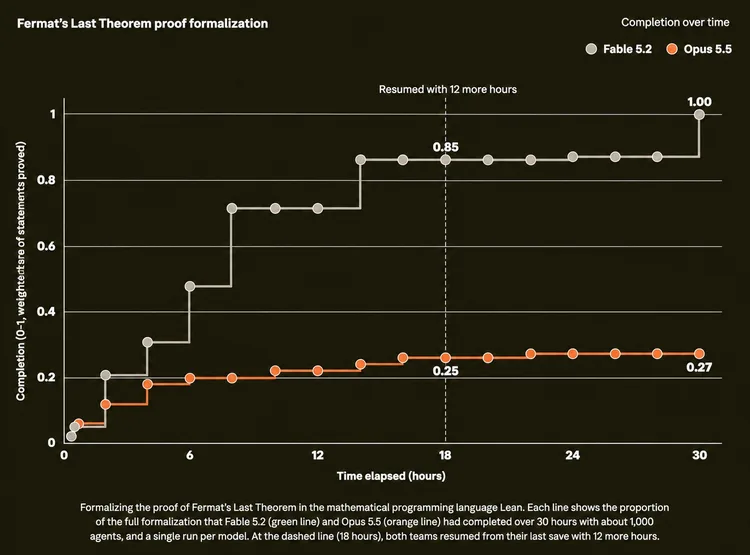
Anthropic is also showcasing results outside programming. A thousand Fable 5.2 agents converted the proof of Fermat’s Last Theorem into the Lean language, in which a computer can verify it step by step. It took 30 hours, while the company’s previous attempt took 11 days. Under the same setup, Opus 5.5 completed roughly a quarter of the work in 18 hours. The model did not devise a new proof; it merely converted an already known text.
According to Anthropic, it also solved two physics problems related to black holes and quantum gravity. The results were published as preliminary scientific studies, but they have not yet undergone peer review. Given a one-paragraph prompt, Fable then designed three electronic devices: a voice-controlled home assistant, a USB speakerphone, and a pocket-sized virtual pet. It selected the components itself and designed the printed circuit boards, 3D-printable enclosures, and software. All three devices worked without a single wiring modification. It also improved significantly at controlling robots, which used it to solve a puzzle cube or unscrew a bottle cap.
What has changed since Fable 5.1
The previous version had problems. In the current Artificial Analysis index, it fell below Opus 5.5, and customers were paying more for weaker performance. In the same benchmark, Fable 5.2 jumped from 49 to 65 points, the highest score of any model and six points more than Opus.
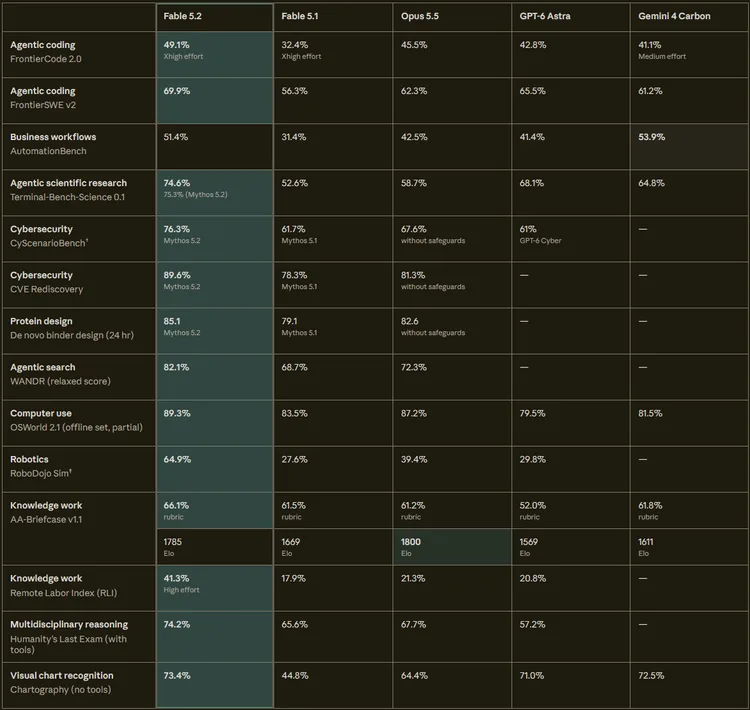
Anthropic’s tables show the biggest gains on long-running tasks. In a test where the model completes real assignments from the freelance job market, it completed 41 percent of tasks compared with 18 percent for its predecessor. In a test measuring whether the authors of open-source software projects would accept its code modifications, it jumped from 32 to 49 percent. Its success rate in controlling a simulated robot more than doubled. However, all these figures were measured by the manufacturer itself.
Ordinary users will notice the changes as well. At the medium effort level used by default in the Claude and Claude Code applications, the model consumes fewer tokens than version 5.1. Its safety filters unnecessarily hold it back roughly half as often, and 60 percent less often in cybersecurity. Testers have also noticed that the model is more likely to admit when it does not know something instead of making it up.
Where Fable 5.2 does not lead
Fable 5.2 does not lead everywhere. Google’s Gemini 4 Carbon beat it in a business process automation test, while Opus 5.5 remains slightly ahead in office work. Commenters on Hacker News point out that they can barely tell the difference from Opus in routine programming and that Anthropic’s table compares Fable at the highest effort level with Gemini at medium effort.
Czech journalist Patrick Zandl had Fable, Opus, and Sonnet look for hidden bugs in real code. The cheapest model, Sonnet 5.5, found the most bugs on the list, while Fable and Opus more reliably detected the most serious one. Fable at medium effort performed better than at high effort and beat Opus running at full power in a quarter of the time. However, Zandl did not find a clear winner between the Fable and Opus models.
Professor Ethan Mollick of the Wharton School points out that the model is poor at assessing the quality of its own work. A scientific paper written by Fable itself ballooned to 182 pages and still contained errors. Another tester found that the model does not know what time it is. One user also complained that Fable launched more agents than it was supposed to and exhausted a five-hour limit in less than twenty minutes.
How much it costs
Through the API, one million input tokens cost $8 and one million output tokens cost $40. Fable 5.1 cost $10 and $50, respectively. According to TechCrunch, the new version is cheaper than its main competitor, OpenAI’s GPT-6 Astra. However, Opus 5.5 still costs half as much, at $4 and $20.
A fast mode can be enabled for twice the price, accelerating generation by up to two and a half times. Anthropic also claims that Fable at high effort achieves the same programming result as Opus at maximum effort for roughly half the task cost. However, no one has independently calculated this yet.
Availability
Fable 5.2 has been available since November 9 on all Anthropic platforms, specifically in the Claude applications on paid plans, in Claude Code, and through the API under the designation claude-fable-5-2. It is also offered by Amazon, Google, and Microsoft cloud platforms. On the Pro plan and standard seats in the Team plan, the model may consume no more than half of the weekly limit. Anyone with Fable included in their subscription will receive one to three limit resets as a bonus this week, depending on the length of their prepaid subscription period.
Companies that objected to data being stored for security reviews can now use the model without data retention through the Enterprise Frontier Safeguards system, which is currently in closed beta. Mythos 5.2 will be available only to security experts and biology researchers who pass a verification program. Enterprise plan customers will be able to access it through the Claude Security tool, which scans their code for security vulnerabilities.
Sources: anthropic.com, gptunnel.en and techcrunch.com