Claude 4: A Revolution in Artificial Intelligence with New Agentic Features and ASL-3 Safety Measures
Anthropic has just introduced (in May 2025) its most advanced family of artificial intelligence models, Claude 4, which sets new standards in reasoning, programming, agentic workflows, and creative writing. This latest generation includes two main variants—Claude Opus 4 and Claude Sonnet 4—and brings a range of breakthrough features that could fundamentally change the way people and organizations work with artificial intelligence.
Hybrid Reasoning and Process Transparency
One of the most significant innovations in Claude 4 is the implementation of hybrid reasoning, which combines immediate responses with extended step-by-step thinking. This feature allows users to view summarized versions of the model’s reasoning processes, providing unprecedented transparency and control over how AI reaches its conclusions. Users can therefore better understand the logic behind responses and influence the direction of reasoning according to their needs. The model supports up to 200 thousand tokens in its context window, meaning it can process very long documents or complex tasks within a single conversation. This capacity opens up new possibilities for analyzing extensive texts, processing large datasets, or working with complex technical documentation that previously had to be divided into smaller parts.
Advanced Programming Capabilities and Agentic Functionality
Claude Opus 4 excels at long-term engineering tasks that can take several days. The model can generate code, perform refactoring, and adapt to specific programming styles with high-quality output of up to 32 thousand tokens per response. This capability makes Claude 4 an ideal partner for complex software projects requiring a consistent approach and adherence to coding standards. The new Code Execution Tool allows Claude to run Python code in a secure environment, opening up possibilities for direct data analysis, visualization creation, statistical modeling, and document processing. Developers can therefore use AI not only to generate code, but also to test and debug it immediately.
Autonomous Search and Research
Claude 4 introduces advanced agentic search and research capabilities that allow the model to autonomously search internal and external data sources and synthesize insights from extensive information sets. This functionality is particularly useful when working with patent databases, academic papers, or other specialized information sources where it is necessary to find and connect relevant data from different sources. The model achieves human-level quality in content creation with improved creativity and natural prose. It excels in both technical writing and narrative creation, making it a versatile tool for a wide range of communication needs.
New Tools for AI Agent Developers
For developers building AI agents, Claude Opus 4 offers several new features. MCP Connector and Files API enable the integration of external systems, such as project management tools, and efficient file management across sessions. This functionality significantly expands the possibilities for connecting AI with existing workflows and systems. Prompt Caching and Batch Processing offer ways to reduce costs through prompt caching for up to one hour and batch processing, which provides additional savings. Organizations receive free quotas for using these tools before minimal additional fees begin to apply.
ASL-3 Safety Measures
With the release of Claude Opus 4, Anthropic activated AI Safety Level 3 (ASL-3) safety measures as a precautionary measure. These measures include stricter internal protections against model theft and targeted deployment restrictions aimed at preventing misuse related to the development of chemical, biological, radiological, and nuclear weapons. These measures are narrowly focused so that they do not restrict general use cases or queries unrelated to safety risks.
Performance Improvements and Model Comparison
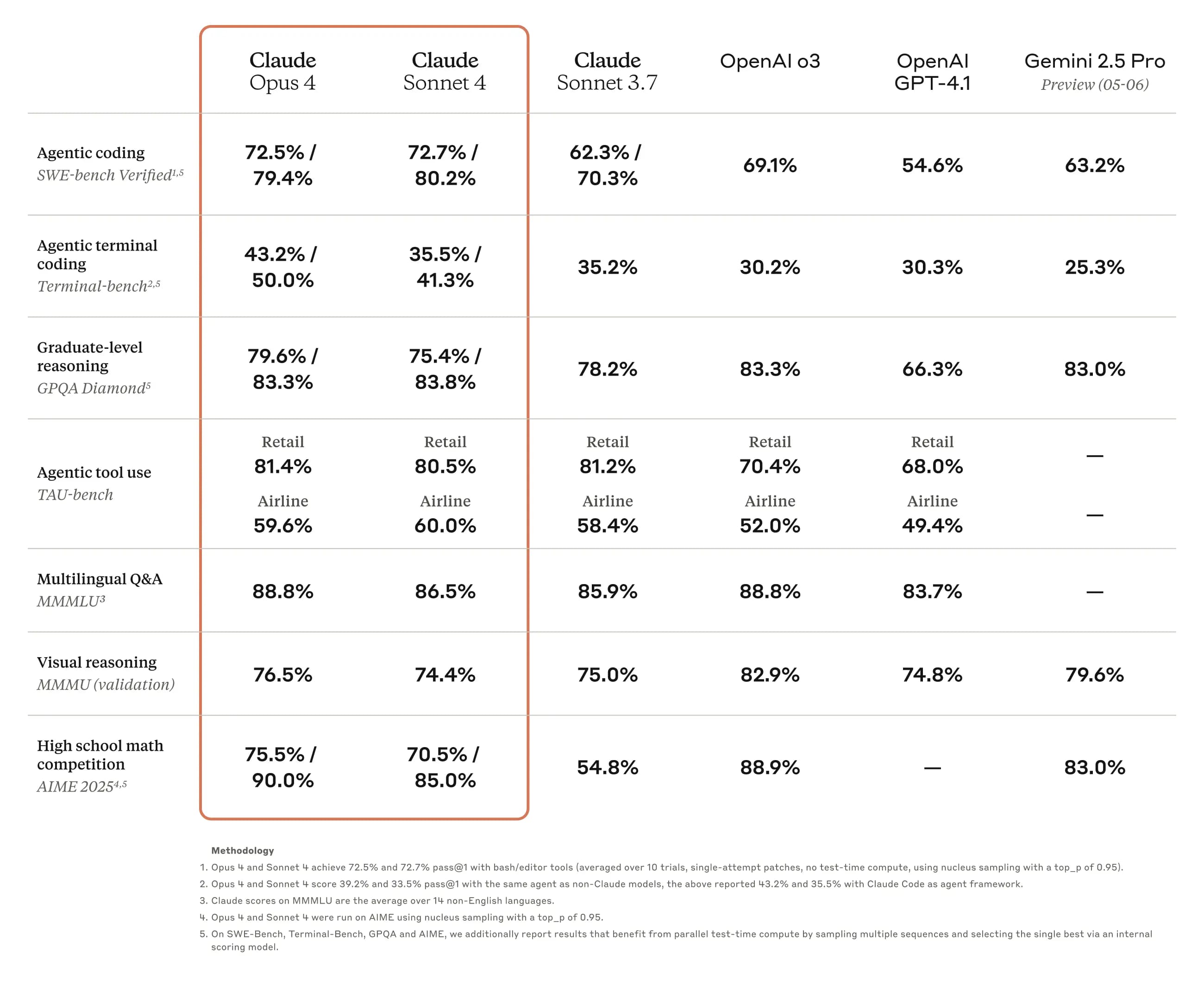
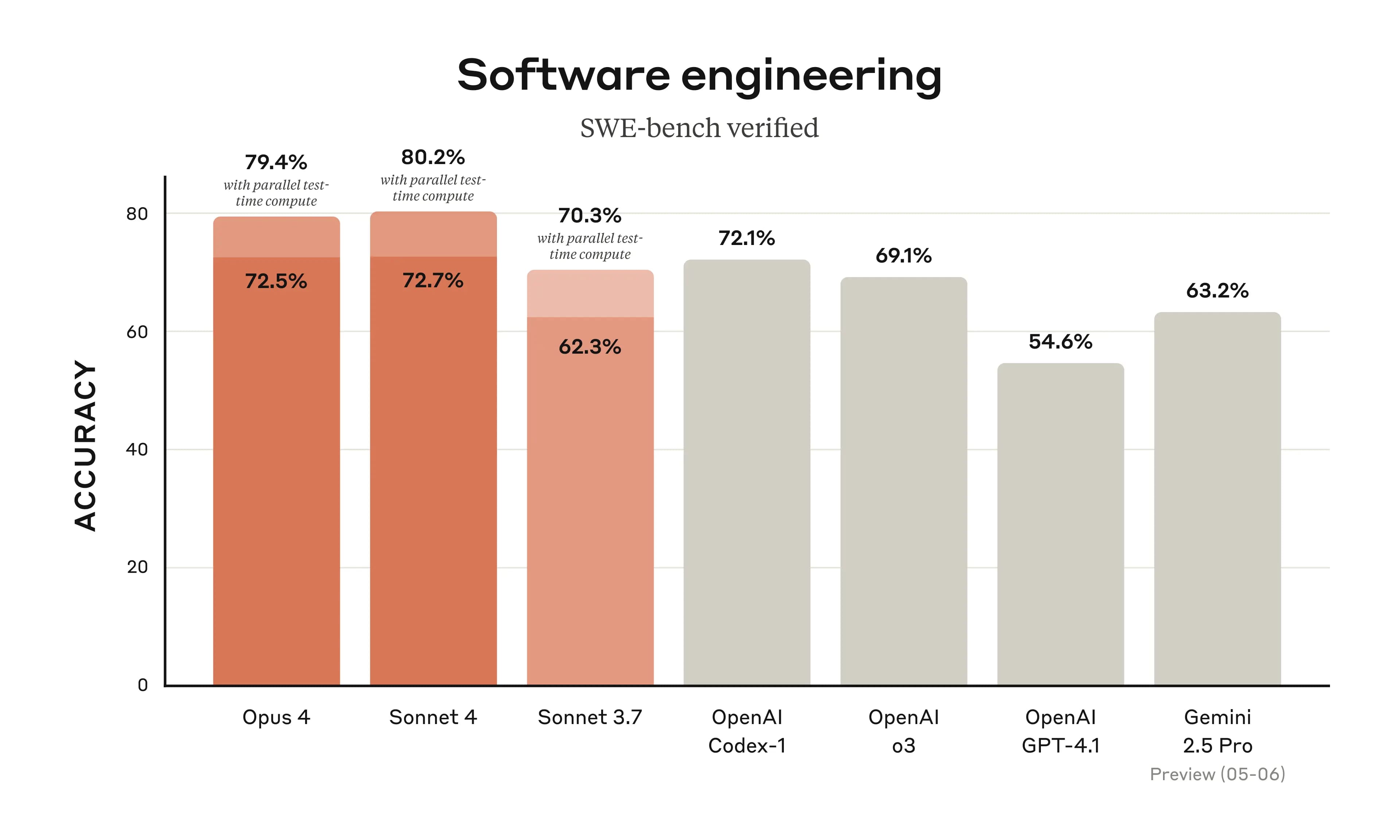
Compared with previous model generations, the performance table shows clear improvements across all key metrics. Claude Sonnet 3.7 offered a good level of intelligence, reasoning, and programming with fast processing. Claude Sonnet 4 delivers better results in all these areas while maintaining speed. Claude Opus 4 achieves the best results in intelligence, reasoning, and programming, though at the cost of slower processing. Opus is best suited for in-depth analysis or complex multi-step tasks where maximum capability is required, while Sonnet offers faster responses with slightly less processing depth.
Migration and Implementation
Transitioning from earlier model versions is relatively simple and generally requires only updating the model name in API calls. Instead of "claude-3-x", it is necessary to use "claude-opus-4-yyyyMMdd" or "claude-sonnet-4-yyyyMMdd". Developers should also handle the new "refusal" stop reason, which indicates when content is rejected for safety reasons, and review prompt engineering best practices tailored specifically for optimal results with Claude 4 models.
Availability and Pricing
Claude Opus 4 is available through Anthropic’s "Claude" web application and, for developers, also through the Anthropic API, Amazon Bedrock, and Google Cloud Vertex AI. Pricing starts at 15 dollars per million input tokens and 75 dollars per million output tokens, with significant discounts available through prompt caching and batch processing options. Business plans include Pro, Max, Team, and Enterprise tiers. Claude 4 represents a significant advancement in artificial intelligence, particularly in the areas of programming agents, reasoning, and content creation, with robust safety controls active by default. This latest generation of models opens up new possibilities for businesses and individuals seeking advanced AI solutions for their specific needs.