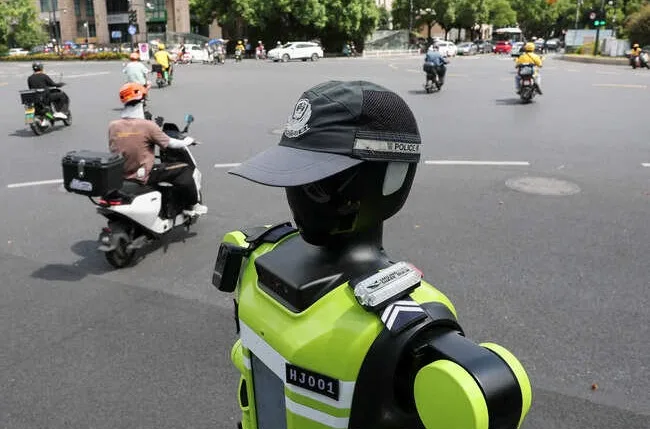
A new robotic traffic police officer has been stationed at an intersection in Hangzhou since spring. It measures 188 centimeters, weighs ninety-eight kilograms, moves on wheels, and is not allowed to arrest anyone. This model, designated T2, is manufactured by SUPCON Information, and during its time on the streets it has already issued more than 170,000 warnings to drivers and pedestrians.
Robots on duty
Fifteen of these machines have been operating in Hangzhou since May, and SUPCON claims that the monthly number of helmetless rides and failures to stop at stop signs has fallen by more than forty percent in the areas they patrol. Although the local traffic police declined to comment on these figures, the robots have nevertheless attracted the attention of authorities across the country. Today, roughly fifty of them are in service in eight cities across three provinces, and their number is expected to rise to approximately two hundred by the end of the year.
The robot combines cameras, radar, and its own computing unit, allowing it to monitor several violations at once. It detects riders without helmets, e-bikes carrying passengers, cars stopping beyond the marked line, and pedestrians entering the road against a red light.
The robot has seven-jointed arms that it uses to mimic standard traffic police signals synchronized with the traffic light cycle. The nearly two-meter-tall figure is clearly visible from a distance, its prerecorded messages sound polite, and in addition to monitoring traffic, the machine can provide directions, parking information, or advice on traffic regulations, while an integrated emergency button connects passersby directly to the local police.
🇨🇳 Seems like traffic officers will be the next ones to get replaced.
— Mario Nawfal (@MarioNawfal) August 15, 2026
In China, they’re already out here standing in the rain, waving cars through with perfect form and zero overtime.
The robots don’t complain, don’t take breaks, and don’t care if it’s pouring.
Human traffic…
"It doesn't get tired"
Cao Hui, who heads SUPCON's unmanned systems center, wants to intervene before an offense occurs and offer a timely reminder instead of issuing a fine after the violation, preventing people from developing bad habits in the first place.
The machines operate autonomously from seven in the morning until six in the evening, travel between predetermined stations on their own, and are not remotely controlled by anyone. Police officers merely monitor and deploy them through a shared platform, while Cao adds that the robot does not get tired and can work steadily for long periods.
The company says it tested the robots for thousands of hours in tourist districts, near schools, in shopping centers, during rush hour, and in adverse weather. Although harsh sunlight, rain, and large temperature fluctuations still cause problems for the cameras and radar, SUPCON nevertheless reports a violation detection success rate of more than ninety-five percent.
From exhibition halls to intersections
The traffic robots are part of China's push to move machines from showrooms into real-world operation. Hangzhou tested its first unit as early as December, and on the first day of the May Day holiday, the city deployed an organized group of fifteen robots on the streets around West Lake. Together with human police officers, they directed crowds and advised tourists, while similar machines also appeared in Kashgar and Ordos on the same day.
Enthusiasm for domestic robotics in China is currently also being fueled by other projects, with Unitree unveiling a humanoid nicknamed Superman at the World Robot Conference in Beijing. According to the company, it can accelerate to 12.66 meters per second, slightly faster than Usain Bolt's recorded speed during his record-breaking 100-meter sprint, and can also jump two meters high from a standing position.
The future is already here! 🤖🚦
— Hola Fujian (@HolaFujian) August 21, 2026
A smart robot traffic police officer has recently been deployed in Hanjiang, Putian. With precise and standardized traffic-control gestures, the robot helps guide vehicles and pedestrians in an orderly manner. Capable of working around the clock,… pic.twitter.com/PU7nkcaaZY
Exports are still struggling
Manufacturers also see markets outside China, with robotics company AiMOGA, backed by automaker Chery, targeting countries where police officers serve in extreme conditions, namely the high temperatures of the Middle East and the long rainy seasons of Southeast Asia. According to manager Zhang Guiping, however, selling a robot abroad is more difficult than selling a car because the machine must integrate with local police systems, obtain certification, and comply with data protection rules, which is the toughest challenge for devices equipped with cameras and sensors.
Similar concerns are also being raised in Europe and Britain, where civil liberties organizations warn that routine biometric surveillance in public spaces is becoming normalized in this way. A machine with a camera permanently stationed at an intersection raises this issue regardless of the fact that it cannot arrest anyone.
The Chinese government expects the market for so-called embodied intelligence to exceed one trillion yuan by 2035 and is counting on the scale of domestic production eventually opening doors in foreign markets as well. Meanwhile, however, the U.S. Federal Communications Commission has banned future imports of foreign-made humanoid and quadruped robots on national security grounds, with the measure being so broad that even ordinary robotic vacuum cleaners will most likely fall under it.
Sources: reuters.com, indiatimes.com and wenewsenglish.com