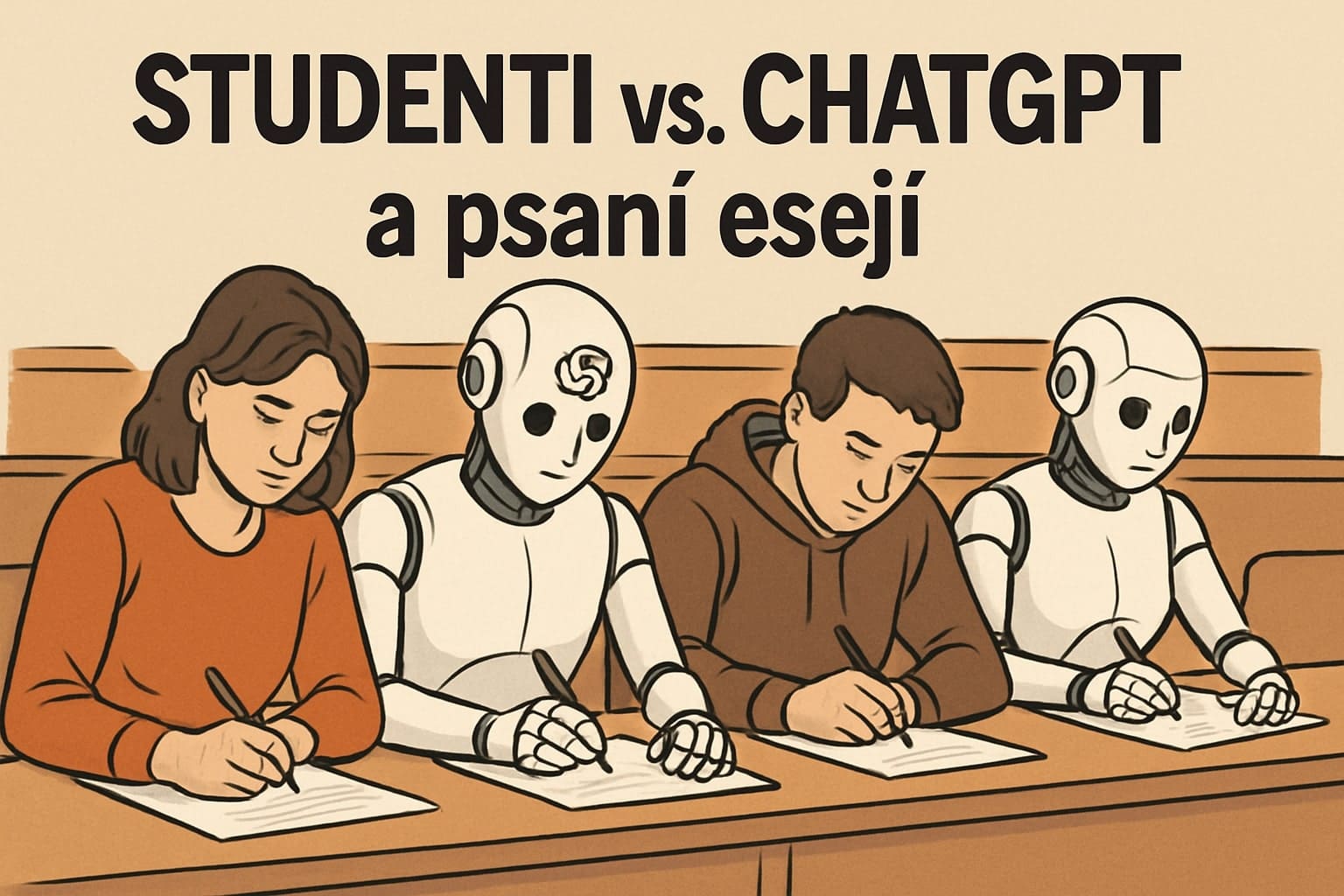
ChatGPT versus students: Who creates more compelling academic texts?
At a time when artificial intelligence has permeated almost every area of human life, researchers are beginning to explore how its outputs compare with human creativity. The latest study, led by renowned expert Ken Hyland, has yielded surprising findings about who writes better academic papers—university students or the advanced artificial intelligence ChatGPT.
Research reveals surprising differences between human and machine writing
Ken Hyland, a prominent researcher of academic discourse and writing, focused his study on comparing essays written by university students with texts generated by ChatGPT. The research specifically examined how authors communicate with readers, particularly the strategy of engaging readers through rhetorical questions, personal remarks, and other interactive elements. The study's results revealed fascinating differences between human and machine approaches to academic writing. Students proved to be significantly better in several key areas that make a text more compelling and engaging. Their essays displayed a richer range of reader-engagement features. They included rhetorical questions, personal remarks, and direct appeals to readers, which improved clarity, established a connection with the audience, and made the arguments more persuasive. Students brought a personal touch to their texts and clearly presented their position on the topic.
At the opposite end of the spectrum were essays generated by ChatGPT, which, although linguistically fluent and formally consistent with academic conventions, felt impersonal. The texts created by artificial intelligence lacked personal engagement and avoided questions and personal comments. They were less engaging and less persuasive, typically lacking a strong, clearly articulated perspective on the topic. Although ChatGPT was able to imitate academic writing conventions, it struggled to create texts with an authentic personal approach.
The study specifically analyzed "engagement markers"—features such as rhetorical questions and personal comments that make written text interactive and persuasive. Hyland found that student essays were "full of rhetorical questions," a technique that was almost entirely absent from ChatGPT outputs. Students also frequently incorporated personal observations and comments, further increasing reader engagement. Surprisingly, although ChatGPT statistically used certain phrase patterns more often to express a position, this did not translate into authentic personal engagement or persuasive authority, as it did in the student texts. This difference reflects the nature of the data on which artificial intelligence is trained and the statistical learning methods that prioritize textual coherence over conversational nuances. Moreover, the quality of ChatGPT's output proved to be highly dependent on the quality of the prompt. If the prompt is not well considered or detailed, the resulting text may be superficial or overly general. This presents another challenge for students who want to use artificial intelligence effectively.
Practical implications for Czech universities and academic integrity
The study also revealed a paradox in the educational use of artificial intelligence. Teachers may have more work reviewing AI-generated texts than they would if students wrote them themselves. If a student simply has AI write the paper and does not personally engage in finding sources and formulating their own opinion, the process loses its purpose and educational value. This points to a fundamental question about the role of artificial intelligence in education.
The results of Hyland's study have broader implications for the education system. While artificial intelligence tools such as ChatGPT can imitate academic language, they struggle to replicate the human capacity for engagement, taking a position, and critical thinking in writing. This suggests that artificial intelligence should serve as an educational aid rather than a shortcut, because academic writing is closely linked to the development of independent thinking and persuasive communication—skills that current AI cannot fully model.
Czech universities are taking a largely constructive approach to the use of ChatGPT and similar tools. Instead of blanket bans, they encourage students to use them honestly and adhere to ethical guidelines. Universities recognize that we are on the threshold of a major revolution in education and that ChatGPT can significantly assist students in their studies. The Faculty of Social Sciences at Charles University suggests several ways students can use ChatGPT without violating academic integrity. Students can use ChatGPT to gain new perspectives and ideas, but they must ensure the originality of their work. At the same time, all sources used must be properly cited, including any use of ChatGPT as a source of information or inspiration. However, the line between acceptable and unacceptable use of AI remains unclear, and as the experience of Czech universities shows, misuse is difficult to prove. This creates new challenges for academic integrity and the educational process as a whole.
The study's conclusion is clear: students generally write more interesting, distinctive, and persuasive texts because they incorporate personal experiences, opinions, and creativity. ChatGPT, by contrast, produces formally correct but less engaging and personally invested texts. If the goal of the paper is to engage readers and present an original perspective, students still have the upper hand. For routine or formal writing, however, ChatGPT can be a useful tool.
This study therefore confirms that even in the era of advanced artificial intelligence, the human element in academic writing remains irreplaceable. Personal experience, critical thinking, and the ability to create an emotional connection with readers are still areas in which humans outperform machines. The research findings should serve as guidance for both educators and students when considering the role of artificial intelligence in the educational process.