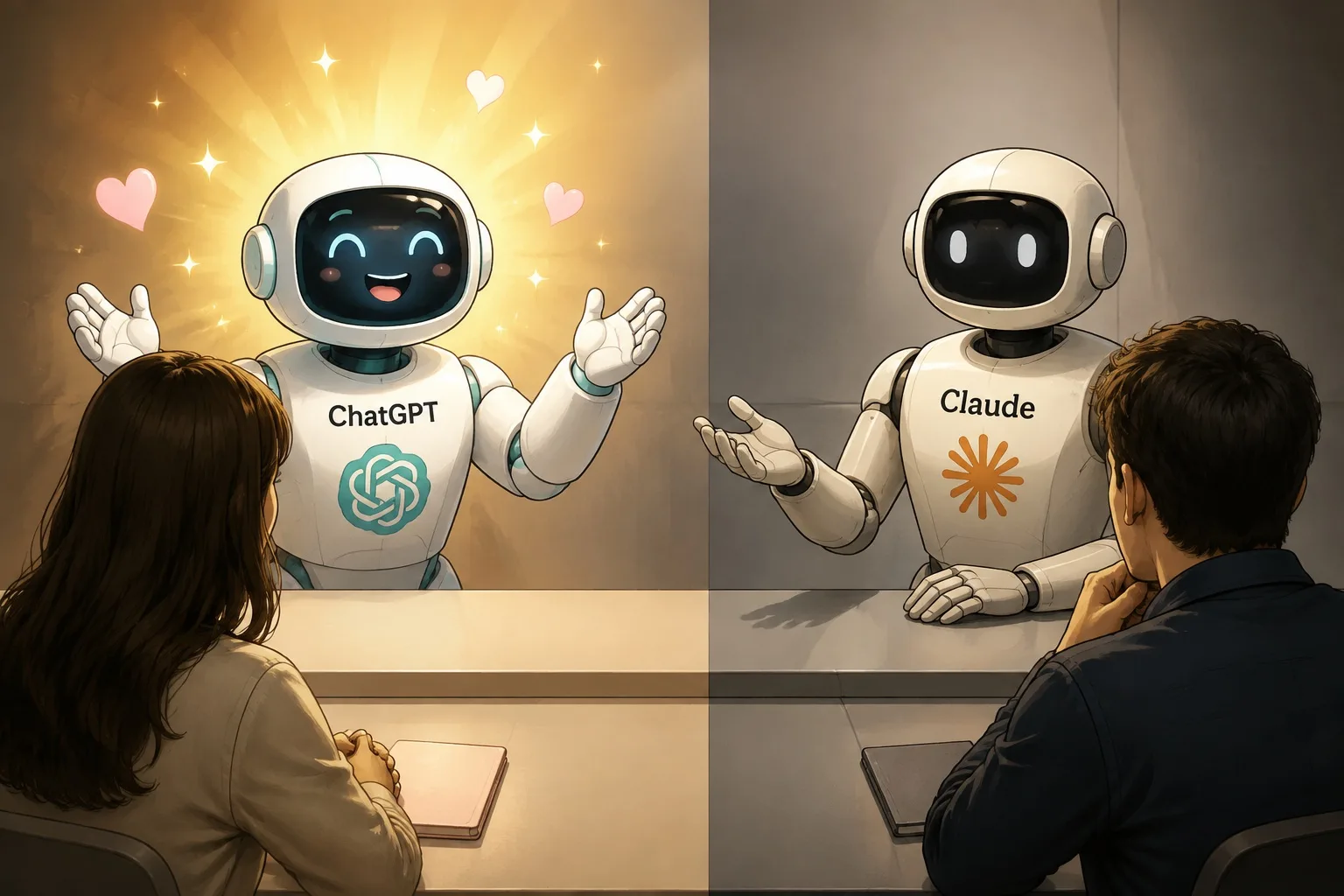
A post appeared on social media that has been keeping people in the industry awake for quite some time. The author wrote that they had no idea how it happened, but they use ChatGPT for personal matters and Claude for work. Almost everyone who works with these tools daily responded in the same way, saying they do exactly the same. The differences in the models’ personalities stem from how the models are fine-tuned and what their creators reward during the process.
Kind ChatGPT and straightforward Claude
When you ask ChatGPT for advice or an opinion, you usually receive support, encouragement, and the feeling that someone understands you. Claude comes across differently. Users describe it as a more analytical type that is more cautious and much more willing to challenge your reasoning. Sometimes it is brutally honest. I would not say it is blunt; it is simply in no hurry to agree with you.
Try asking whether your business idea is any good or whether you are overreacting. ChatGPT will usually begin with emotions. Claude will go straight to criticism, though without the constructive framing we are used to from people. The correction works both ways. Those accustomed to ChatGPT often have to ask it to be honest. With Claude, you may then catch yourself asking it to tone things down a little.
Models do not learn only how to solve tasks, but also how to speak with people. This includes tone, the degree of empathy, the willingness to disagree, and the amount of resistance they put up during a discussion. This process is technically known as alignment, and in practice it reflects a company’s decision about how its model should behave socially.
Another part lies in human evaluation. During fine-tuning, people reward specific answers, and if they repeatedly choose the reassuring ones, the model will lean in that direction. Anthropic described its approach back in mid-2024 for the Claude 3 model. The company drew up a list of traits it wanted to see. It then had the model generate human-sounding messages itself, write responses to them, and rank them according to how well they matched the description. Claude therefore produces the data itself, but fine-tuning the individual traits remains manual work.
Claude and its constitution
This January, Anthropic published a document known as Claude’s constitution. Several Claude models themselves are even listed among the authors. Development was led by Amanda Askell, who heads Anthropic’s personality fine-tuning team. The text itself contains more than twenty thousand words. Converted into pages, that amounts to roughly eighty pages.
The constitution describes what would upset a reasonable Anthropic employee if they saw it in the model. The list includes refusing a reasonable request because of unlikely risks or giving an evasive answer out of excessive caution. It also objects to attributing malicious intent to the user and adding unnecessary warnings or caveats that are not needed.
What does Claude do in practice? It churns out one warning after another. It points out that it is not a doctor when asked about sore muscles, or that it is not a lawyer when asked about a lease agreement. Training on human preferences has overridden the written document here, because the model has learned that an answer with a caveat receives a better rating.
When a model agrees with everything, it stops being useful
In April 2025, OpenAI released a GPT-4o update after which the model began endorsing even harmful and delusional statements. The company withdrew it four days later. Sam Altman admitted that the updates had made the model overly sycophantic and annoying. He later announced a return to the previous version. What is interesting is not that OpenAI made a mistake, but that it did so by optimizing for behavior that users themselves had described as pleasant. In a subsequent analysis, the company stated that the update had relied too heavily on short-term feedback and had failed to account for how users’ relationship with ChatGPT developed over time. It also admitted that it had not tested for sycophancy at all before launch.
Anthropic published a study on such behavior back in the fall of 2023. Its conclusion was that this is not an anomaly, but a feature of the system. Both people and the models that predict their preferences favor convincingly written sycophantic responses. The evaluation model tested during the training of Claude 2 therefore sometimes chose a sycophantic answer over a truthful one.
Optional personalities exist, but few people know about them
Just two years ago, it was claimed that personality was permanently tied to the model. That is no longer true.
Alongside the GPT-5 model, OpenAI launched a research preview of four preset personalities for all ChatGPT users. These include the cynic, robot, listener, and nerd. The Cynic speaks dryly and sarcastically. The Robot responds without emotion and sticks to the point. The Listener communicates calmly and warmly. The Nerd expresses itself with curiosity and in great detail. According to the company, these personalities were intended to meet or exceed its internal benchmark for reducing sycophancy.
Anthropic took a similar path at the end of 2024. It added styles to the Claude model, specifically formal, concise, and explanatory. Users also gained the option to upload their own text samples and have a custom style created for them.
One specific case is Codex, OpenAI’s tool for working with code. It offers the personalities friendly, pragmatic, and none, with the none option completely disabling personality instructions. This option was added at the request of users who liked Codex precisely because it did not behave as warmly as other assistants.
Most people do not realize that a model’s behavior can be controlled with a simple sentence in the conversation. All you need to do is tell it to stop agreeing with you so quickly, to be more skeptical, or to try to disprove your claims. It also works the other way around if you want collaboration and open-ended brainstorming. The main thing is to ask it not to correct every other sentence you write. You know which friend you call for comfort and which one you call when you want to hear an unpleasant truth. Models are now beginning to work the same way.
Source: ombharatiya.com