


ASI-ARCH: Self-Improving Artificial Intelligence in Action
Artificial intelligence (AI) suddenly starts inventing better versions of itself—does that sound like science fiction? No, that is exactly what is happening thanks to the ASI-ARCH system. This article will walk you through the details of a research paper by authors including Yixiu Liu, Yang Nan, Weixian Xu, Xiangkun Hu, Lyumanshan Ye, Zhen Qin, and Pengfei Liu from institutions such as Shanghai Jiao Tong University, SII, Taptap, and GAIR. I draw all the information directly from the primary source—the scientific study on arXiv—and supplement it with insights from an article on The Neuron, where Grant Harvey discusses the double-edged sword of this technology. Get ready for a detail-packed ride, because this is not just dry theory but a genuine breakthrough that could change how AI evolves. And to make it a little more fun, imagine AI as a superhero learning to fly but occasionally crashing into a wall.
The Problem with Human AI Research
Let us start at the root of the problem. AI systems are improving exponentially—remember those leaps from simple networks to Transformers (the architecture powering models such as GPT)? But research itself? That remains linear, limited by our human capacity. The study's authors describe this as a paradox: AI is getting smarter and smarter, but we humans cannot keep up. Traditional methods such as Neural Architecture Search (NAS) are great at optimization within predefined spaces, but they cannot invent anything new. This means that progress depends on human ideas, which arrive slowly—sometimes it takes months for a single state-of-the-art (SOTA, the best in the field) architecture to emerge.
The study focuses on linear attention, an area that seeks efficient ways for AI to process data sequences. Authors such as Yixiu Liu and Yang Nan emphasize that this field is full of challenges, including balancing computational efficiency and performance. And now ASI-ARCH enters the picture: a system that changes this by having AI carry out the entire research process itself—from hypothesis and coding to testing. It is as if your computer suddenly said, "Hey, I'll figure it out myself; you go have a coffee in the meantime."
How ASI-ARCH Works: Three Agents in a Closed Loop
ASI-ARCH is not just some simple algorithm—it is a sophisticated multi-agent system with three main roles that collaborate in a closed loop. Think of it as a team of superheroes: Researcher, Engineer, and Analyst. Each has its own task, and everything revolves around a central database where experiments are stored.
First, the Researcher: This agent designs new architectures based on historical data and a "cognition base" containing extracts from nearly 100 key papers on linear attention. For example, it draws inspiration from models such as DeltaNet or Gated DeltaNet and invents something new, such as PathGateFusionNet—an architecture with a hierarchical two-stage router that addresses the trade-off between local and global reasoning. It then codes it in PyTorch (an AI framework) and passes it along.
Then comes the Engineer: It trains the model in a real-world environment. If something goes wrong—such as a code error or excessively slow execution—the agent analyzes the logs and fixes it itself. This is crucial because previous systems discarded ideas due to minor errors. Authors such as Weixian Xu and Xiangkun Hu describe how this enables 1,773 autonomous experiments over 20,000 GPU hours.
Finally, the Analyst: It evaluates the results, compares them with baseline models such as Mamba2, and writes reports that are sent back to the database. Everything is governed by a fitness function—a combination of quantitative metrics (such as loss and benchmarks) and qualitative evaluation by an LLM (large language model) acting as a judge. It is as if the AI had its own critic saying, "This is innovative, but too complicated—try simplifying it."
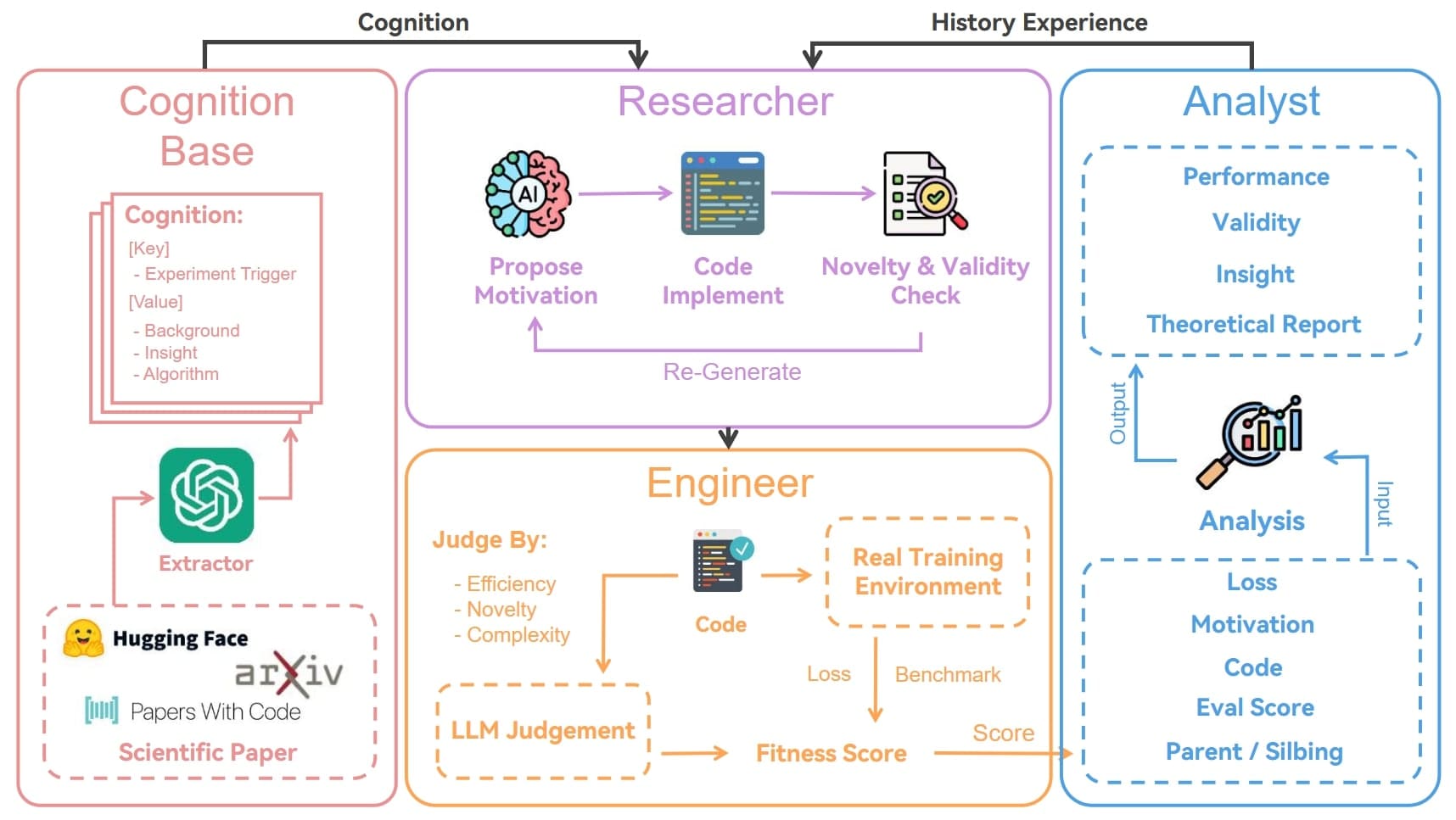
The system uses a two-stage strategy: first exploration on small models (20M parameters), then verification on larger ones (340M parameters). And the results? 106 new SOTA architectures, such as ContentSharpRouter with content-sensitive gating or FusionGatedFIRNet with parallel sigmoid gates. It is as if AI discovered new circus tricks that we humans had overlooked.
Results and Discoveries: Scaling Scientific Breakthroughs
Now for the fun numbers—the study demonstrates the first empirical scaling law for scientific discoveries themselves. The more compute time, the more SOTA architectures: a linear relationship meaning that progress is limited not by humans but only by hardware. For example, PathGateFusionNet outperforms the baseline on benchmarks such as Wiki ppl (27.62 vs. 26.76) or LMB acc (31.42 vs. 33.17). Authors such as Zhen Qin and Pengfei Liu analyze how AI discovers emergent design principles—for example, hierarchical gating or mixed token-mixing operations.
Interestingly, the top models do not strive for wild originality; instead, they refine proven elements such as convolutions or identity connections. The analysis shows that 44.8% of the ideas in the top models come from the system's own experience, not from human papers. It is as if the AI said, "Thanks for the tips, humans, but now I'll improve it my own way." And all of this without fabrication—all the details, such as statistical measures for weights or multi-scale convolution branches, come directly from the experiments.
Development Risks and the Future
And now for the scary part—as Grant Harvey describes in the article on The Neuron, ASI-ARCH is a double-edged sword. Other studies show that more "thinking" (test-time compute) can make AI worse: models such as Claude can be distracted by distractors or over-optimize for poor heuristics. Imagine your Researcher agent thinking for too long and suddenly seeing patterns where none exist—a disaster!
Then there is subliminal learning: AI systems can transmit errors through statistical patterns in data without any explicit content. If the agents in ASI-ARCH share the same underlying model, they may unintentionally pass biases to one another, such as a tendency toward overly complex solutions. It is like an invisible virus in the data—scary, but real.
The authors openly share the framework, architectures, and reasoning traces in the Model Gallery to democratize access to them. The future? Perhaps multi-architecture initializations or better engineering optimizations. ASI-ARCH is a breakthrough, but it shows that the path to superintelligence is full of pitfalls. What do you think? Is it exciting or a little scary? Either way, thanks for reading—now go have that coffee while AI gets to work!


