Artificial intelligence has become an integral part of our everyday lives, from chatbots and image generation to voice assistants, and understanding basic AI concepts is no longer just the domain of experts, but a necessity for anyone who wants to understand the technologies they use every day. This guide explains 33 of the most important AI terms simply and clearly, so you can confidently navigate the world of artificial intelligence and take full advantage of its capabilities.
Basic Concepts: The Building Blocks of AI
Artificial intelligence (AI) is a technology that can simulate human intelligence, enabling systems to learn, solve problems, and make decisions. Machine learning (ML) is a key component of AI in which a computer learns from data without being explicitly programmed for every possible scenario.
Deep learning (DL) is a specialized form of machine learning that uses complex structures called neural networks, which process data in multiple layers, much like the human brain. These networks consist of a series of interconnected layers of nodes that process information together.
Generative AI (GenAI) can create new, original content, from essays and stories to images, music, and computer code. In contrast, predictive AI uses data to predict the future, for example by analyzing purchasing data to forecast popular products.
Natural language processing (NLP) enables computers to understand, interpret, and generate human language. Whenever you use a chatbot or voice assistant, you are experiencing NLP in action. Computer vision enables computers to see and interpret visual information from images and videos.
Large language models (LLMs) are the technology behind many generative AI systems. They are powerful models trained on vast amounts of text data. AI models such as ChatGPT and Gemini are examples of LLMs that require cloud computing because they need powerful hardware.
Small language models (SMLs) are trained with far fewer parameters and less data. They are designed to run locally on less powerful devices; for example, Gemini Nano is available on several Android phones.
Working with AI Tools
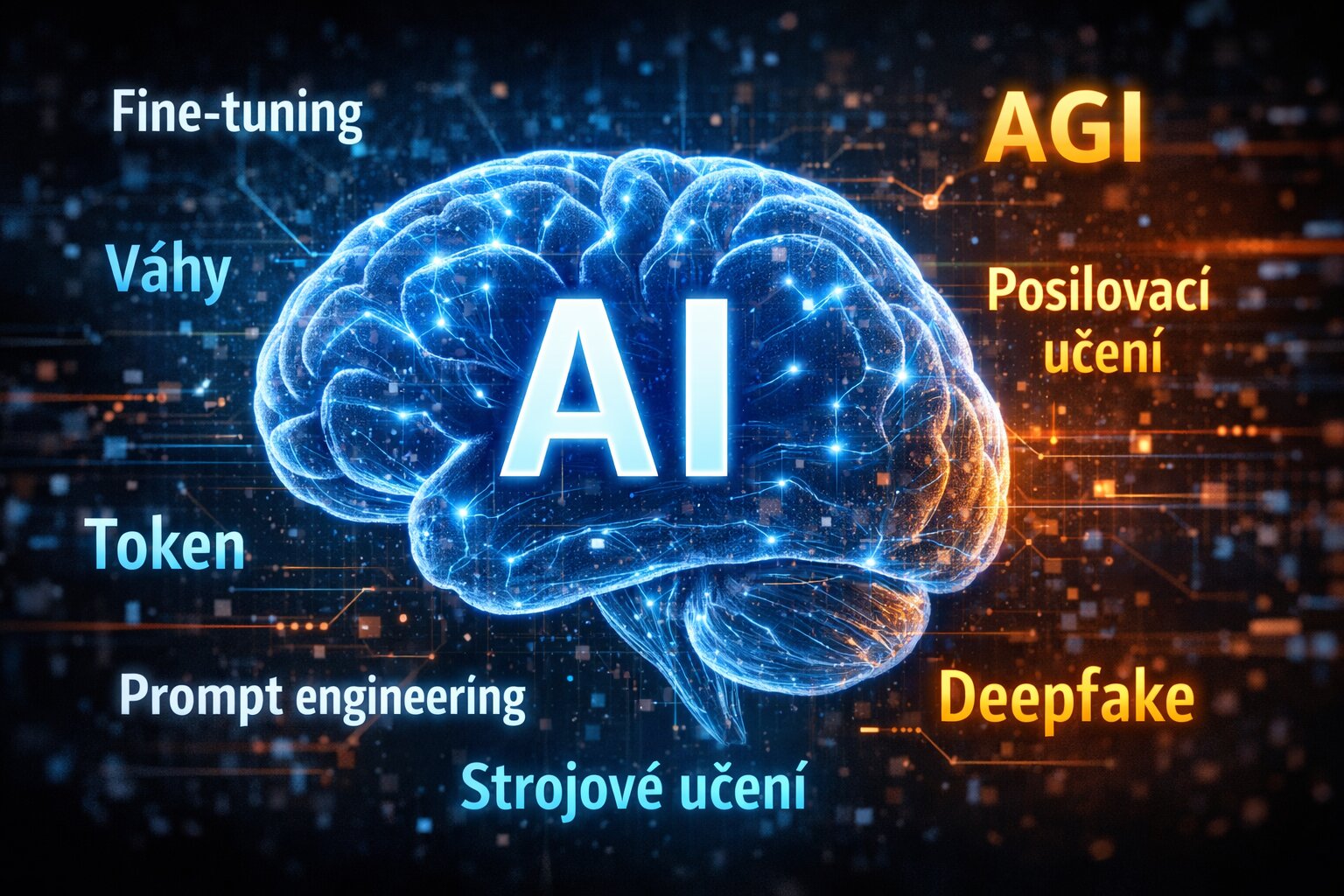
A prompt is essentially what you say to AI—the text or command you enter into a chatbot to get a response. A good prompt is often the key to obtaining a high-quality response. Prompt engineering is the art and science of creating effective prompts to achieve the best possible response.
Hallucination is an important term describing a situation in which AI provides a confident-sounding answer that is completely wrong or nonsensical. A deepfake is a synthetic video, audio recording, or image of a person that looks or sounds so realistic that it is difficult to tell it is fake.
A context window is the amount of information an AI model can remember or consider at once when generating a response. If a conversation goes on for too long, the AI may forget what you said at the beginning.
A token is the smallest unit of data processed by an AI model. In text, a token can be a word, part of a word, or even a punctuation mark. Temperature is a setting that controls how creative or random an AI response is—a high temperature produces more varied responses, while a low temperature produces more predictable ones.
Agents are AI systems capable of independently performing complex, multi-step tasks, often without continuous human supervision. For example, an agent could book a flight by interacting with multiple websites.
Model Training and Development
A model is the trained algorithm itself—a file or program containing the AI's knowledge and ready to make predictions or generate content. There are models for specific tasks, such as Google's Imagen for images and Veo for videos.
A dataset is the entire collection of training data used to teach AI. Model training is the complete process of feeding data to an AI model so that it can learn a specific task.
Supervised learning is a training method in which the AI receives a labeled dataset with answers and learns by comparing its predictions with the correct ones. Unsupervised learning means that the AI receives unlabeled data and must find hidden patterns on its own.
Reinforcement learning is a method in which AI learns through trial and error, receiving rewards for correct actions and penalties for incorrect ones. Zero-shot learning is an AI model's ability to perform a task for which it was not explicitly trained, based solely on the broad understanding gained from its training data.
Data distillation is a technique for transferring knowledge from a large, complex model to a smaller, more efficient one. Synthetic data is artificially generated information that mimics the statistical properties of real-world data and is useful for training models.
Fine-tuning is the process of taking a pre-trained model and training it on a smaller, specific dataset to improve its performance on a particular task. Overfitting occurs when a model learns the training data too well and memorizes specific examples instead of understanding general patterns.
Inference is the process of using a trained AI model to make a prediction or generate new content from new data. Bias is a systematic error in an AI system that leads to unfair or inaccurate results, often due to unrepresentative training data.
Technical and Advanced Concepts
Parameters are internal settings or variables that an AI model adjusts during training. The size of an LLM is usually measured by its number of parameters—an LLM with fewer than 10 billion parameters is considered an SML.
Vector embeddings are a way of representing words, images, and other data as numerical vectors, enabling AI to understand relationships between different pieces of information. An algorithm is a set of rules or instructions that a model follows when learning from data.
Weights are values that a neural network assigns to its connections and that determine the importance of inputs. Layers are the different levels of a neural network through which information flows, from the input layer through the hidden layers to the output layer.
An attention mechanism is a technique that allows a model to focus on the most important parts of the input data when generating a response. A transformer is a specific type of neural network architecture that uses an attention mechanism to process sequential data.
An API (Application Programming Interface) is a set of rules and protocols that enables communication between two different software programs, such as a website and an AI model. A GPU (Graphics Processing Unit) is a specialized processor that excels at the parallel computations required to train AI models.
Artificial general intelligence (AGI) is a hypothetical form of AI that would have the ability to understand, learn, and apply knowledge across a wide range of tasks at a human level, much like the human brain.