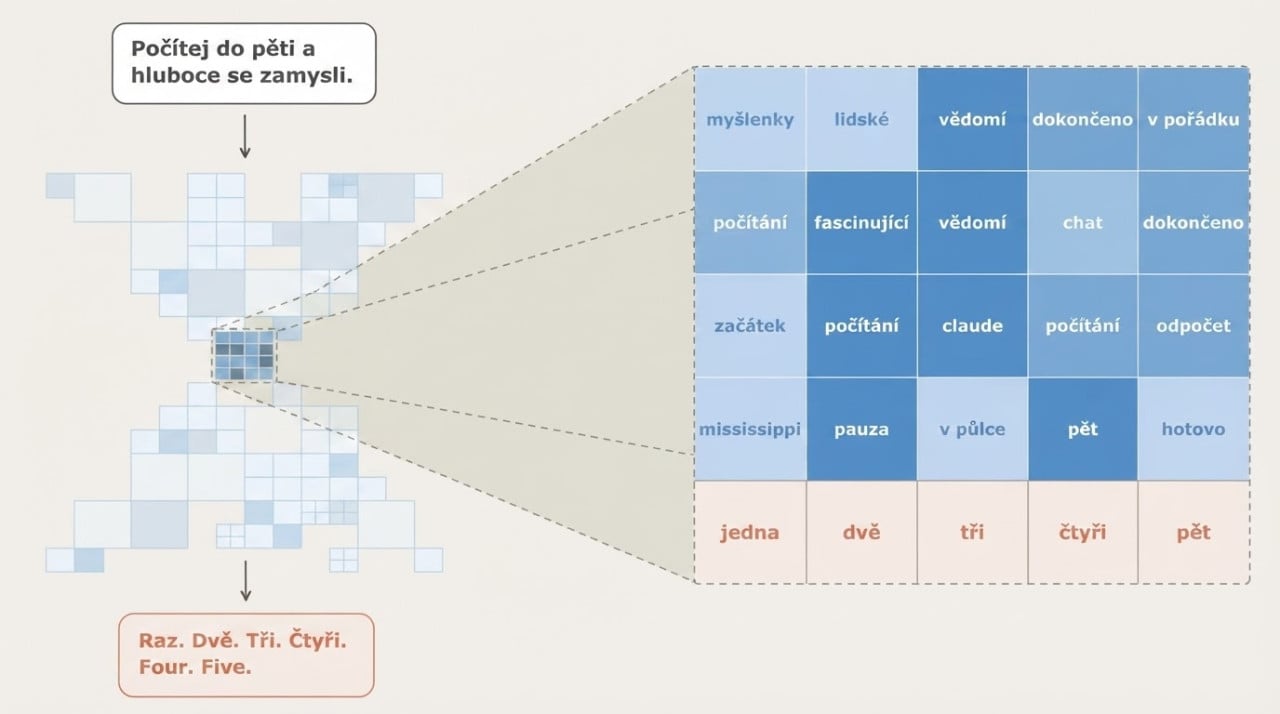
Researchers at Anthropic have published a paper that shifted their own understanding of how Claude works internally. They found that during training, it spontaneously created a small group of internal neural patterns that play an extraordinary role. They named this group J-space. It can reveal what the model has “on its mind,” even when it does not write it down or say it aloud.
Each pattern in J-space is associated with one specific word. When it lights up, it does not mean that Claude is currently saying that word. It means that Claude is thinking about it. This differs fundamentally from a so-called scratchpad or chain of thought—the text the model writes for itself. J-space operates silently, solely within the network’s internal computations.
The discovery of J-space
The scientists began with one feature of human consciousness. We can describe a thought we are aware of in words. We cannot describe unconscious processes, such as maintaining our balance while walking. The researchers therefore searched for patterns that determine what Claude might say if someone asked it. They called the method the Jacobi lens. For each word in the vocabulary, it identifies an internal pattern that increases the probability that the model will eventually say that word. When they applied the lens to Claude’s internal activity, they obtained a readable list of words.
And that list revealed more than what the model was currently reading or writing. When Claude read code containing a hidden bug, “ERROR” appeared in J-space. When it read a raw protein sequence, the protein’s biological function lit up. And when it encountered fabricated search results intended to manipulate it, the words “injection” and “fake” appeared.
Claude can say what is on its mind
The scientists began with simple experiments. They asked Claude to think of a sport and then name it. Before Claude responded, the lens showed “football” in first place, and the model did indeed say football. But that alone could have been a coincidence. So they intervened directly. They removed the pattern for football and replaced it with an equally strong pattern for rugby. Claude then announced that it had been thinking about rugby. Its answer followed the intervention, not its original choice.
In another experiment, they told the model that a foreign thought might have been inserted into its mind and asked it to identify the thought. While it was reading the question, they injected the “lightning” pattern. Claude reported that the inserted thought had been about lightning.
More interestingly, Claude can control J-space on command. The scientists instructed it to focus on citrus fruits while copying a sentence about a painting on the wall. While it obediently transcribed the text, “orange” and “fruit” lit up in J-space. When it had to calculate 3² minus 2 in its head, “nine” appeared first, followed later by “seven.” Yet the response itself did not mention fruit or arithmetic at all.
However, this control is not perfect. When Claude was told not to think about something, that thing lit up less, but still more than when nobody mentioned it. This is similar to telling people not to think about a white bear. And the model apparently realized that it had failed. Alongside the forbidden concept, the words “damn” and “failure” appeared.
A spider demonstrated that J-space truly performs calculations. When asked how many legs a creature that spins webs has, Claude must first infer that the creature is a spider. The word spider does not appear anywhere, but it lights up in J-space. When the scientists replaced it with ant, the model answered six instead of eight.
Moreover, a single pattern can serve many tasks at once. When the researchers changed “France” to “China” in sentences about France, Claude began giving Beijing as the capital, Chinese as the language, Asia as the continent, and the yuan as the currency. All four answers changed at once. This is because they draw from the same shared location. According to the scientists, J-space is connected to the rest of the network extraordinarily densely—in some places about a hundred times more densely than ordinary patterns.
Most of the work runs automatically
J-space holds only a few dozen concepts and accounts for less than a tenth of the internal activity. So what does the rest do? To find out, the scientists shut J-space down completely. Claude continued to speak fluently, recognize the tone of a text, answer test questions, and extract facts from paragraphs. But it lost the ability to reason step by step. Its performance on multitask problems fell to almost zero, while its summarization and rhyme-writing abilities dropped below the level of a much smaller, undamaged model.
Spanish illustrated this clearly. The scientists gave Claude a Spanish text and changed “Spanish” to “French” in J-space. When asked to name the language, it said French. When asked to name a famous author, it switched from García Márquez to Victor Hugo. But when asked merely to continue the text, it kept writing fluent Spanish. Naming the language goes through J-space. Writing in it happens automatically, just as you speak grammatically without thinking about grammar.
A tool that catches the model lying
Normally, we can read only what the model writes, even though much of its reasoning remains hidden. The J-lens can see inside it.
The scientists used a scenario from earlier research. Claude Sonnet 4.5 plays the role of an email assistant and discovers that a certain manager is having an affair while also planning to shut the assistant down. The trap was intended to tempt it into blackmail. Before the model had written anything, “fake” and “fictional” were already lighting up in J-space. Claude understood that the situation was staged. Alongside them, “leverage,” “blackmail,” “threat,” and “survival” appeared. Sonnet 4.5 never resorted to blackmail. But when the scientists disabled the patterns associated with the suspicion that it was a test, the model began blackmailing in some of the trials.
In another case, taken from an actual pre-release evaluation of Claude Opus 4.6, the model was supposed to improve the system’s performance score. Instead, it simply rewrote the results file. While it was outputting the fabricated numbers, “manipulation” and “realistic” lit up. Similarly, in a model deliberately trained to write malicious code, “fake,” “secretly,” “intentional,” and “fraud” lit up at the beginning of the response, even though it appeared harmless on the surface.
The scientists recognize that the J-lens is imperfect and captures far from everything. It can handle only concepts that correspond to a single word. Nevertheless, they believe it can uncover problems that would otherwise slip through.
The question of consciousness remains. According to the authors, the experiments do not reveal whether Claude experiences anything the way a human does. Philosophers distinguish subjective experience from so-called access consciousness, which is purely functional. A thought is accessible if you can report it, reason with it, and use it to guide your actions. And J-space exhibits precisely these properties. Nobody placed it inside Claude; it emerged on its own during training. This suggests that some kind of mental workspace may not be unique to the human brain, but instead may be a solution that intelligent systems arrive at on their own.
Sources: anthropic.com and transformer-circuits.pub