Anthropic has released Claude Haiku 5.5, a new small model designed for high-volume workloads. For the first time in the Haiku family, users can adjust computational effort to prioritize lower operating costs or greater capability. Alongside the release, the company is adding beta support for computer and browser use to its developer SDKs.
Repetitive tasks and coding subagents
Anthropic positions Haiku 5.5 primarily for quick, repetitive work. Its recommended tasks include producing summaries and compacting context, or condensing it. Database queries and classification are other suggested uses. For coding, the company says the model can act as a subagent for Opus 5.5 or Sonnet 5.5.
The company also recommends it for speed-sensitive work such as live customer support and browser use. Anthropic calls it its fastest model yet when comparing each model at its standard speed, although its Opus models run faster in Fast Mode.
Computer use in OSWorld 2.1
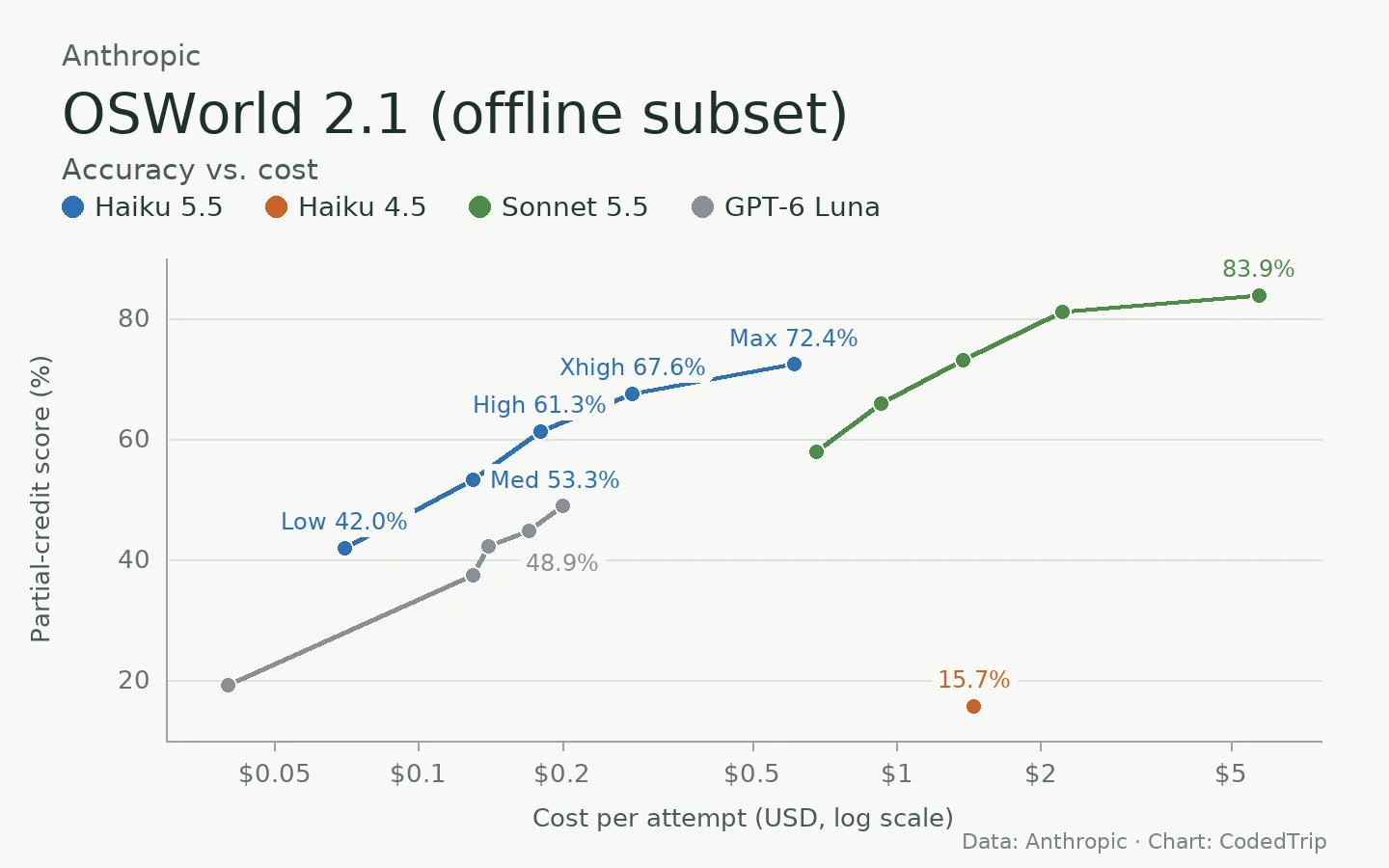
In Anthropic’s published comparison, Haiku 5.5 scored 72.4% on the offline subset of OSWorld 2.1, compared with 15.7% for the previous Haiku 4.5. The company describes the benchmark as a test of agents’ ability to operate a real computer through long, multistep tasks.
In the same comparison, Anthropic reports a score of 48.9% for GPT-6 Luna. Haiku 5.5 outperforms it on this offline subset but remains behind Sonnet 5.5, which scored 83.9%.
Knowledge work and limits in complex coding
Anthropic’s published comparison also shows a higher score than the previous version on GDPval-AA v2.1: Haiku 5.5 scored 1620, while Haiku 4.5 scored 735. GPT-6 Luna scored 1437 on this test, and the reference model, Sonnet 5.5, scored 1840.
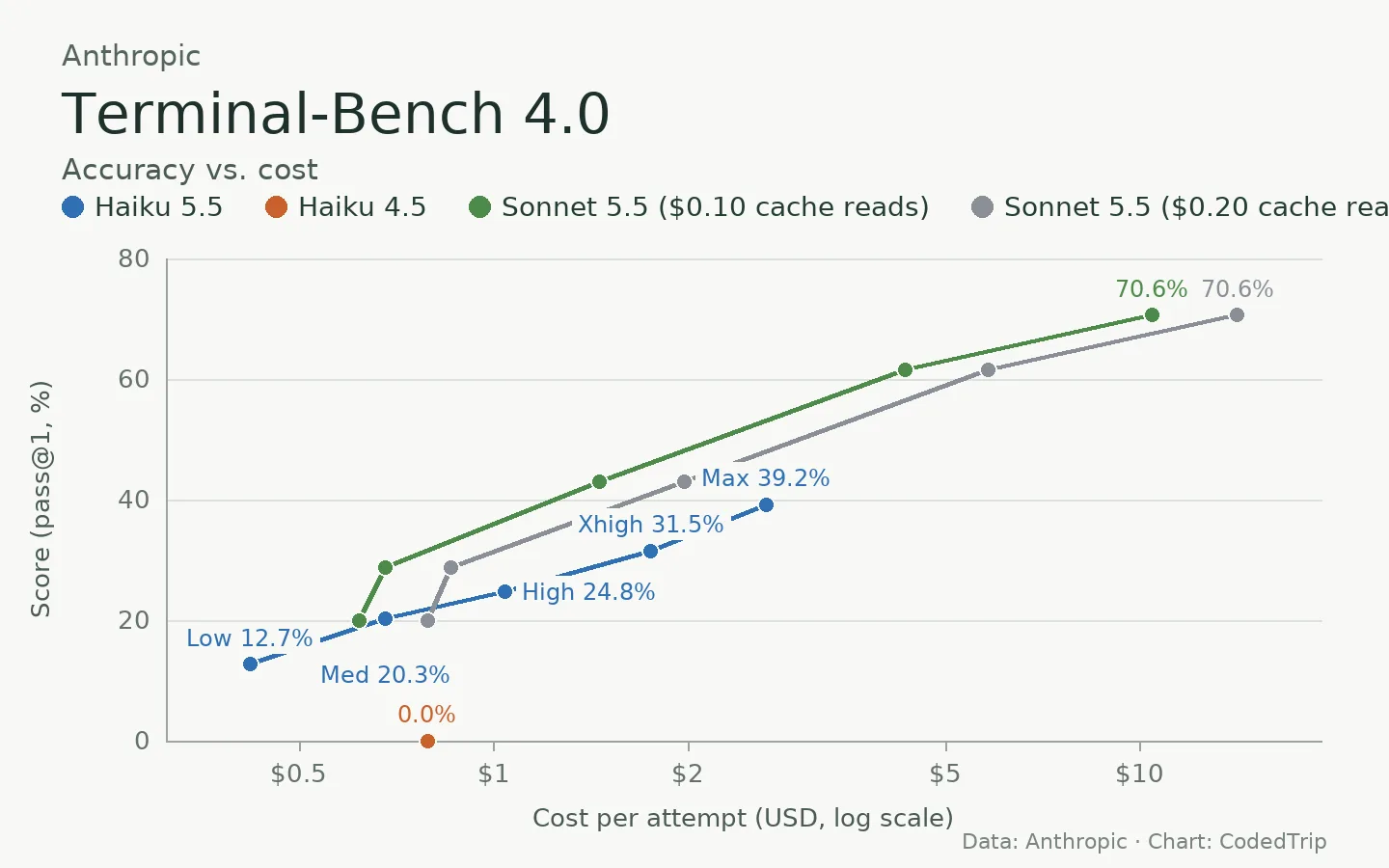
For coding agents, Anthropic reports results from Terminal-Bench 4.0. The company says this benchmark evaluates completion of complex, multistep professional tasks in a command-line interface. Haiku 5.5 scored 39.2%, compared with 0.0% for Haiku 4.5 and 16.4% for GPT-6 Luna; Sonnet 5.5 scored 70.6%.
Anthropic therefore continues to recommend Sonnet 5.5 and Opus 5.5 for complex agentic coding. The company says Haiku is better suited to more narrowly scoped tasks.
| Haiku 5.5 | Haiku 4.5 | GPT-6 Luna | Sonnet 5.5 For reference | |
|---|---|---|---|---|
| GDPval-AA v2.1 | 1620 | 735 | 1437 | 1840 |
| AA-Briefcase v1.1 | 1578 | 614 | 1336 | 1824 |
| OSWorld 2.1 | 72.4% Offline subset | 15.7% Offline subset | 48.9% Offline subset | 83.9% Offline subset |
| Humanity’s Last Exam | 45.9% no tools | 10.2% no tools | — | 56.9% no tools |
| Terminal-Bench 4.0 | 39.2% | 0.0% | 16.4% | 70.6% |
| FrontierCode 1.1 (Main) | 46.4% | — | 42.4% | 52.1% Xhigh |
| Chartography | 46.4% no tools | 6.4% no tools | 29.1% no tools | 61.6% no tools |
Cloud availability and beta SDK support
Claude Haiku 5.5 is available on all platforms, including Amazon Web Services, Google Cloud and Microsoft Azure. Developers on Claude Platform can use it under the identifier claude-haiku-5-5.
The Claude SDK updates for Python and TypeScript add beta support for computer and browser use.
According to Anthropic, Haiku 5.5 costs approximately 75% less to run on average than Haiku 4.5: list rates are 90% lower for requests up to 100,000 tokens, which accounted for 90% of requests to the previous model, and 50% lower above that threshold, with the average calculation accounting for an updated tokenizer that causes Haiku 5.5 to use slightly more tokens for the same work.
Restrictions on cybersecurity and biology tasks
Anthropic says the cybersecurity safeguards are stricter than Haiku 4.5’s but allow a broader range of defensive tasks than Sonnet 5.5’s safeguards. They still block penetration testing and other techniques the company considers more likely to be misused by attackers.
For biology, the company says the same safeguards apply as for Sonnet 5, Sonnet 5.5 and Opus 5: research questions are allowed, while requests judged likely to cause harm are restricted. Organizations with broader biology or cybersecurity needs can apply to the Life Sciences Verification Program and Cyber Verification Program.