

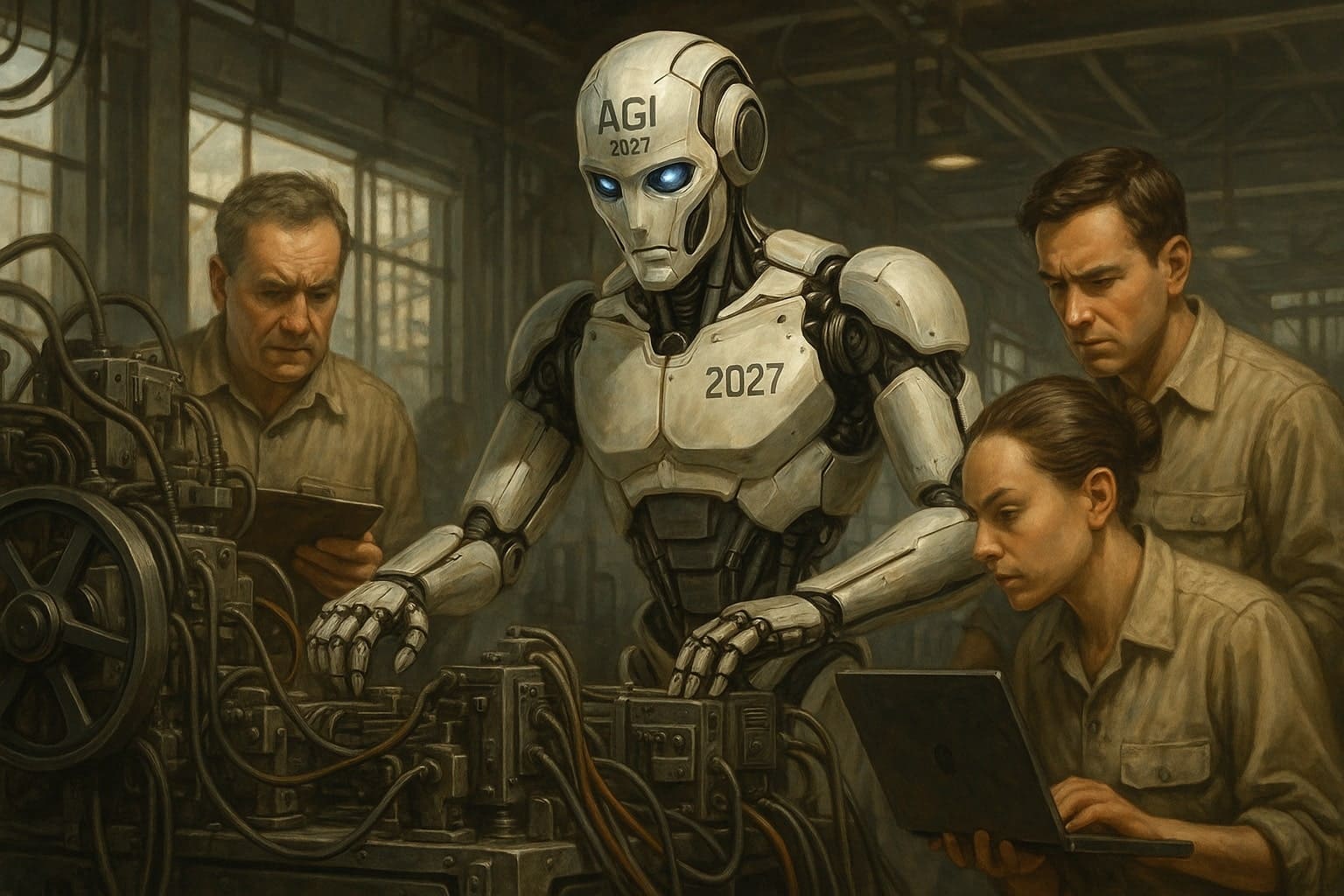
Anthropic, a company focused on artificial intelligence development, has official estimates for when AGI, or artificial general intelligence, will arrive. According to its recommendations to the OSTP from March 2025, it expects powerful AI systems to emerge in late 2026 or early 2027. These systems should have intellectual capabilities equal to or greater than those of Nobel Prize winners in fields such as biology, computer science, mathematics, and engineering.
In the essay Machines of Loving Grace, Dario Amodei explains in detail that such an AI would be smarter than a Nobel Prize winner in areas such as biology, programming, mathematics, engineering, or writing. It could prove unsolved mathematical theorems, write outstanding novels, or create complex code from scratch. It would also have interfaces like a human working remotely: text, audio, video, mouse and keyboard control, and internet access. It would be able to take actions, communicate, order materials, conduct experiments, watch videos, or create them—all at the level of the best people in the world.
This AI would not only answer questions but would independently perform tasks lasting hours, days, or weeks, much like an intelligent employee who asks for clarification when needed. The resources used for training would make it possible to run millions of instances, and the AI would absorb information and generate actions 10 to 100 times faster than a human, although it could be limited by the response times of the physical world or software.
Powerful AI would fully automate AI research and development, scientific research in many fields, and most remote office work. For example, it would automate AI research without human assistance, at a speed comparable to research conducted with humans. It would also handle most scientific research that can be performed remotely in laboratories, for most companies in relevant fields. Finally, it would automate a substantial share (more than 25%) of remote office work in America, provided there were enough computing power and regulations did not prevent it.
Early predictions and their validation
Anthropic is the only AI company with official AGI estimates, as confirmed by Jack Clark, co-founder of Anthropic. In the essay Machines of Loving Grace and in the recommendations to the OSTP, Dario Amodei reiterates that powerful AI systems will arrive in late 2026 or early 2027. Jack Clark confirms on the X platform that this view remains valid.
Dario Amodei previously predicted that between June 2025 and September 2025, AI would write 90% of code, and that by March 2026, AI would write almost all code. According to the author, this has not happened yet, although the situation is complicated. The metric "share of code written by AI" is not ideal because it does not capture how much AI increases productivity. For example, Anthropic employees report that Claude makes them 20 to 40% faster, according to information from the Sonnet 4.5 system card, even though AI writes most of the code.
The author proposes a timeline that would match Anthropic's expectations, working backward from March 2027, when powerful AI would be complete. This timeline is derived from the AI 2027 scenario, shortened to 60% of its length to match the current situation in October 2025.
A proposed timeline that Anthropic might expect
Under the proposed timeline, powerful AI would be complete in March 2027, which would require a massive acceleration in AI research. In February 2027, AI would fully automate AI research, accelerating progress. In December 2026, AI would fully automate engineering research, enabling faster progress toward powerful AI in just 3.5 months.
In September 2026, AI would make engineers five times faster, successfully complete tasks that would take an average engineer many months, and complete 90% of tasks lasting several weeks. In June 2026, the speedup would reach almost threefold, and AI would successfully complete complex tasks such as writing an efficient inference stack for DeepSeek V3 on Amazon's Trainium chip, most two-week tasks, and nearly all one-day tasks.
In March 2026, the speedup would be 1.8 times, and AI would successfully complete most one-day tasks, such as optimizing training or inference in a company's codebase. In October 2025, which is now, the speedup would be 1.3 times.
The author provides a table with data: For example, in December 2026, the engineering multiplier would be 50x and the AI research multiplier 6x, with unlimited reliability on long tasks. In September 2026, it would be 5x for engineering and 2x for AI research, with 50% reliability on 10-month tasks and 90% reliability on 3-week tasks.
Why powerful AI by early 2027 seems unlikely
The author estimates the probability of powerful AI by early 2027 at about 6%, which is very low. The main reason is that it would require progress much faster than trends suggest. METR showed an exponential trend in the length of software tasks that AI can complete with 50% reliability: by the end of 2026, AI would be able to complete 16-hour tasks with 50% reliability and 3-hour tasks with 80% reliability. But performance is worse on real-world tasks at AI companies.
Other trends, such as SWE-bench or RE-bench, suggest that saturation will occur in a year or more, and there is a large gap between saturation and full engineering automation. The author refutes arguments that trends underestimate progress: For example, the acceleration of AI research before full automation will not be as massive as would be necessary.
Another objection is that scaling RL (reinforcement learning) will produce above-trend progress, but the author disputes this. Superexponential growth in the trends would have to be extreme, which is unlikely. A massive algorithmic breakthrough is specific and rare, with a base rate of once every 10 years, not every few years.
The author argues that even if AI fully automated engineering by the end of 2026, powerful AI by early 2027 would still be less likely. METR trends measure performance against average engineers, but full automation requires surpassing the best. The last mile of automation will be difficult, with a long tail of skills that are hard for AI to acquire.
There may be a gap of more than a year between full engineering automation and powerful AI, even if faster AI research shortens it.
So what are the expectations?
The author predicts slower progress: By December 2026, the engineering multiplier would be 1.75x, with 50% reliability on 7-hour tasks and 90% reliability on 1-hour tasks. By September 2026, it would be 1.6x, with 50% reliability on 5-hour tasks and 90% reliability on 0.75-hour tasks. By June 2026, it would be 1.45x, with 50% reliability on 3.5-hour tasks and 90% reliability on 0.5-hour tasks. By March 2026, it would be 1.35x, with 50% reliability on 2.5-hour tasks and 90% reliability on 0.35-hour tasks. In October 2025, it would be 1.2x, with 50% reliability on 1.5-hour tasks and 90% reliability on 0.2-hour tasks.
This forecast is based on extrapolating trends, such as a doubling of the time horizon. December 2026 would look similar to March 2026 in the proposed timeline, which is 3–4 times slower than Anthropic's expectations.
What updates should come over the next year?
If the author's median expectations are met, with AI making engineers 1.75 times faster and handling nearly full-day tasks by the end of 2026, the author would revise the estimates toward longer timelines and a lower probability of above-trend progress before massive automation. The probability of fully automating AI research before 2029 would decrease, but the current paradigm would suggest powerful AI within 15 years, probably within 10 years.
For Anthropic, this would dramatically call its view into question; it should focus on better trends and be more conservative. It should acknowledge its mistake and make new predictions.
If the proposed timeline is met by June 2026, with a threefold speedup and successful completion of two-week tasks, the author would revise toward shorter timelines: a 20% probability of full automation by early 2027, with a median timeline of mid-2029. A 15% probability of powerful AI by early 2027, 25% by mid-2028, and 50% by early 2031.
If progress is slower than the author expects, the revisions would shift toward longer timelines for everyone. If it is faster than the author expects but slower than the proposed timeline, the author would shorten the estimates, while Anthropic would lengthen them.


