

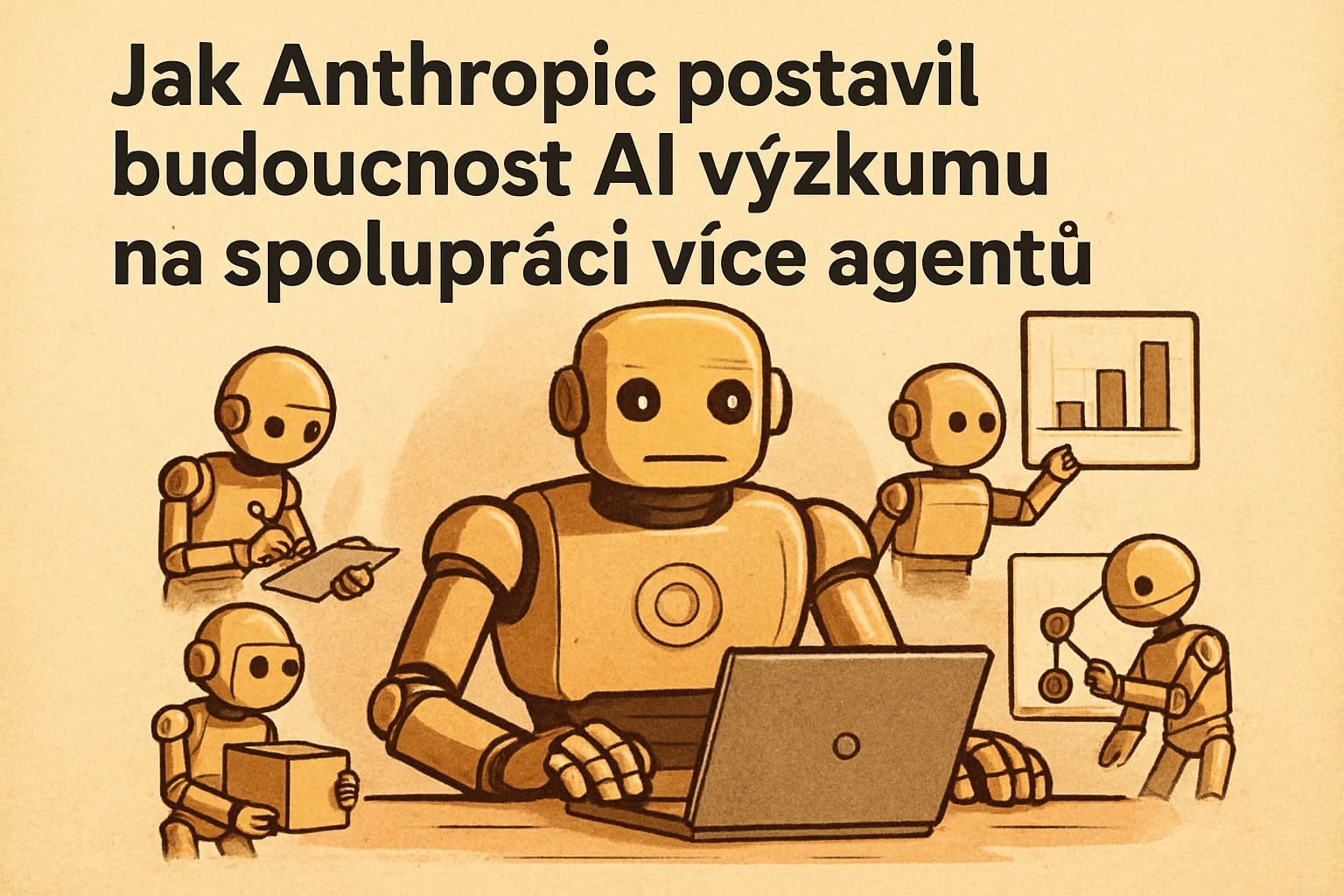
How Anthropic Built the Future of AI Research on Multi-Agent Collaboration
Claude from Anthropic now features a research capability (Research feature) that can search the web, Google Workspace, and other integrated services to solve complex tasks. This system uses multiple Claude agents working simultaneously, representing a fundamental departure from traditional simple AI assistants. The developer team led by Jeremy Hadfield, Barry Zhang, Kenneth Lien, Florian Scholz, Jeremy Fox, and Daniel Ford shares insights from this journey from prototype to production deployment.
The journey from an experimental system to a production version taught the developers key lessons about system architecture, tool design, and prompt engineering. A multi-agent system consists of multiple agents—large language models that autonomously use tools in a loop—working together. Their research feature includes an agent that plans the research process based on user queries and then uses tools to create parallel agents that search for information simultaneously.
Why Multi-Agent Systems Outperform Individual Models
Research involves open-ended problems where it is very difficult to predict the necessary steps in advance. A fixed path for exploring complex topics cannot be hard-coded because the process is inherently dynamic and dependent on how the investigation unfolds. When people conduct research, they tend to continuously update their approach based on discoveries and follow leads that emerge during the investigation.
This unpredictability makes AI agents particularly well suited to research tasks. The essence of search is compression—distilling insights from a vast corpus. Subagents facilitate compression by working in parallel with their own context windows and simultaneously exploring different aspects of a question before condensing the most important tokens for the lead research agent.
Anthropic's internal evaluations showed that multi-agent research systems excel particularly at "breadth-first" queries, which involve simultaneously pursuing multiple independent directions. They found that a multi-agent system with Claude Opus 4 as the lead agent and Claude Sonnet 4 subagents outperformed single-agent Claude Opus 4 by 90.2% on their internal research evaluation. For example, when asked to identify all board members of S&P 500 information technology companies, the multi-agent system found the correct answers by dividing the task into assignments for subagents, while the single-agent system failed to find the answer through slow, sequential searches.
System Architecture and Operation in Practice
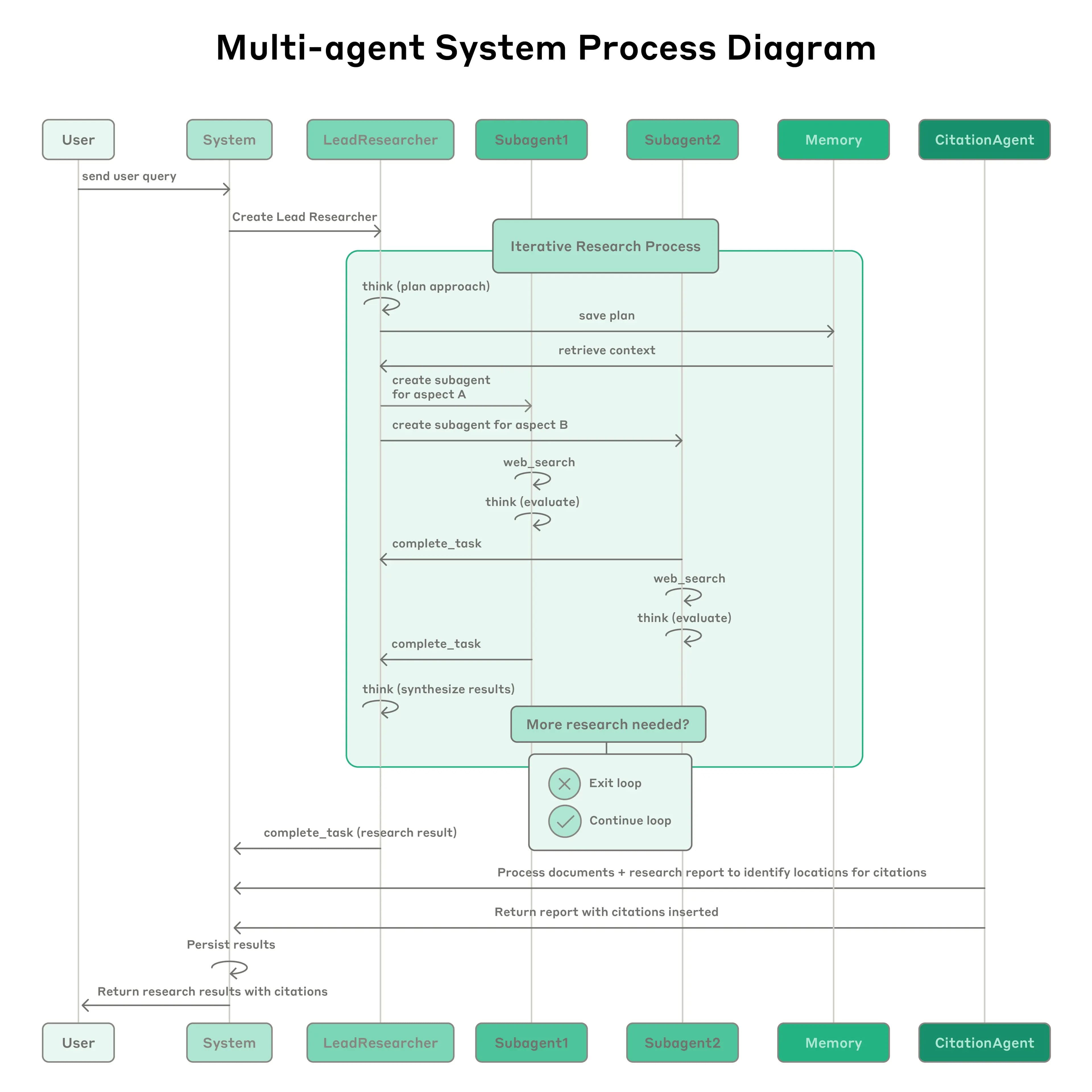
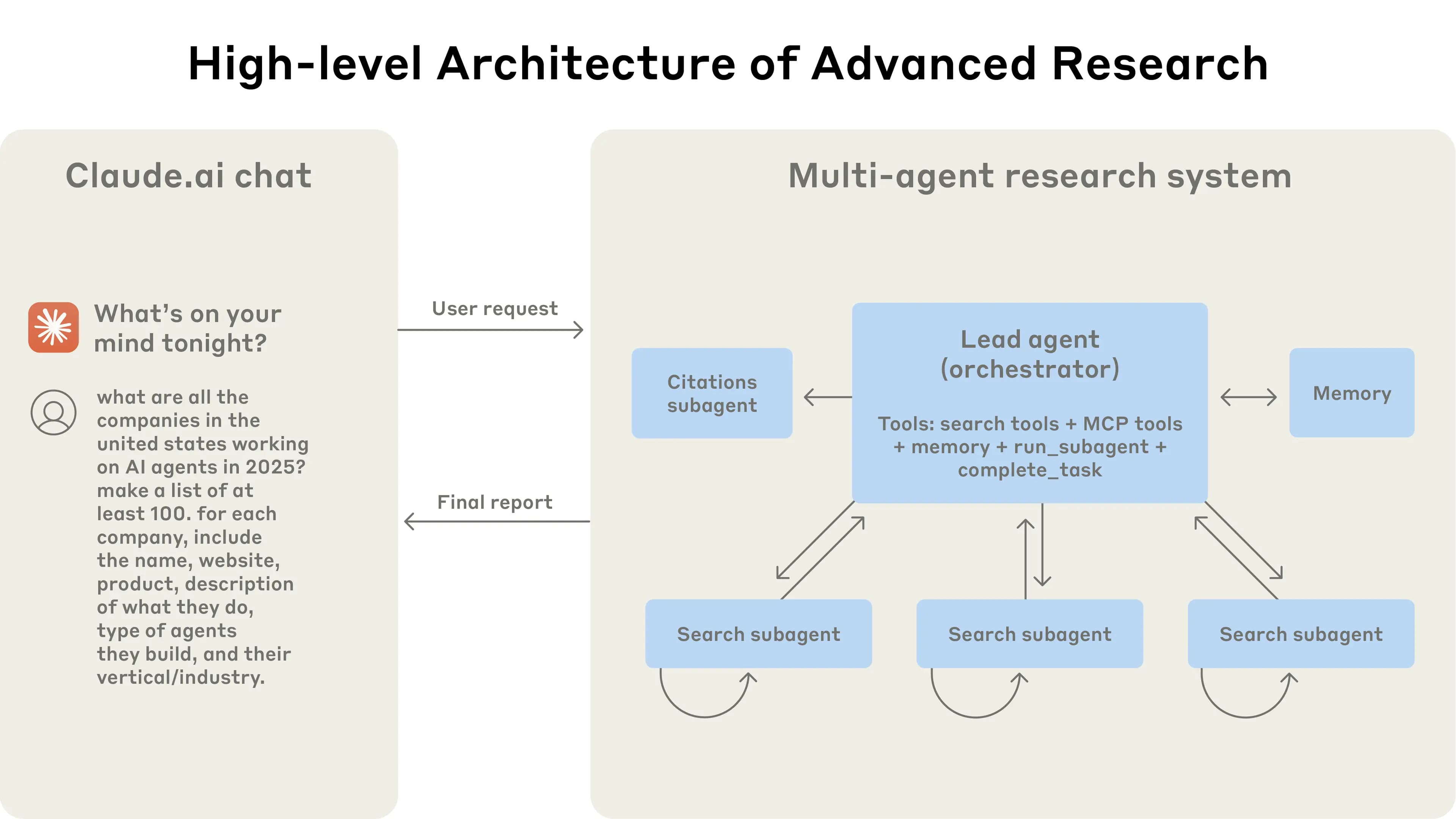
Anthropic's research system uses a multi-agent architecture with an orchestrator-worker pattern, where the lead agent coordinates the process and delegates tasks to specialized subagents that work in parallel. When a user submits a query, the lead agent analyzes it, develops a strategy, and creates subagents to simultaneously explore different aspects.
Subagents act as intelligent filters by iteratively using search tools to gather information and then returning a list of companies to the lead agent so it can assemble the final answer. Traditional approaches using Retrieval Augmented Generation (RAG) employ static retrieval—they retrieve the passages most similar to the input query and use those passages to generate an answer. In contrast, their architecture uses multi-step search that dynamically finds relevant information, adapts to new findings, and analyzes results to formulate high-quality answers.
Technical Challenges and Solutions
Multi-agent systems burn through tokens quickly. In their data, agents typically use about 4 times more tokens than chat interactions, while multi-agent systems use about 15 times more tokens than chats. To be economically viable, multi-agent systems require tasks whose value is high enough to justify the increased performance cost.
The developers had to solve agent coordination problems—early agents made mistakes such as creating 50 subagents for simple queries, endlessly searching the web for nonexistent sources, and distracting one another with excessive updates. Because each agent is prompt-driven, prompt engineering was their primary lever for improving these behaviors.
Evaluation and Testing in Real-World Use
Evaluating multi-agent systems presents unique challenges. Traditional evaluations often assume that AI follows the same steps every time, but multi-agent systems do not work that way. Even with the same starting points, agents may choose entirely different valid paths to achieve their goal. Instead of checking whether agents followed the "correct" steps prescribed in advance, flexible evaluation methods are needed to assess whether the agents achieved the correct results while following a reasonable process.
Anthropic began its evaluations with small samples of about 20 queries representing real-world usage patterns. They also used an LLM-based evaluator that assessed each output according to the following criteria: factual accuracy, citation accuracy, completeness, source quality, and tool efficiency. Human evaluation captures what automation misses—including hallucinated answers to unusual queries or subtle biases in source selection.
Users say that Claude has helped them find business opportunities they had not considered, navigate complex healthcare options, resolve complicated technical errors, and save up to several days of work by discovering research connections they would not have found on their own. The most common uses include software system development (10%), professional content development (8%), business strategy (8%), academic research (7%), and information verification (5%).


