Developers working with AI agents keep facing the same conundrum: you want a smart model, but you do not want to pay for every token from the top-tier Opus. What can you do? Anthropic has come up with an answer that part of the community had effectively invented on its own. They call it the advisor strategy.
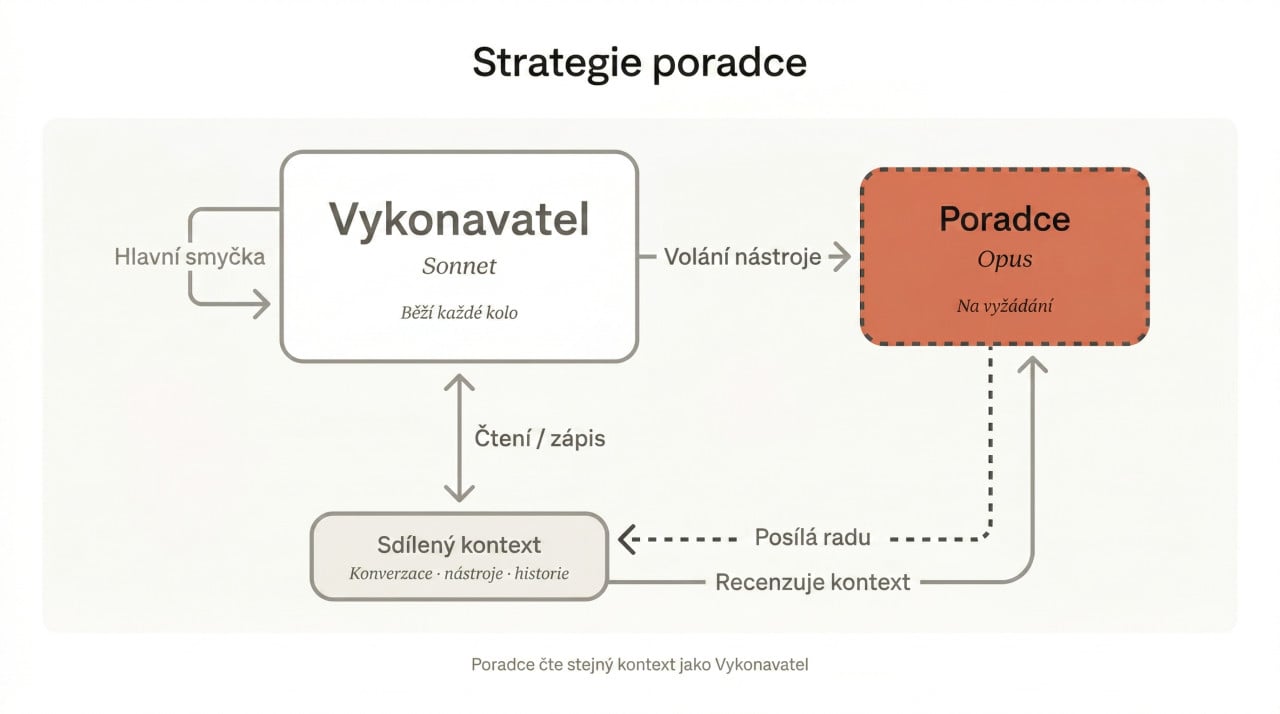
The principle is surprisingly simple. A smaller and cheaper model (Sonnet or Haiku) manages and executes the entire task. It calls tools, reads the results, and keeps working. But as soon as it encounters a problem it cannot solve on its own, it calls Opus. Opus reviews the context, gives it a plan or correction, and Sonnet continues. Opus itself never calls tools or writes outputs for the user. It only provides advice.
Benefits and how to use it
The test results are solid. Sonnet with Opus as an advisor scored 2.7 percentage points higher on the SWE-bench Multilingual benchmark than Sonnet alone. At the same time, the cost per task fell by almost 12%. That may sound modest, but it adds up very quickly at higher task volumes.
The results with Haiku are even more interesting. On the BrowseComp benchmark, Haiku with Opus as an advisor achieved a score of 41.2%, while on its own it managed only 19.7%. It still lags behind Sonnet (which scores approximately 70% on its own), but costs 85% less per task. For companies processing thousands of requests per day, this is a very important figure.
Anthropic has packaged the entire approach into a tool called the Advisor tool, which is available through the Messages API. All communication between the models takes place within a single API request. Sonnet simply calls the advisor, receives a response, and continues. The setup is simple:
response = client.messages.create(
model="claude-sonnet-4-6",
tools=[
{
"type": "advisor_20260301",
"name": "advisor",
"model": "claude-opus-4-6",
"max_uses": 3,
},
],
messages=[...]
)
The max_uses parameter limits how many times Sonnet may consult the advisor within a single request. Tokens from both models are billed separately at their respective rates, so you retain a clear overview of the costs.
Who does it make sense for?
The Advisor tool is currently in beta and works only on Anthropic's platform. It can be added with one extra line of code and a single header in the API request. Anthropic recommends testing three configurations side by side: Sonnet alone, Sonnet with Opus as an advisor, and Opus alone, so you can see exactly where the sweet spot lies for your use case.
Companies such as Genspark and Eve Legal have already confirmed the results. Eve Legal reports that Haiku with Opus as an advisor delivers top-tier model quality on document extraction tasks, but at one-fifth of the cost. It is hard to find a reason not to at least give this a try.