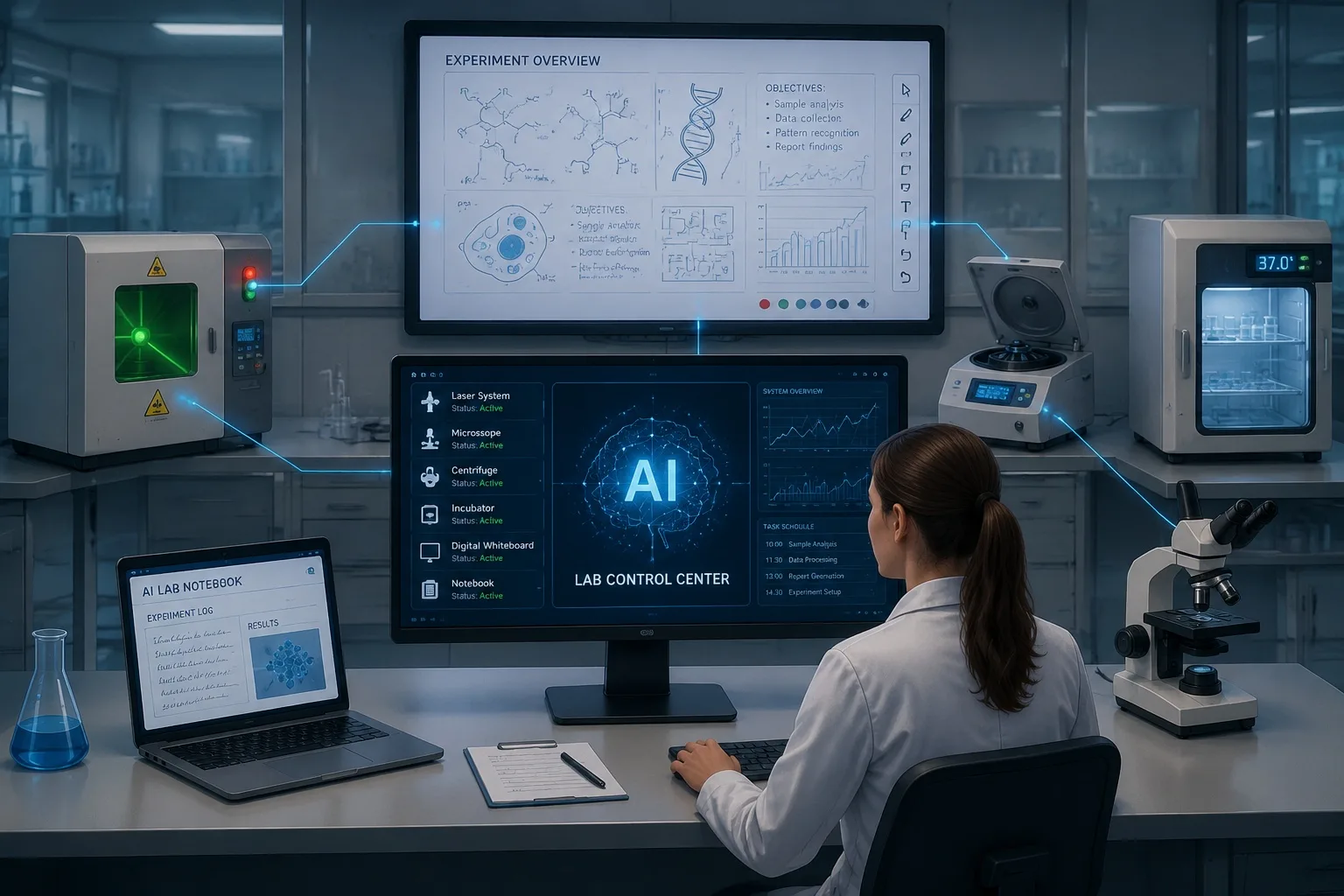
Anthropic has opened a research preview of the Model Hardware Standard, or MHS for short. It is a shared specification that enables AI agents to operate physical devices safely, and the company has made it available to an initial group of laboratories and advanced manufacturers. An autonomous system can thus control several laboratory and manufacturing instruments at once, from microscopes and pipetting robots to robotic arms. It can handle tasks ranging from routine experiments in drug discovery to calibrating a laser in a quantum computer. The developers compare it to the USB-C cable, which standardized how peripherals exchange information.
Starting up a new setup in a laboratory or manufacturing facility takes weeks, sometimes even months. Most instruments do not communicate with one another, so specialists have to write custom integrations. MHS is intended to reduce this work to hours or minutes. Zihao Song of the University of Washington explained that each of his machines has its own software and driver, and connecting them all takes months or years of effort.
A driver that knows four words, plus a machine description
MHS is built on a standardized driver, which is software that translates communication between a computer's operating system and an instrument. It uses a simple set of commands such as “read,” for example to determine the temperature, and “write,” for example to set the temperature, which every device understands. The equipment also identifies itself in a standard format, allowing machines and AI agents to find one another on the network without a custom-written intermediary.
The driver also includes tags in which a person describes the limits and characteristics of a given machine in plain language, such as the payload capacity of a robotic arm. This knowledge previously resided in manuals or only in the operator's head. MHS then uses the tags to create a reference file describing what the instrument measures, what can be changed, and what safety restrictions apply.
Control works in three ways: through the Model Context Protocol, the command line, and code files. An autonomous system can therefore control several devices at once with a single line, monitor the results, and continuously adjust parameters. The standard works with any device that has a programmable interface and is not tied to Claude models.
Genentech, pipetting, and bubbles the model could not handle
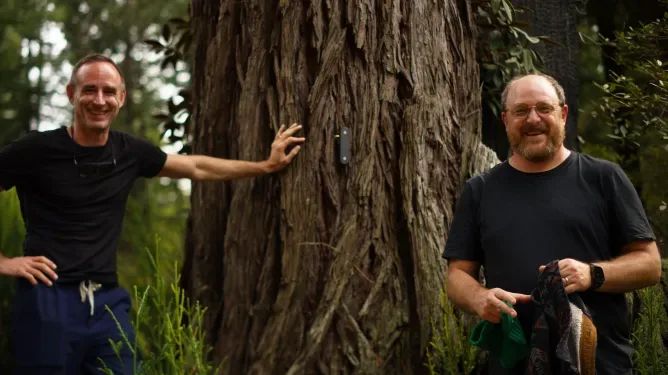
The foundation of the standard was laid by Alek Kemeny of Anthropic's Beneficial Deployments team and Arco Bast, a postdoctoral researcher at the HHMI Janelia Research Campus. At the time, Bast was imaging a brain using a setup that combined lasers, motorized stages, and cameras from different manufacturers without a common interface. He therefore devised a vocabulary in shared memory through which the instruments exchanged values, and Kemeny subsequently connected AI models to this interface.
Virginie Ruetten, who studies the effects of sleep in zebrafish at Janelia, had detectors in MATLAB, cameras in Python, and electrophysiology in C#. Before she could begin taking measurements, she had to launch seven programs in a precise order, with any error ruining the experiment. After switching to MHS, starting an experiment takes her a single click. She also added a new camera in just a few minutes, something that had previously been a multi-day project.
Genentech scientists used MHS to test the automation of a BCA assay, a common procedure for measuring protein concentration in a sample. They connected a pipetting robot, a robotic arm, and a microplate reader, with Claude controlling the entire process. On the first attempt, the model performed the procedure with the same flow-rate setting for both aqueous and viscous solutions, which created bubbles and impaired transfer accuracy. The researchers therefore had it tune the flow rate itself by performing test transfers of a colored solution and comparing them with work performed by an expert on the same plate. Claude arrived at a value of around 140 microliters per second for water and 10 microliters per second for the viscous sample, which the specialists approved.
With the bubbles, however, the system did not understand the physical cause of the failure and tried repeating the operation in the same location with different settings, agitating the liquid even further. Only after the team explained that the error code was caused by the foam and that it should move to a clean well and mix less did it follow these instructions for the remainder of the experiment.
Eight hours instead of several weeks
At Carnegie Mellon University, a team built a system consisting of a pipetting robot, a plate reader, a robotic arm, and cameras, distributed across three computers with incompatible controls. The plate reader has no programming interface, so the MHS system clicked through its window just as a person would. Getting it up and running took about eight hours, whereas a custom vendor solution takes several weeks to build. Serial dilution experiments then ran approximately three times faster.
The team deliberately triggered six failures, including a missing plate, a disconnected camera, and an activated emergency stop. The system detected all these problems before anything moved. When the autonomous agent was then tasked with obtaining a usable curve, it assessed the first attempt as inadequate because of saturation at the upper end of the range, discarded the plate on its own, and repeated the measurement with the concentration reduced from 200 to 100 micrograms per milliliter. The second phase produced a reliable result without any human intervention.
A laser that returns to its frequency on its own
The most striking results came from QuEra, which builds quantum computers based on neutral atoms. Its lasers must maintain frequency with a precision of approximately one part per trillion, which the authors compare to measuring the distance from Earth to the Moon with a tolerance equal to the width of a human hair. Temperature, vibrations, or a change in pressure can knock the instrument off frequency, however, causing quantum operations to fail. It then takes an operator five to ten minutes to bring it back. QuEra already had a software script for this that a team of four people had spent several months developing. However, it worked in only about 58 percent of cases, and a single attempt took around 150 seconds.
The company then gave Claude the same problem through MHS. Overnight, a loop of four roles ran in which one model instance proposed a hypothesis, the second translated it into code, the third ran it on a live laser, and the fourth decided on the next step. The model rewrote the linear sequence into a decision tree that first analyzes the instruments and intervenes only in the controllers relevant to the particular failure. By morning, the time required to restore the frequency had fallen to roughly six seconds. In a blind test without the agent present, the script succeeded in 695 out of 700 attempts, or 99.3 percent of cases.
The team then assigned the agent to optimize lock quality, which is determined by twelve interconnected servo-loop parameters. The company's specialist-designed setting had a residual error of 15.7 millivolts, while Claude reduced it to 1.55 millivolts after 363 attempts and sixteen hours. During nineteen hours of operation, its setting did not lose lock once, whereas with the expert solution the laser lost lock approximately 1.6 times per hour.
What the model still cannot do
Anthropic adds that Claude learns about the physical world from text and images, so its spatial reasoning has limitations and the work requires expert supervision. In the pilot project at QuEra, the model could not resolve actual hardware failures because it knew the setup only through its software, and it often waited for human confirmation on steps it considered risky. As a result, the experiment sometimes remained stalled overnight. The authors note, however, that an overly cautious agent is still better than one that is not cautious enough.
The new specification does not yet work with devices that lack a programmable interface, so Anthropic is working directly with their manufacturers on drivers. It is collaborating with partners in research, robotics, and manufacturing on safety testing and plans to publish the results when MHS is released as open source.
Instrument manufacturers are joining in
Hardware vendors are also adding MHS support to their products. Amazon Web Services is preparing it for the Strands Robots library, Automata is adding it to the LINQ platform, and Doosan Robotics is testing it on robotic arms. QIAGEN has a prototype running on the QIAsymphony Connect instrument, and MBF Bioscience is writing a driver for ScanImage, the software that powers laser microscopes in hundreds of laboratories.
Elizabeth Kelly, who leads the Beneficial Deployments team at Anthropic, told CNBC that the standard was developed for science, but she also sees major benefits for the commercial sector and industry. According to CNBC, Anthropic is thereby moving deeper into hardware, where competitors including OpenAI and Amazon have spent billions of dollars on devices built around artificial intelligence and on manufacturing tools.
Among the first to deploy these rules on widely available equipment are Hugging Face, with its LeRobot robotics library, and Raspberry Pi. Following successful tests with a camera driver, these companies are preparing support for several of their models.