

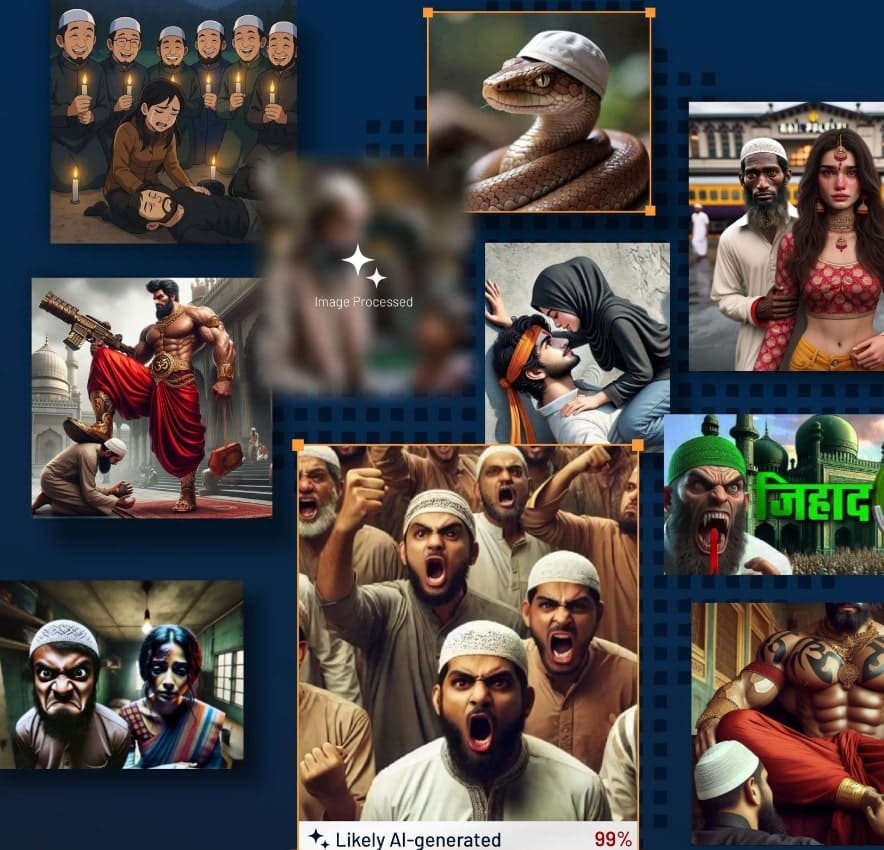
In today's digital age, artificial intelligence (AI) is becoming a tool that not only facilitates content creation but also helps spread hate. According to a new report from the Center for the Study of Organized Hate (CSOH), AI-generated images and videos have become a key element in a new wave of anti-Muslim hate on Indian social media. Published in October 2025, the report details how these technologies amplify narratives targeting minorities.
The CSOH report analyzes the period from May 2023 to May 2025 and identifies more than 1,326 AI-generated posts targeting Muslims. These posts came from 297 public accounts on platforms such as X (formerly Twitter), Instagram, and Facebook. Together, these materials received more than 27 million interactions, including shares, likes, and views. This represents an enormous reach and speed of dissemination that traditional methods cannot achieve.
AI makes it easier to create hateful content
Generative AI tools such as Midjourney, Stable Diffusion, and others make it possible to create realistic images and videos without advanced skills. Previously, users needed to know how to operate programs such as Photoshop, but now a simple prompt is enough to produce content within seconds. The CSOH report emphasizes that these tools lower the barriers for creators of hateful material, enabling rapid production and large-scale distribution.
For example, AI enables anonymous and immediate campaigns in which content is spread in a coordinated manner across different accounts. Forensic analysis and metadata scanning confirm that these images are indeed generated by AI. This approach makes hate more appealing and easier to share, particularly among young users who value visual appeal.
Main themes in AI content
The CSOH report divides hateful content into four main categories. The first is the sexualization of Muslim women, which combines misogyny with Islamophobia and receives the most interactions. The second category includes exclusionary and dehumanizing rhetoric in which Muslims are portrayed as subhuman beings or a threat.
The third area covers conspiracy narratives such as "Love Jihad" or "Population Jihad," which portray Muslims as a threat to society. The final category aestheticizes violence, making hate visually appealing or humorous and thereby increasing its reach. These themes often use exaggerated features and stereotypes that reinforce the narratives of right-wing groups.
Impact on society and remedies
This trend is intensifying social tensions in India, a country with a large online population and a complex political situation. AI not only normalizes prejudice but also increases the risk of offline violence against Muslims. The CSOH report warns that the situation will worsen without action and calls for systems that identify the misuse of AI.
Experts describe the situation in India as particularly concerning due to the local context, while similar tactics are also emerging in Europe, though on a smaller scale. CSOH recommends that platforms introduce better detection of AI-generated content and that regulation of these tools be improved to prevent their misuse for spreading hate.


