

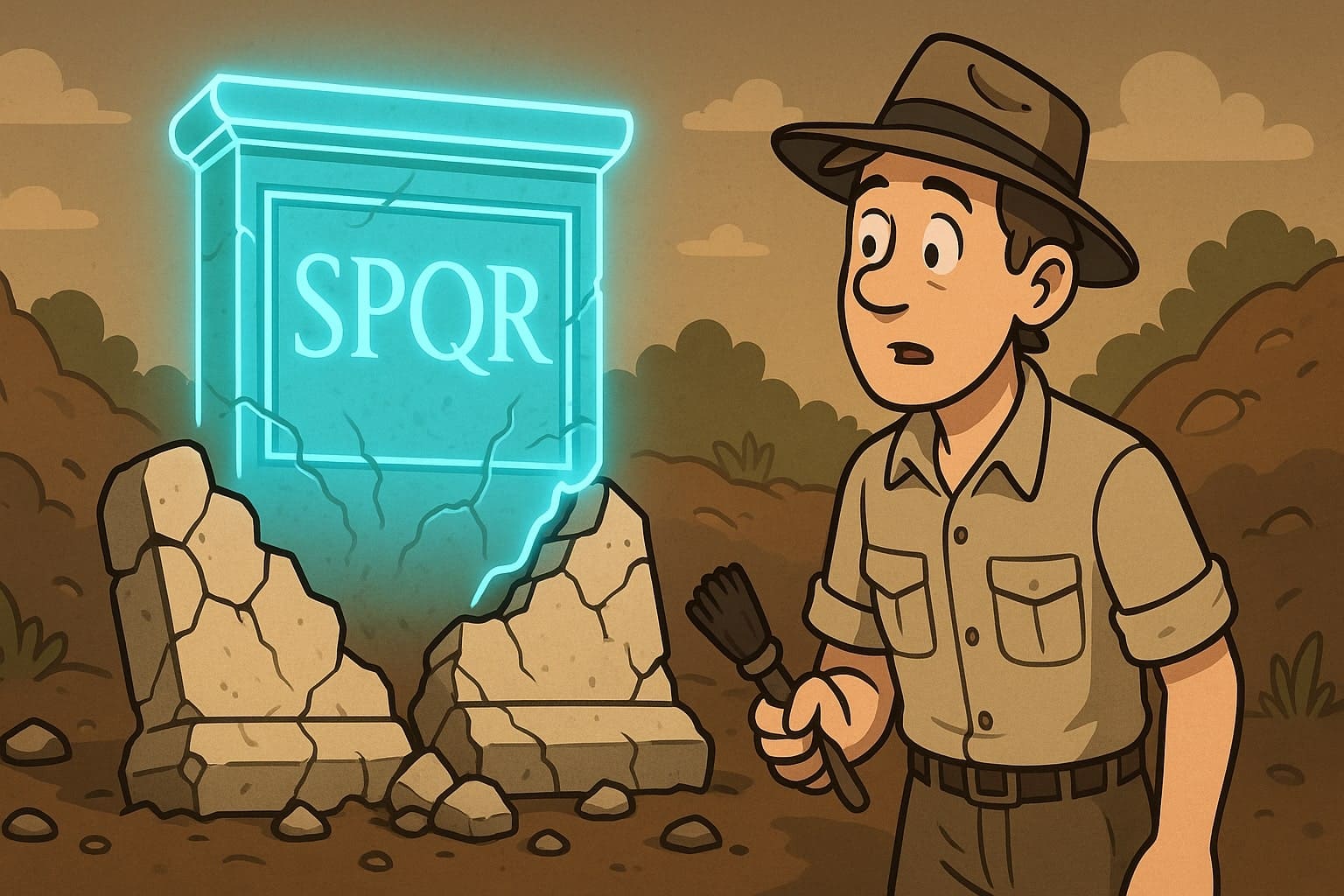
Artificial Intelligence Reveals the Secrets of Ancient Rome
Imagine a tool that searches through thousands of ancient Roman inscriptions, compares them, and reveals their secrets faster than a team of historians. That is exactly what Aeneas is: a multimodal generative neural network developed by Google DeepMind in collaboration with researchers such as Yannis Assael, Thea Sommerschield, and Alison Cooley. This model was trained on the Latin Epigraphic Dataset (LED), which includes 176,861 Latin inscriptions from databases such as the Epigraphic Database Roma (EDR), Epigraphic Database Heidelberg (EDH), and Epigraphik-Datenbank Clauss-Slaby (EDCS_ETL). Aeneas processes both text and images to contextualize inscriptions, restore damaged sections, and determine their geographical and chronological origins.
According to a study published in the journal Nature, Aeneas achieves a character error rate (CER) of 40.5% when restoring text with known lengths and 55.5% for unknown lengths, an accuracy of 72% in geographical attribution to the correct Roman province, and an average dating deviation of 13 years from the actual ranges. The model emulates the work of historians by searching for parallels—inscriptions with shared phrases, functions, or cultural contexts—and presenting them with metadata. In an evaluation involving 23 historians, ranging from students to professors, Aeneas increased their confidence in completing tasks by 44% and was useful in 90% of cases.
How Aeneas Works in Practice
Aeneas takes an image of an inscription and its textual transcription as input, processing them through a transformer architecture based on the T5 model with relative positional embeddings. Special characters such as "-" for a known length of damage or "#" for an unknown length enable the restoration of text of any length, which is a novel development in the field. The model generates hypotheses for restoration, geographical attribution among 62 Roman provinces, and chronological attribution by decade, supplemented by saliency maps that show which elements influenced its decisions.
For example, when analyzing the text "Res Gestae Divi Augusti" (RGDA), which describes the deeds of Emperor Augustus, Aeneas determined a date of around AD 10–20, with peaks around 10–1 BC and AD 10–20, reflecting a bimodal distribution consistent with scholarly hypotheses. The saliency maps highlighted chronologically significant elements such as the archaizing spelling "aheneis," the title "princeps iuventutis" from 5 BC, and the Altar of Augustan Peace from 13 BC. The top parallels included inscriptions such as TM 262102 (an AD 19 law concerning Germanicus) and TM 558342, which share imperial ideology and archaizing elements despite originating from different places such as Rome, Trento, and Baetica.
Researchers such as Thea Sommerschield compare the study of inscriptions to a giant jigsaw puzzle, where Aeneas helps find the missing pieces more quickly. The model is open source, available here, and can be adapted to other ancient languages.
What Are Aeneas's Capabilities?
Although Aeneas is bringing major changes to epigraphy, it has its limitations. Extremely damaged inscriptions still require human expertise because the model "hedges its bets" and offers multiple possibilities instead of a single prediction. In the evaluation, historians incorporated an average of 1.5 parallels from Aeneas into their research, which improved their performance: the restoration error rate fell from 39% to 21%, geographical accuracy increased to 68%, and dating came within 14.1 years of the correct date.
Alison Cooley emphasized that Aeneas is transforming epigraphy into a cutting-edge field, while Thea Sommerschield highlighted its role in accelerating research. The historians participating in the evaluation appreciated how Aeneas changed their perception of inscriptions—for example, one said that the parallels changed their view of the text and saved days of work. The model outperforms its predecessor Ithaca by 15% in restoration, 20% in geography, and 17 years in dating.
AI in Historical Research
Aeneas demonstrates how AI can be a valuable collaborator for experts. In a case study of a votive altar from Mogontiacum (Mainz, CIL XIII, 6665, TM 211813) dating to AD 211 and dedicated by Lucius Maiorius Cogitatus to the goddess Aufaniae, Aeneas correctly dated it to AD 214 and placed it in Germania Superior, identifying parallels such as an altar from AD 197 (FM 07-055 no. 16) that shares formulas and iconography. This reveals connections between epigraphic traditions in provinces such as Germania and Pannonia.
With its open access, Aeneas opens the door to discoveries about Roman society, language, and life. The collaboration between AI and historians such as Yannis Assael and Alison Cooley underscores how technology accelerates research while emphasizing the need for human judgment. If you are an enthusiast of ancient history, Aeneas could soon reveal even more fascinating details about our past.


