


AI's Environmental Impact: Google Releases Data on Water and Energy Consumption
While until recently the discussion focused primarily on the benefits of artificial intelligence for society, its impact on the environment is now being discussed with increasing frequency. Operating models such as Gemini or GPT requires a large amount of energy. But how much is actually needed? Google has provided an answer.
Comprehensive Environmental Footprint Measurement
Creating and training language models requires powerful servers that run for weeks at a time. But it does not end there. Another crucial phase also has an environmental impact: when artificial intelligence answers our queries.
Google decided to subject all of this to a detailed analysis and developed a clear methodology that measures the energy consumption, carbon footprint, and water consumption of artificial intelligence per response. It published the results in its study and also shared its conclusions on the Google Cloud blog.
While previous estimates of environmental impact were only approximate, Google has now created a complete list of measurement criteria. The ecosystem includes the performance of the chip and the entire supporting system, including networks and processors, data center cooling and power supply, as well as the sources of the energy used to run artificial intelligence. This allows Google to calculate very accurately what is consumed and produced when responding to a user query.
How Much Energy Does One Gemini Response Consume?
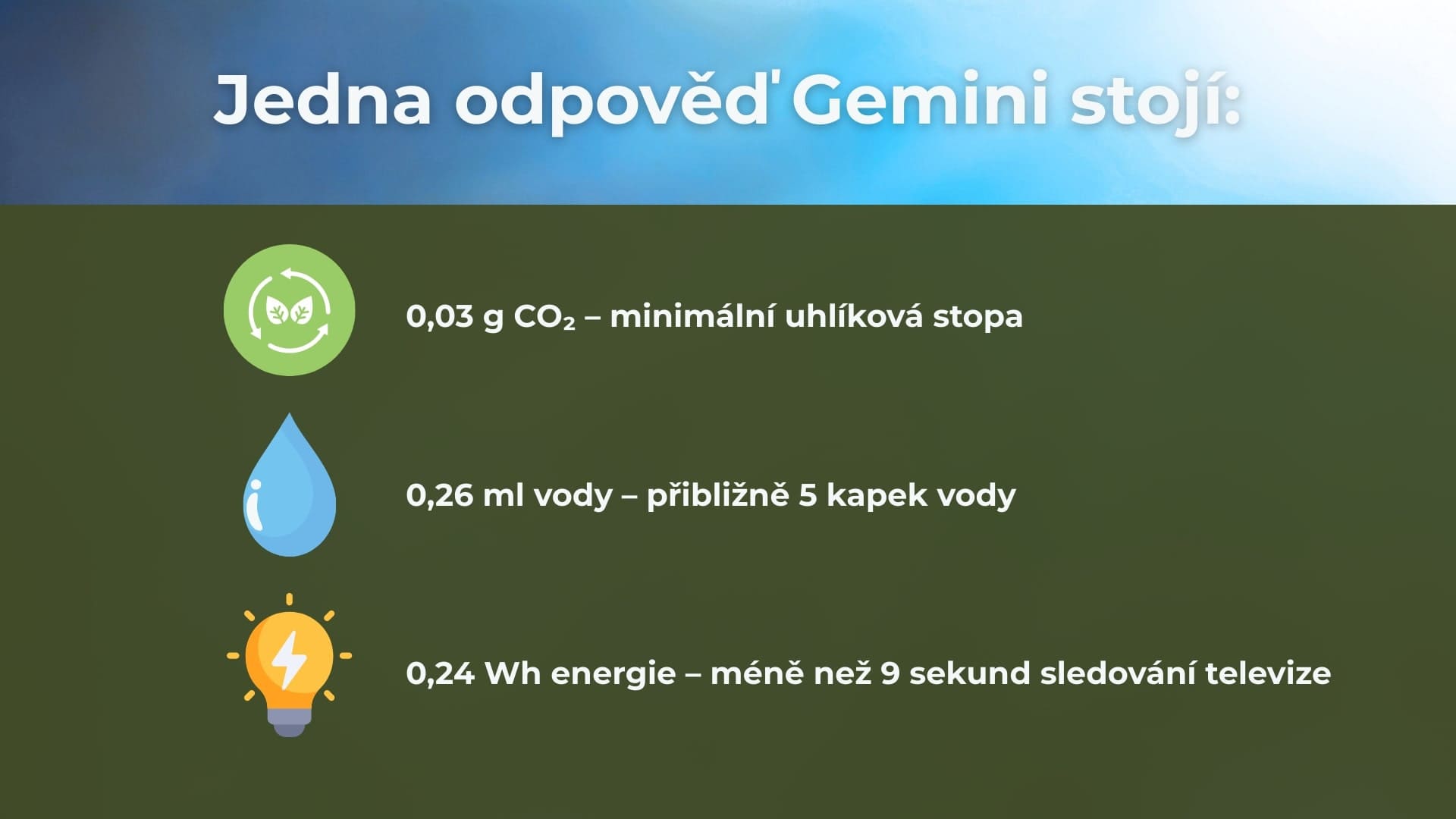
And the measurement results? Even after including all data related to data center operations, the figures are surprisingly low. If you ask the Gemini artificial intelligence a question, answering it involves the following, according to the report:
-
Consumption of 0.24 Wh of energy: less than 9 seconds of watching television
-
Production of 0.03 g of CO₂: a minimal carbon footprint
-
Consumption of 0.26 ml of water: approximately 5 drops of water
And what do these figures tell us? That the environmental impact of a single query is entirely negligible. However, it is important to remember that Gemini has more than 300 million users per month. This may be one reason why Google is continuing its efforts to monitor and reduce the environmental impact of artificial intelligence.
Improvements Within One Year
In the published report, Google emphasizes that it has also managed to significantly reduce the environmental impact of AI systems over the past 12 months. This is demonstrated by energy consumption per query, which fell 33-fold, and the carbon footprint, which was reduced by approximately 44-fold. The optimization of software centers and the transition to more environmentally friendly energy sources helped make all of this possible.
What Will This Bring in the Future?
This transparent methodology has not only provided data on Gemini, but is also becoming an important step toward future comparisons of AI models. If other companies also decide to publish their data, it will be easier to compare and choose artificial intelligence models based not only on performance, but also on their sustainability.
Google's report also shows that increasingly capable and powerful language models can be designed and operated more sustainably than before.
Source: Google Cloud, Epoch AI, Times of India


