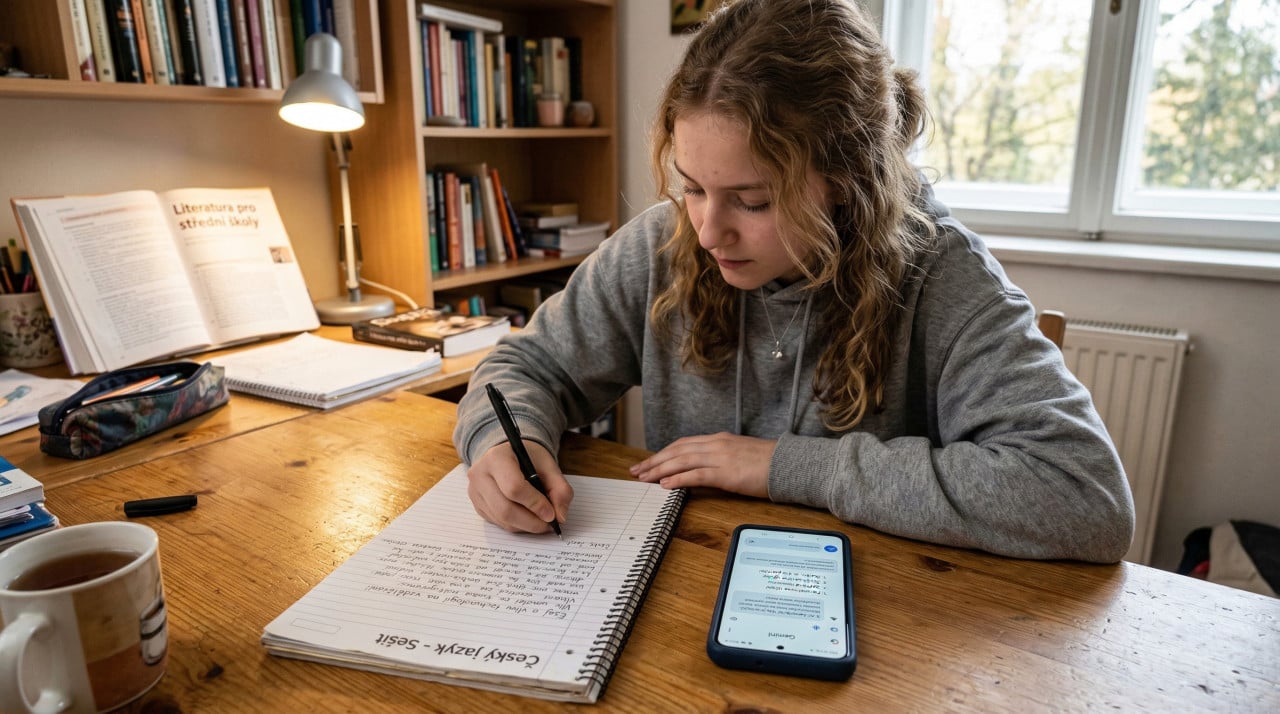
One student wrote an essay. In his own words, with his own ideas. An algorithm labeled him a cheater. What did he do? He signed up for several AI services and began studying how the detectors work. Not to cheat. But to defend himself. This is the current reality at American universities.
The cobra effect in the classroom
The British colonial administration in India once offered a reward for dead cobras in an effort to reduce their numbers. People began breeding cobras. When the government ended the program, the breeders released the snakes into the wild. The problem was suddenly worse than before the intervention. Artificial intelligence detectors in schools work exactly the same way.
Educator Dadland Maye, who has taught at both Brown University and New York's CUNY, documented this in an essay for the Chronicle of Higher Education. One of his students only began using generative AI after learning that dashes in text supposedly trigger detectors. To protect herself from a false accusation, she began running her own writing through AI tools. She wanted to find out how it would look in the eyes of the algorithm. A tool designed to prevent cheating became the reason she started using AI.
Writing well is suspicious
Writer and journalist Mike Masnick described his own experience on Techdirt: his child was assigned to write an essay about Vonnegut's short story Harrison Bergeron, a story about a dystopian society that handicaps anyone who excels. The school's detector labeled the essay as 18% AI-generated. The culprit? The word "devoid" (empty). When it was replaced with the simpler "without," the score dropped to zero.
The irony of the situation is almost painful. The child was forced to make an essay worse—an essay about a story warning against the forced suppression of excellence.
And this is not an isolated case. Maye describes a student who had been praised for years for writing above her grade level. After transferring to a new school, she realized that no one there knew her. Her professors would not know that her confident voice had been honestly developed over time. She began googling what might raise suspicion. She opened Google Gemini, and the door swung open.
"I feel like I'm cheating," she told Maye. Yet it was self-defense, not dishonesty, that drove her to it.
The system punishes the honest while cheaters get through
Many CUNY students work 20 to 40 hours a week. Many of them are multilingual speakers. Every professor has different rules for AI. One bans it completely, while another actively recommends it. Students have learned to keep quiet rather than risk making a mistake.
One student spent hours rewriting his own sentences that a detector had labeled as AI-generated, even though he had written every word himself. "I rewrite and rewrite," he said. "It takes too much time." And here is the real problem: rewriting a text to satisfy an algorithm has nothing to do with learning how to write. Revision should serve the purpose of the text, not appease a dubious bot.
As The Guardian points out, as many as 92% of students admit to using AI in their studies, and the numbers continue to rise. Some professors describe a nightmare in which AI systems grade AI-generated homework. A conversation between two robots.
Talking openly about AI
In the end, Maye did the only sensible thing. He stopped requiring students to disclose every use of AI. Instead, he told them: you may use AI for research and outlines, but the actual text must be your own. He taught them how to write prompts responsibly and how to recognize when the tool begins to replace their own thinking. The atmosphere in the classroom changed. Students came to him after class with questions. How could they write research prompts without copying the output? How could they tell when a summary strayed too far from the source?
These conversations were educational in nature. They only became possible once AI stopped being a problem to police and became a subject to teach.
Stanford literature professor Lea Pao is trying a different approach: she has students memorize poems, visit museums, and write by hand. She is trying to reconnect them with the physical experience of learning. It does not always work out. One student arrived at a museum when it happened to be closed and then turned to AI. But Pao is not giving up. "You plant seeds and hope," she says.
The question we must answer
American universities cost hundreds of thousands of dollars and lead to decades of debt. Public trust in higher education is declining. And now AI has arrived, capable of replacing independent thought. The question is becoming more urgent than ever: what is higher education actually for? Ohio State University literature professor Michael Clune warns that schools that embrace AI uncritically are cutting off the branch they are sitting on." Dora Zhang of the University of California, Berkeley, talks to students about AI in existential terms: "What is this doing to us as a species?"
Some students themselves are beginning to resist. They see that they are guinea pigs in a vast social experiment. They reject AI for environmental reasons, out of skepticism toward technology companies, and from a sense that someone is stealing something important from them. Perhaps this is exactly the signal schools should be listening to. Instead of deploying detectors that punish good writers and push honest students into the arms of tools they never wanted to use, it might be worth trying something radical: trusting students and teaching them to think.