AI Designs Strange Physics Experiments That Actually Work!
Scientists around the world are increasingly turning to artificial intelligence to help them design complex experiments that humans would struggle to devise on their own. These ideas often look at first glance like a chaotic jumble, lacking the symmetry or elegance we would expect from human designs. Yet they work, and sometimes they even produce better results than traditional methods. In fields such as gravitational-wave detection and quantum entanglement, for example, AI has shown that it can explore an enormous number of possibilities and find solutions that humans would miss.
AI and Improvements to the LIGO Detector
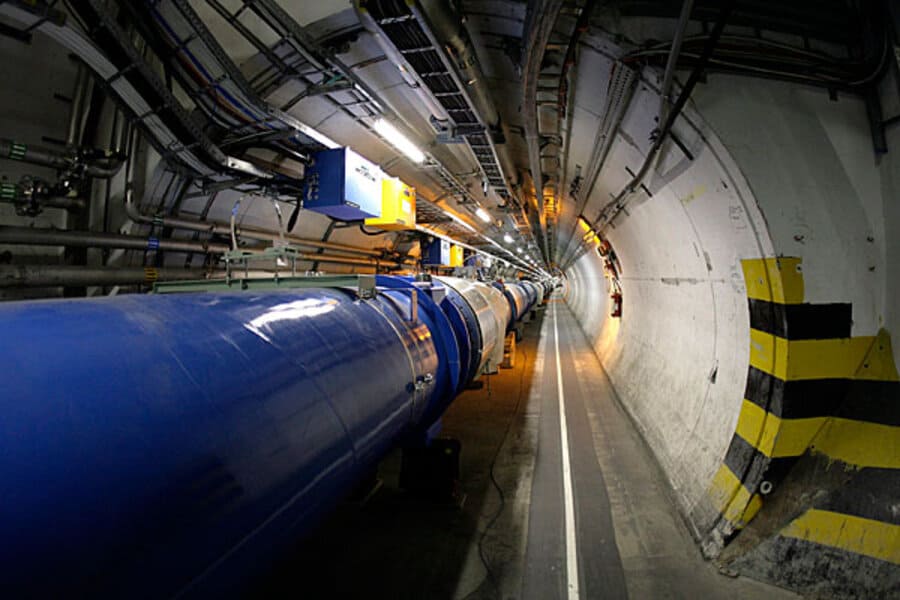
One of the most impressive examples is the work of physicist Rana Adhikari of the California Institute of Technology (Caltech). He led a team that sought to improve the sensitivity of the LIGO detector, a massive facility for detecting gravitational waves. LIGO has two four-kilometer-long arms in which laser beams are reflected to measure minute changes in length caused by gravitational waves—changes smaller than the width of a proton. Construction of the detector took decades, beginning in 1994, and the first detection did not occur until 2015, when it captured a wave from the collision of two black holes.
Adhikari and his team used software developed by physicist Mario Krenn, originally intended for designing tabletop experiments in quantum optics. They gave the AI all possible components—lenses, mirrors, lasers—and allowed it to design a complex interferometer without restrictions. The results were initially incomprehensible: the designs looked like "alien objects," with no symmetry, thousands of elements, and lengths of hundreds of kilometers. After modifications to make them interpretable, the AI proposed adding a three-kilometer ring between the main interferometer and the detector, allowing light to circulate before leaving the arms.
This idea proved ingenious. It turned out that the AI had rediscovered and optimized a little-known interferometer technique described by Russian physicists decades ago but never used experimentally. The result? A 10 to 15 percent increase in LIGO's sensitivity, which would make it possible to detect a broader range of gravitational-wave frequencies and potentially discover unexpected astrophysical phenomena. Adhikari admitted that if his students had come up with such a design, he would have dismissed it as "ridiculous." Aephraim Steinberg of the University of Toronto called it proof that AI had found something thousands of people had overlooked during 40 years of work on LIGO.
Quantum Entanglement Without a Shared Past
Another fascinating application of AI involves quantum entanglement, in which two particles share a common quantum state even when they are far apart. In 1993, Anton Zeilinger, a future Nobel laureate in physics, showed that entanglement could be created between particles that had never met—a method known as entanglement swapping. His design involved crystals, beam splitters, and detectors for two pairs of photons.
Mario Krenn's team used PyTheus software, which represents experiments as graphs with nodes and edges corresponding to elements such as beam splitters or photon paths. The goal was to find a configuration that would create entanglement between photons A and D, which had no shared past, after photons B and C had been detected and destroyed. The algorithm optimized the graphs using a function that minimized the difference between the output and the desired state.
Student Soren Arlt discovered a configuration that looked completely different from Zeilinger's—it was simpler and borrowed ideas from multiphoton interference. Krenn was initially convinced that it had to be an error, but mathematical analysis confirmed it. In December 2024, Xiao-Song Ma's team at Nanjing University in China built the experiment and verified that it worked exactly as the AI had predicted.
AI in Data Analysis and the Search for Symmetries
AI is not limited to experimental design; it also helps with data analysis. Kyle Cranmer of the University of Wisconsin–Madison used machine-learning models to predict the density of dark matter clusters based on observable properties. His system found an equation that describes the data better than those created by humans, although there is not yet an explanation of how it arrived at it.
Rose Yu of the University of California, San Diego trained models on data from the Large Hadron Collider (LHC) at CERN to find symmetries in the data. Without any knowledge of physics, they discovered Lorentz symmetries, which are crucial to Einstein's theories of relativity—for example, that the rate of particle production should not depend on the Earth's rotation. This shows that AI can uncover patterns purely from data, even though interpretation remains the responsibility of humans.
It is not that machines are inventing new concepts—not yet—but rather that they rapidly search vast spaces of possibilities and find efficient, albeit strange, solutions. Physicists such as Adhikari and Cranmer emphasize that humans still play a key role in interpretation and validation, but collaboration with AI could accelerate discoveries in quantum mechanics or high-energy physics. It is like having a tireless assistant who thinks outside the box, and the results are truly astonishing.